
Start with the Recommendation
The single criterion that decides everything else when sourcing a tulle mini dress is seam integrity under load. Tulle is an open-mesh netting with low tear resistance and high fraying tendency; a dress that fails at a side seam or shoulder strap is a total loss, regardless of how well the fabric was sourced or how clean the stitching looks.
The recommendation: choose a manufacturer that can document ASTM D434 seam slippage results of 3 mm or less at 6.8 kg (15 lbf) load on your exact fabric, and that performs this test on production lots, not just on pre-production samples. A factory that cannot produce this data is a pass, no matter how attractive their MOQ or price per unit.
This standard filters out the two failure modes that dominate tulle garment returns: seam slippage (the seam pulls apart under tension) and fraying at cut edges. Both are measurable, both are testable, and both are the manufacturer’s responsibility to control. Everything else — fabric weight, hole size, AQL levels, lead times — is secondary to the question of whether the garment holds together when worn.
What You Need Before Contacting a Manufacturer
Before you contact any OEM or ODM, three documents must exist. Without them, you are asking a factory to guess, and you will pay for their guesses in sampling fees and revision cycles.
Tech pack. This is the construction blueprint: flat sketches with measurements, stitch types, seam placements, trim callouts, and grading specs for each size. For tulle, the tech pack must also specify seam allowance and edge-finish method (French seam, rolled hem, or binding) because these directly affect fraying risk.
Bill of materials (BOM). Every component with a supplier reference: tulle by fiber content and weight, lining fabric, zipper, thread type, labels. The BOM is what lets the factory quote accurately and lets you verify that what was quoted is what shipped.
Quality specification. The measurable pass/fail criteria: acceptable seam slippage, colorfastness ratings, AQL levels, and inspection points. This document is the basis for your QC inspection and for any dispute resolution.
For a deeper breakdown of what each document must contain, see our guide to tech packs for custom clothing manufacturers.
Tulle Fabric Specifications: What to Define
"Tulle" is not a spec. It is a category name that covers fabrics ranging from 20 g/m² bridal illusion to 90 g/m² stiff netting, and a factory will quote you whatever they have in stock unless you define the measurable properties.
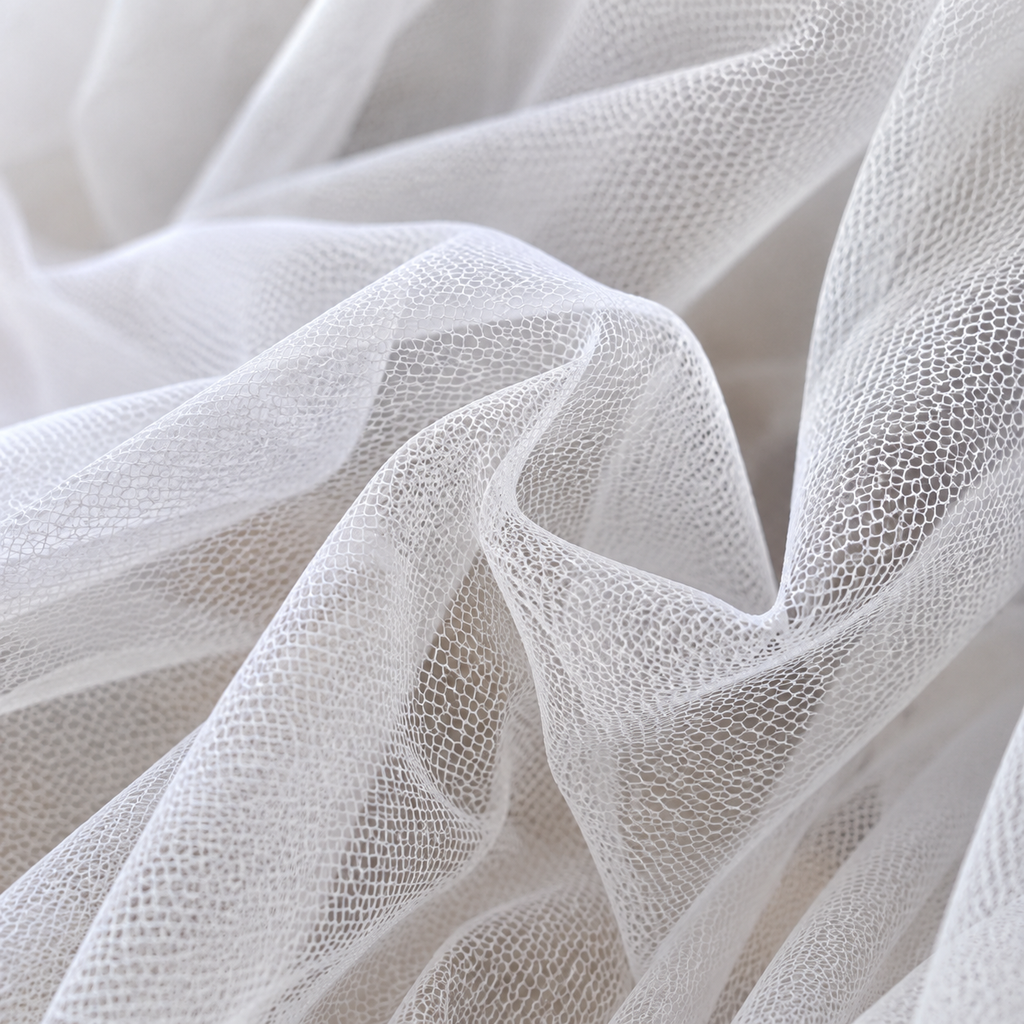
Specify four properties, each with a unit and a test method:
Fiber content. Nylon tulle (polyamide) is the standard for dresses because it dyes well and holds shape; polyester tulle is cheaper but less drapable. Specify "100% nylon" or "100% polyester" — blends behave unpredictably in dyeing and heat-setting.
Fabric weight. State it in grams per square meter (g/m²) with a tolerance, e.g., "45 g/m² ± 5%." Verify with ASTM D3776. A weight spec without a tolerance is unenforceable.
Denier. This is the linear density of the individual yarns, typically 20–40 denier for dress tulle. Lower denier = finer, softer, more delicate; higher denier = stiffer, more structured. Specify it because it controls drape and durability.
Hole size or mesh count. Measured in holes per inch (HPI) or mesh openings in millimeters. A typical dress tulle is 10–15 HPI. This determines sheerness and how the fabric behaves under tension.
A vague name like "soft tulle" or "bridal tulle" invites substitution. A spec sheet with these four numbers prevents it.
Construction and Seam Strength for Tulle
Tulle’s open mesh structure creates two construction problems that do not exist with woven fabrics: seam slippage (yarns pull apart at the seamline under tension) and fraying (cut edges unravel). Both are preventable, but only with specific construction choices and verification.
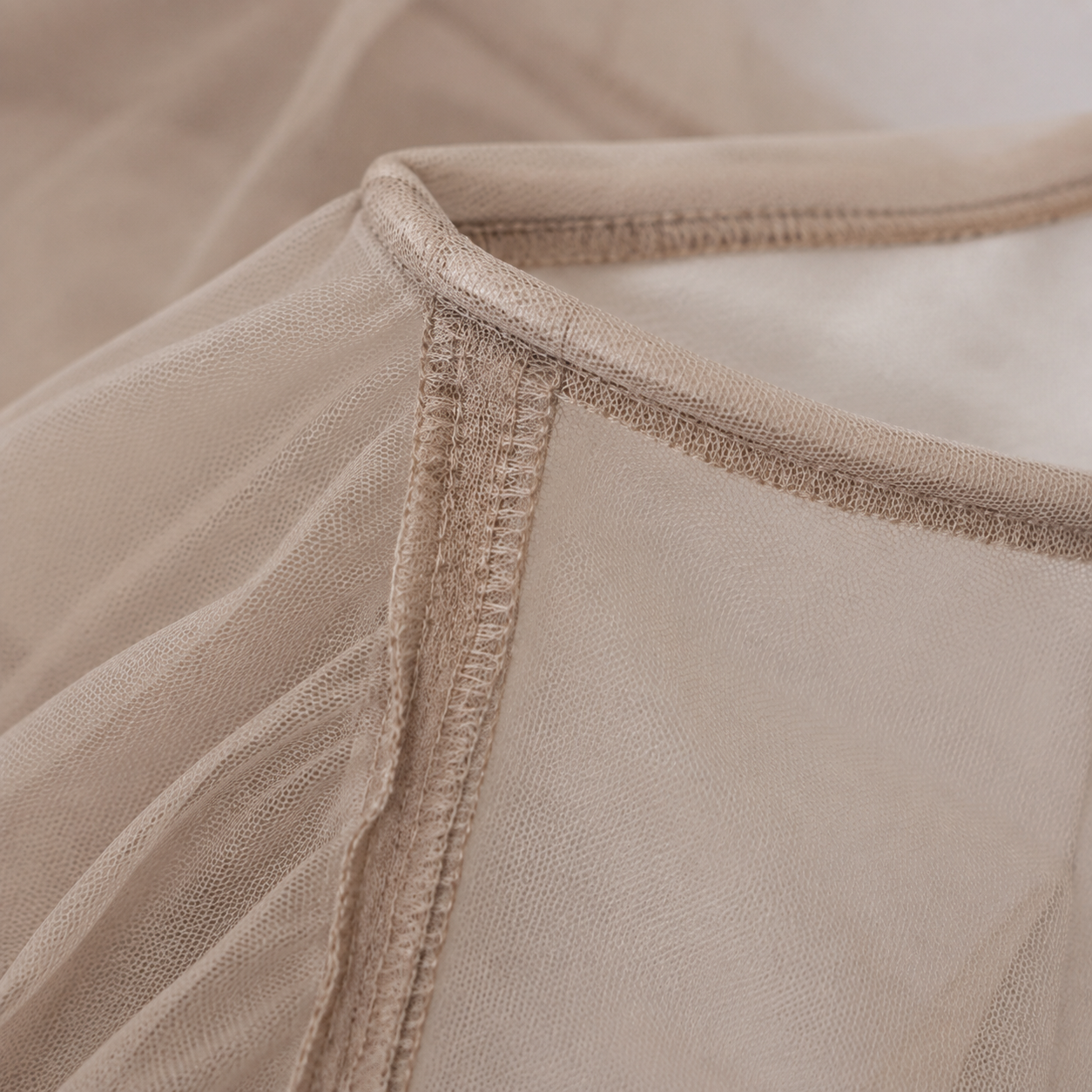
Demand these measurable tests and construction standards:
Seam slippage per ASTM D434. The test measures how far the seam opens under a specified load. For tulle dresses, demand a maximum of 3 mm at 6.8 kg (15 lbf). This is the single most reliable predictor of a dress failing at the hip or shoulder seam during wear.
Stitch density. Specify 8–10 stitches per inch (SPI) for tulle. Fewer stitches allow the mesh to shift and fray at the needle holes; more stitches can cut the yarns.
Seam allowance and finish. Specify a 1.2 cm (1/2") seam allowance with a French seam or bound edge. A raw edge on tulle will fray within the first few wears, and no amount of overlocking fully prevents it.
Needle specification. The factory should use a fine needle (size 60/8 or 65/9) with a ball point to avoid cutting the mesh yarns. This is a process detail, but it is verifiable by asking the factory what needle they run.
Standards and Certifications to Demand
Demand OEKO-TEX Standard 100, ASTM D434, ASTM D5034, and AATCC 16.3 — anything less leaves your fabric or seam performance unverified.
OEKO-TEX Standard 100 is the baseline for chemical safety. It limits restricted substances in every component, including the tulle, lining, and thread. For a dress worn against skin, require at least Class II (direct skin contact) certification. Ask the supplier to share the certificate and confirm its validity through the OEKO-TEX online portal — a claim of compliance without a traceable certificate is a red flag.
ASTM D434 covers seam slippage, the failure mode where tulle pulls apart at the seam under tension. ASTM D5034 measures grab tensile strength, telling you how much force the fabric itself withstands before tearing. AATCC 16.3 tests colorfastness to light, critical because tulle dyes fade quickly under display lighting.
These standards are verifiable by third-party labs. If the manufacturer cannot name the standard and provide a test report, treat the claim as unsubstantiated.
MOQ, Lead Time, and Small Batch Production
Expect MOQs of 100–300 pieces per color for OEM tulle mini dresses, with lead times of 45–60 days from tech pack approval to shipment. Small batch production (under 100 pieces) raises per-unit cost by 30–50% and typically extends lead time by 10–15 days.
Tulle is a specialty fabric with longer supplier lead times than cotton or jersey. A manufacturer holding tulle stock can start cutting within 7 days; one ordering from the mill adds 2–3 weeks. Confirm fabric availability before committing to a timeline.
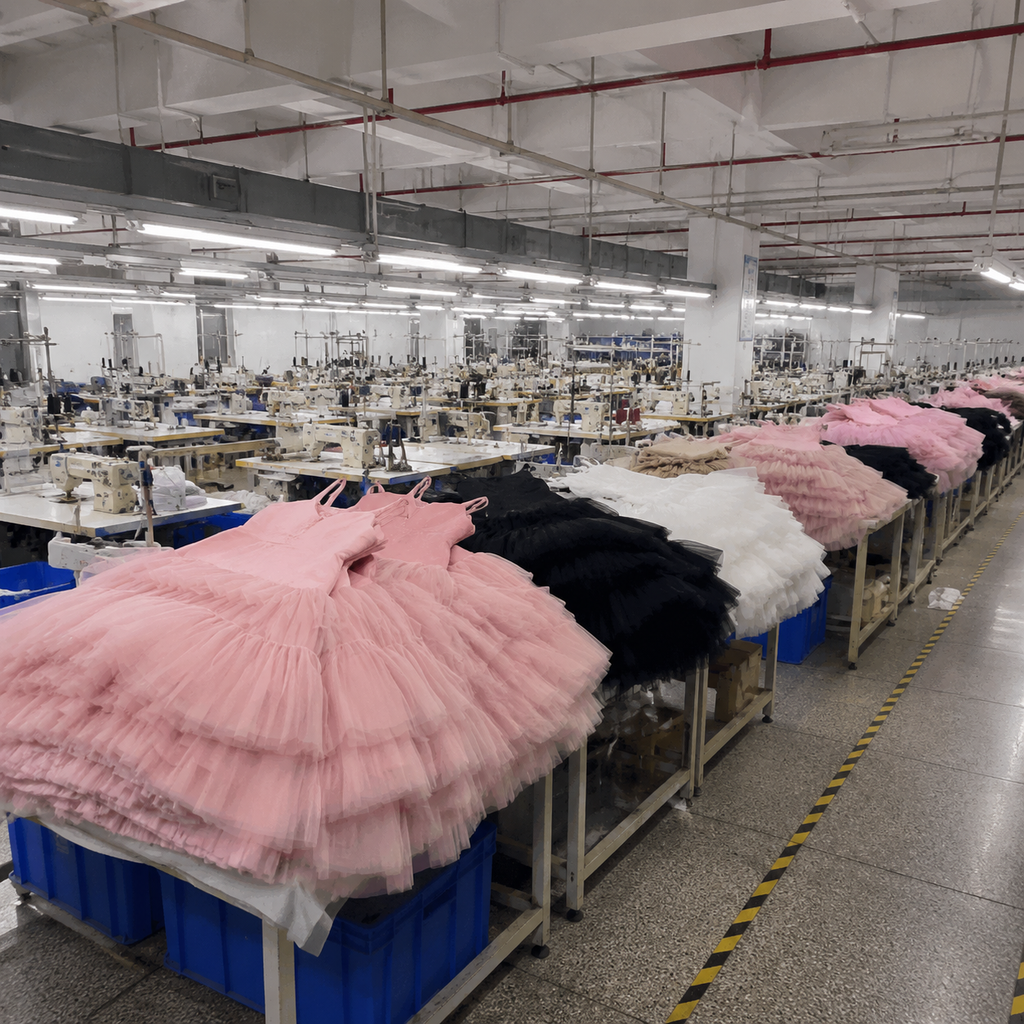
Small batch production changes cost structure. Setup costs — pattern grading, marker making, and machine calibration — are fixed regardless of order size. At 50 pieces, those fixed costs spread thin; at 300 pieces, they become negligible. Ask for a tiered quote at 100, 200, and 300 pieces to see the price curve. If your volume is under 50 pieces per color, a made-to-order manufacturer is the wrong route; consider a stockist or sample sale instead.
Cost Factors That Move Your Quote
Fabric is the largest cost driver, followed by trims, labor, and finishing — in that order. Each scales differently with volume, so ask for line-item pricing to see where your money goes.
Fabric typically accounts for 40–50% of ex-factory cost. Tulle price scales with fiber content (nylon costs more than polyester), denier, and weight. A 45 g/m² nylon tulle costs more per meter than a 90 g/m² polyester, but uses less material per dress. Specify weight and fiber in your tech pack; vague "soft tulle" requests invite substitution.
Trims — zippers, lining, boning, lace appliqués — add 15–25%. Custom-printed labels and branded packaging push this higher. Labor for tulle construction runs 20–30% because the fabric is slippery and prone to fraying, slowing sewing. Finishing, including hemming and steam pressing, adds 5–10%.
Volume scaling is not linear. Fabric and trims drop 5–15% as you move from 100 to 500 pieces. Labor rarely drops below a floor, because sewing speed has physical limits. If a quote shows labor dropping steeply with volume, verify the factory is not planning to cut seam allowances or skip finishing steps.
Quality Control: AQL, Grading, and Inspection
Set your AQL at 2.5 for major defects and 4.0 for minor defects, per ISO 2859-1, and inspect at three points: fabric inward, pre-shipment, and after packing. Tulle’s open weave makes defects visible that would hide in a woven fabric, so the inspection plan matters more than the inspector’s opinion.
Use General Inspection Level II, single sampling. For a 500-piece order, that means inspecting 50 pieces; accept on 5 majors, reject on 6. Grade defects against a written standard before production starts — a 3 mm hole in the skirt is major; a loose thread at a seam allowance is minor. Demand the fabric inward inspection at the mill, not at the garment factory, because tulle defects (runs, holes, dye streaks) are cheaper to reject as yardage than as sewn garments.
Pre-shipment inspection should include a fit check on graded samples, not just a visual scan. Tulle stretches during sewing; a dress that measures correctly flat can be 1.2 cm short in the waist when hung. Have the inspector measure three graded sizes against the tech pack, not the sample.
Validation Methods: How to Verify Claims
Verify every fabric claim with a scale, a ruler, and a wash test — not with a supplier’s data sheet. The three claims that matter for tulle are weight, seam strength, and colorfastness, and each has a practical check.
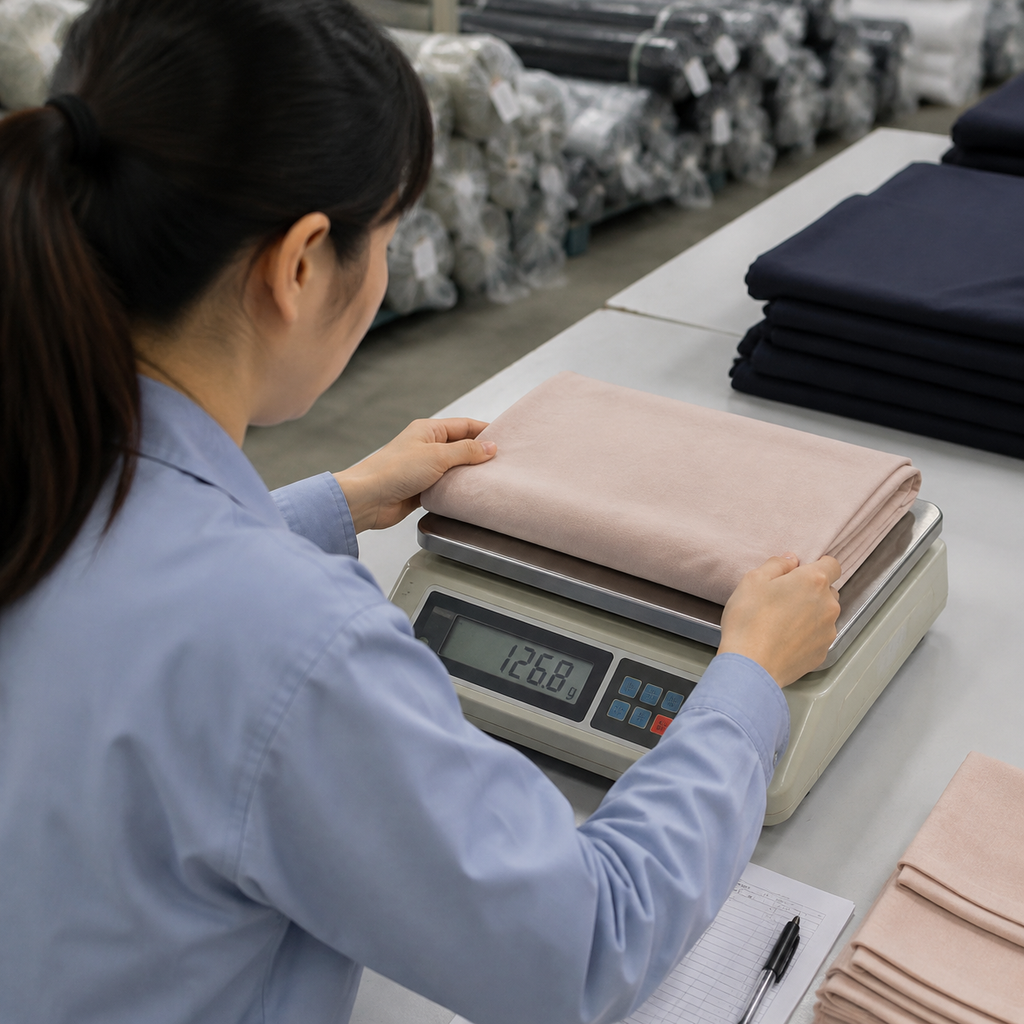
Fabric weight. Cut a 10 cm × 10 cm swatch from the middle of the roll, not the edge. Weigh it on a digital scale accurate to 0.1 g. Multiply by 100 to get grams per square meter. Your spec of 45 g or 90 g should match within ±5%. A 45 g tulle that measures 52 g will change the drape and the cost.
Seam strength. Sew a test seam with the same thread, needle, and stitch density as production. Pull the seam apart by hand — it should resist without the tulle tearing at the stitch line. For a measurable check, demand ASTM D434 seam slippage results from the factory’s lab; a 6.8 kg load with less than 3 mm slippage is the passing threshold.
Colorfastness. Wash a swatch with a white cotton cloth at 30 °C, cold rinse. Any dye transfer to the white cloth fails. For deeper verification, demand ISO 105-C06 results. Check crocking (rubbing) with a dry white cloth — tulle’s open weave holds dye poorly, so this test catches the failures that washing misses.
When a Tulle Mini Dress Manufacturer Is the Wrong Choice
This sourcing route fails when your order is too small for the factory’s minimums, when you need extreme stretch, or when you cannot commit to a tech pack. A tulle mini dress is a structured garment; the fabric’s open weave demands precise cutting and sewing that small-batch generalists often lack.
If your order is under the factory’s MOQ for tulle (typically higher than for jersey because of fabric waste and handling), you will pay a premium that erases the cost advantage of sourcing in China. If your design requires more than 15% stretch — a bodycon tulle dress, for example — tulle is the wrong fabric entirely; it has no inherent give and will tear at the seams. And if you expect the manufacturer to design the garment from a mood board, you need an ODM, not an OEM — and the ODM route carries its own risks covered earlier.
Choose this route when you have a complete tech pack, a realistic volume, and a fabric spec you can defend.
RFQ Checklist
Send a complete RFQ with six attachments: tech pack, BOM, quality spec, fabric spec, target price, and Incoterms. A tulle mini dress RFQ without these documents will return quotes you cannot compare.
| RFQ Item | What to Include | Verification |
|---|---|---|
| Tech pack | Flat sketches, graded measurements, construction details | Compare against pre-shipment inspection |
| BOM | Fiber content, trims, thread, zipper, labels | Cross-check against fabric inward inspection |
| Fabric spec | Weight (45 g or 90 g), denier, hole size, color | Weigh swatch, verify ±5% |
| Quality spec | AQL 2.5/4.0, defect definitions, ISO 2859-1 level II | Confirm before production |
| Target price | FOB or EXW basis, not a bare number | Confirm Incoterms in writing |
| Lead time | Fabric + production + shipping separately | Track against milestones |
State your AQL, your inspection points, and your fabric weight tolerance in the RFQ itself. A manufacturer who questions these specs is either inexperienced or planning to cut corners. One who accepts them and returns a dated production schedule is ready to quote.
Request a quote with these documents and you will get pricing you can act on.

Comments