
Start with the Recommendation
Send a complete RFQ package — tech pack, bill of materials, and quality specification — before you ask for a price. A manufacturer who quotes from a partial brief pads the quote with contingencies: 15–20% higher per-unit cost, longer lead times, and fabric substitutions you did not approve. A complete package removes that guesswork.
The single constraint that decides everything else: if the manufacturer has to interpret your design, you pay for their interpretation. Every measurement, tolerance, and standard you specify in writing is one less variable priced into your quote.
Send all three documents in your first email. This shortens the quote cycle from 7–10 days of back-and-forth to 3–5 days, and it forces the OEM to quote against your spec rather than their default. The rest of this article details exactly what each document must contain.
What You Need Before Contacting a Manufacturer
Three documents must exist before you email any OEM. Without them, you are asking for a guess, not a quote.
1. Tech pack. This is the engineering drawing of your garment: flat sketches, graded measurements with tolerances, construction details, and trim placement. For a dress, this means front/back flats, a measurement table for every size in your range, and stitch-by-stitch construction notes. The satin evening dress article covers tech pack structure in depth — reference it for the full template.
2. Bill of materials (BOM). Every component with a specification: main fabric (fiber content, weight, weave), lining, thread, zippers, buttons, labels, and hang tags. Each line needs a supplier name or a generic spec the OEM can source against.
3. Quality specification. The acceptance criteria: AQL level (typically 2.5 for general, 1.0 for visible defects), colorfastness ratings, seam slippage limits, and any certification requirements (OEKO-TEX Standard 100, for example).
These three documents take 8–12 hours to prepare the first time. They save 2–3 weeks of quote revisions and prevent the OEM from quoting a cheaper, lower-grade fabric than you designed.
The RFQ Document: What to Include
The RFQ document itself is the cover letter that ties your three documents together. It contains six sections, each with measurable specifics.
Product specifications. Reference the tech pack by version number and date. State the garment type, sizes, and any deviations from the tech pack.
Quantities. Give the total order quantity and the breakdown per size and color. A 500-piece order split across 6 sizes and 3 colors is a different quote than 500 pieces of one size in one color — the latter runs 15–25% cheaper per unit due to fewer changeovers.
Target price. State your target landed cost per unit, but specify the Incoterms it applies to. FOB Shanghai and DDP Los Angeles differ by $4–8 per dress depending on freight and duties. Name the Incoterms in your RFQ so the manufacturer quotes against the same baseline.
Timeline. Give the required delivery date and work backward: sample approval, fabric procurement, production, and shipping. A 90-day timeline from sample approval is typical for a 500-piece dress order; state yours explicitly.
Compliance requirements. Name the standards: OEKO-TEX Standard 100 for fabric, AQL 2.5 for inspection, and any destination-market regulations (Textile and Wool Acts for the US, REACH for the EU).
Measurable specs carry units and conditions. "Colorfastness to washing: 4.0 minimum, tested per ISO 105-C06" is quotable. "Good colorfastness" is not.
Tech Pack Essentials for Dresses
The tech pack is the document the factory sews from. Four elements matter most for dresses.
Flat sketches. Front and back views at 1:1 scale with all seam lines, darts, and design details drawn. Include a callout for every construction detail: seam type, stitch density (stitches per inch), and edge finishing.
Measurement table with tolerances. This is the critical section. Every point of measure needs a nominal value and a tolerance. A tolerance of ±1 cm on a 100 cm hem is meaningless; ±0.5 cm on a 60 cm bust is tight but achievable.
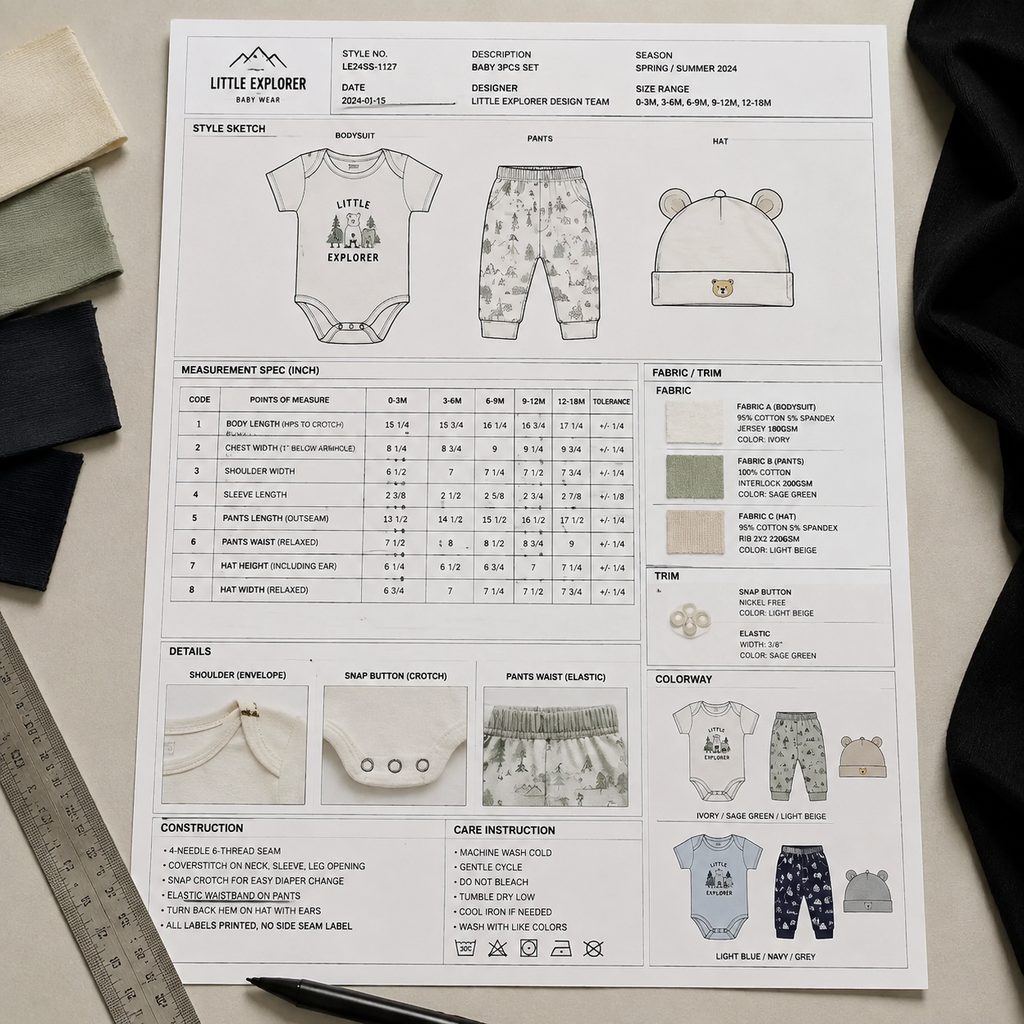
Construction details. Specify seam allowances (1.5 cm is standard for woven dresses), stitch type (lockstitch 301 for seams, overlock 504 for edges), and thread type and weight. A satin dress needs French seams or bound seams to prevent fraying — specify this explicitly or the factory will use a plain overlock.
Grading. The measurement table must include all sizes in your range. Grading increments are not uniform: bust and waist typically grade 4–5 cm per size, hip 4–6 cm, and length 2–3 cm. Specify the grade rules yourself; do not let the factory infer them.
| Measurement point | Size S (cm) | Size M (cm) | Size L (cm) | Tolerance (±cm) |
|---|---|---|---|---|
| Bust | 84 | 88 | 92 | 0.5 |
| Waist | 66 | 70 | 74 | 0.5 |
| Hip | 90 | 94 | 98 | 0.5 |
| Shoulder width | 37 | 38 | 39 | 0.3 |
| Sleeve length | 58 | 59 | 60 | 0.5 |
| Total length (shoulder to hem) | 110 | 112 | 114 | 1.0 |
| Hem circumference | 120 | 124 | 128 | 1.0 |
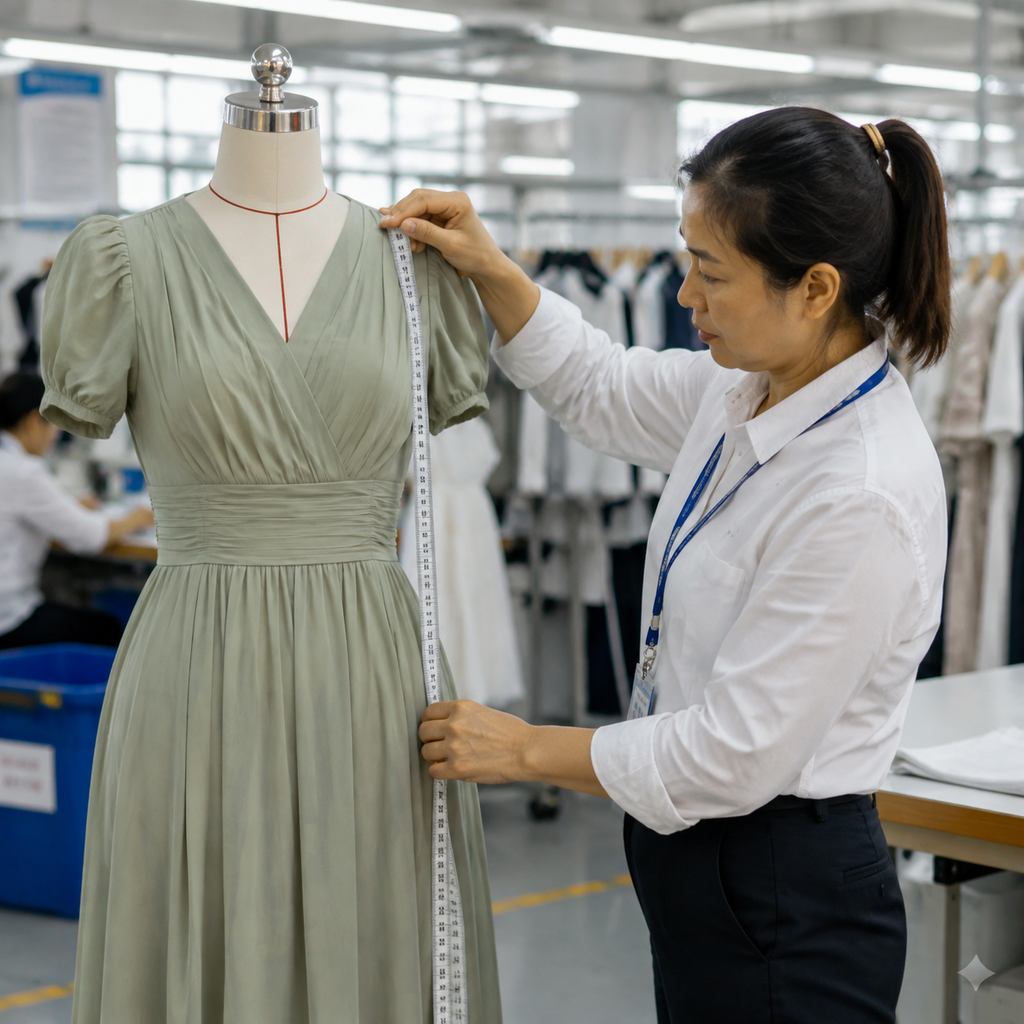
Measurements are taken on a flat surface with the garment un-stretched, per ASTM D5219. State this in the tech pack so the factory and your inspector measure the same way.
Fabric and Trim Specifications
Define every fabric and trim by measurable properties, not by name alone. A name like "satin" covers 40 g/m² to 120 g/m² variations; the manufacturer will quote the cheapest interpretation unless you lock the numbers.
State fiber content as a percentage (e.g., 97% polyester, 3% elastane), weight in grams per square meter (g/m²), weave structure (satin, twill, jersey), and finish (brushed, silicone-treated, wrinkle-resistant). For trims, specify zipper length and material (e.g., 45 cm nylon coil), button diameter in millimeters, and thread type (e.g., 100% polyester, 120 tex).
| Fabric | Typical weight | Common use |
|---|---|---|
| Satin (polyester) | 60–90 g/m² | Evening dresses, linings |
| Crepe | 120–180 g/m² | Bias-cut dresses |
| Tulle | 30–60 g/m² | Overlays, skirts |
| Cotton poplin | 100–130 g/m² | Day dresses |
| Stretch jersey | 180–240 g/m² | Bodycon styles |
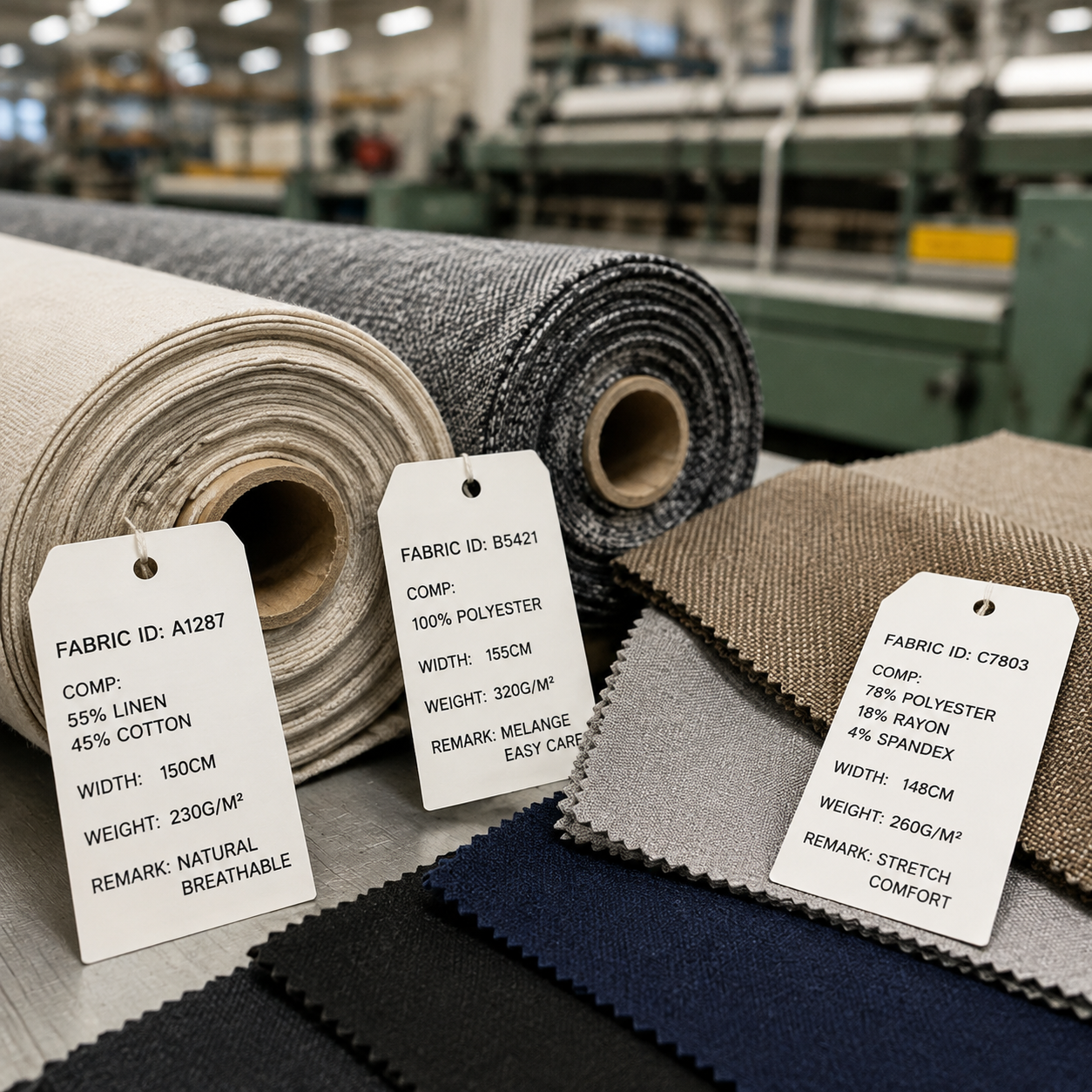
Add certification requirements in the same line: OEKO-TEX Standard 100 product class II for direct skin contact. If a fabric must meet a specific standard, name it in the RFQ; otherwise, the factory will source to price.
Quality Standards and Certifications
Demand standards by designation, not by vague phrases. Set AQL (Acceptable Quality Limit) at 2.5 for major defects and 4.0 for minor defects, per ANSI/ASQ Z1.4, with sample size determined by order quantity per the standard’s tables. State this in the RFQ; it becomes the inspection benchmark.
Require OEKO-TEX Standard 100 certification (product class II for garments worn against skin) and request the certificate number. Verify it on the OEKO-TEX website — the certificate lists the specific factory and product type.
Name the physical tests that matter for dresses: seam slippage per ASTM D434 (minimum 3 mm at 6.8 kg load), colorfastness to washing per ISO 105-C06 (minimum grade 4), and colorfastness to light per ISO 105-B02 (minimum grade 4 after 20 hours). Request test reports from an accredited lab (e.g., SGS, Intertek, Bureau Veritas) before bulk production, not after.
MOQ, Lead Time, and Small Batch Production
MOQs for dress manufacturing in China typically range from 100 to 300 pieces per color per style for a low MOQ clothing manufacturer, though some factories accept 50 pieces for simple styles. Lead times run 30–45 days from sample approval to shipment, with fabric procurement adding 10–15 days if the textile is not in stock.
These figures belong in your RFQ as targets, not as questions. State your desired MOQ and lead time; the factory responds with feasibility. For small batch production, expect a 15–30% higher per-unit cost than at 500-piece quantities — the tradeoff is inventory flexibility, not price parity.
If your volume is under 50 pieces per style, this model fails; see the final section.
Cost Factors That Move Your Quote
Five variables drive per-unit price in dress manufacturing. Fabric dominates: a 120–180 g crepe costs 2–3× a 60–90 g polyester satin at equivalent quality. Trims add 8–15% — a 45 cm invisible zipper at $0.30–0.80 versus a lapped seam at $0.05. Labor scales with construction complexity: a lined bodice with boning takes 45–60 minutes of sewing time versus 20–30 for an unlined shift. Finishing — hand-stitched hems, pressing, garment dye — adds 5–10%. Quantity spreads fixed costs: pattern-making and grading amortize across units, so a 300-piece run carries roughly 1.5× the per-unit overhead of a 1,000-piece run.
| Cost driver | Impact on unit price | What to specify in the RFQ |
|---|---|---|
| Fabric | 40–60% of total | Fiber content, weight (g/m²), weave, finish |
| Trims | 8–15% | Zipper length and type, buttons, lace width |
| Labor | 20–30% | Construction method, seam count, lining |
| Finishing | 5–10% | Hem type, pressing, packaging grade |
| Quantity | 10–30% swing | Target order volume and forecast |
State each in the RFQ with units. A quote based on "nice fabric" is not comparable to one based on "120 g/m² polyester crepe, OEKO-TEX Standard 100 certified."
Lifecycle and Replacement Economics
A dress that fails after 10 washes costs more than its ticket price. The replacement economics are simple: if a $40 dress lasts 20 wears, cost per wear is $2.00; a $60 dress lasting 60 wears costs $1.00. The RFQ specs determine which you get.
Typical failure modes trace directly to specifications. Seam slippage at 6.8 kg (per ISO 13935-2) causes side seams to pull apart under strain — specify the test and the threshold. Color fading after 5 washes (ISO 105-C06) sends customers to returns — demand a minimum rating of 3–4. Shrinkage beyond 3 mm on a 100 cm length distorts the fit — set the tolerance in the tech pack. Hem tape that delaminates after dry cleaning is a trim spec, not a labor issue.
Each failure mode has a verification method and a spec. Put them in the RFQ and the manufacturer prices to the standard, not to the cheapest construction that passes a visual check.
Validation Methods: How to Verify Claims
A manufacturer’s claims are hypotheses until tested. Verify in three stages: pre-production samples, bulk inspection, and independent lab reports.
Sample testing. Request a pre-production sample (not a sales sample) sewn from production fabric. Measure it against the tech pack: all points within the stated tolerances (e.g., bust ±1 cm, total length ±1.5 cm). Test wash a duplicate: check shrinkage, colorfastness per ISO 105-C06, and seam appearance.
Third-party inspection. Use an AQL 2.5 general inspection level II on bulk goods. An inspector checks measurements, construction, and trims against the tech pack. For dresses, add a fit check on a size-run mannequin — grading errors show up here, not in a single sample.
Lab reports. Demand test certificates from an ISO 17025-accredited lab. For fabric porosity or filter-style claims, ASTM F316 applies; for dresses, the relevant tests are seam slippage (ISO 13935-2), colorfastness (ISO 105-C06, ISO 105-B02), and fiber content verification. OEKO-TEX Standard 100 certification covers restricted substances — request the certificate number and verify it on the OEKO-TEX website.
Accept no verbal assurance. A certificate number is checkable; a salesperson’s word is not.
A Typical Sourcing Scenario
A typical scenario: a brand founder needs 500 satin evening dresses for a spring launch. She sends a complete RFQ package — tech pack with graded measurements, BOM listing 120 g/m² polyester satin with OEKO-TEX certification, and a quality spec citing AQL 2.5 and ISO 105-C06 colorfastness at rating 3–4.
The manufacturer returns a quote in 5 working days with per-unit pricing at three quantity tiers, a 45-day lead time from sample approval, and Incoterms options. She requests a pre-production sample, measures it against the tech pack — bust within 1 cm, total length within 1.5 cm — and washes a duplicate to confirm no shrinkage beyond 3 mm.
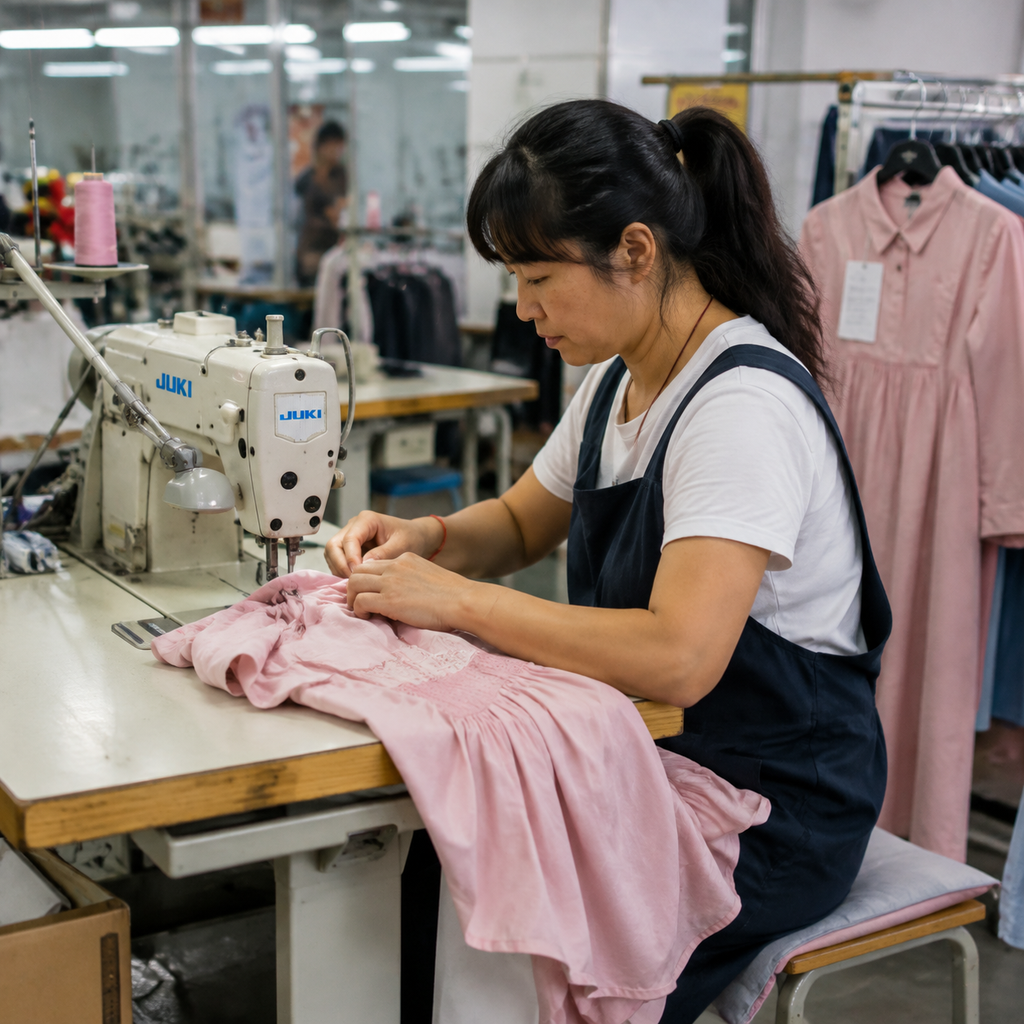
She approves the sample, schedules a third-party inspection at AQL 2.5, and releases the order. The complete RFQ package — not the manufacturer’s goodwill — is what made the quote accurate and the timeline realistic.
When a Dress Manufacturer RFQ Is the Wrong Choice
This approach fails under three conditions. First, very low volume: below 100 units per style, the fixed costs of pattern-making and grading make per-unit pricing uncompetitive — a small batch production specialist with simplified grading may serve you better. Second, extreme customization: if the design requires proprietary fabric development, bespoke hardware, or construction methods your team cannot specify in a tech pack, the RFQ process breaks down — you need a development partner, not a quote. Third, no tech pack capability: if you cannot produce flat sketches, graded measurements, and construction details, the manufacturer fills the gaps with their own assumptions, and the quote is fiction. The RFQ discipline works when you can define the product. When you cannot, the problem is not the manufacturer — it is the specification. Fix that first, then send the RFQ.

Comments