
Start with the Recommendation
Evaluate a satin evening dress OEM on measurable specifications, verifiable standards, and documented processes — not on photos, promises, or sample beauty. Before you send an inquiry, you need a tech pack with graded measurements, a quality agreement referencing AQL 2.5 or tighter, and a fabric specification that names fiber content, weave, weight, and finish. If a manufacturer cannot respond to those three documents with numbers and timelines, move on. The factory that asks you to "trust the sample" is the factory that will ship inconsistent goods. Your RFQ should read like a contract, because it is one.
What You Need Before Contacting a Manufacturer
Three documents must exist before you email any OEM. Without them, you are asking for a guess, and you will be quoted accordingly.
Tech pack. This is the construction blueprint: flat sketches with front/back views, stitch types, seam allowances, trim placement, and a bill of materials. Every measurement point must be defined — bust, waist, hip, hollow-to-hem, sleeve length — with tolerances in centimeters or inches.
Graded spec sheet. A size run (XS–XL, for example) with graded measurements at each point. Grading is not proportional scaling; it follows your size chart. If you skip this, the factory grades to its own chart, and your fit dies at size M.
Quality agreement. This names the acceptable quality level (AQL) for inspection, defect definitions, and what happens on failure. AQL 2.5 for major defects, 4.0 for minor, is the industry baseline. Put it in writing before sampling, not after.
Myth 1: All Satin Is the Same
"Satin" describes a weave, not a fabric. A satin weave has floating yarns on the surface that catch light — but the fiber underneath changes everything.
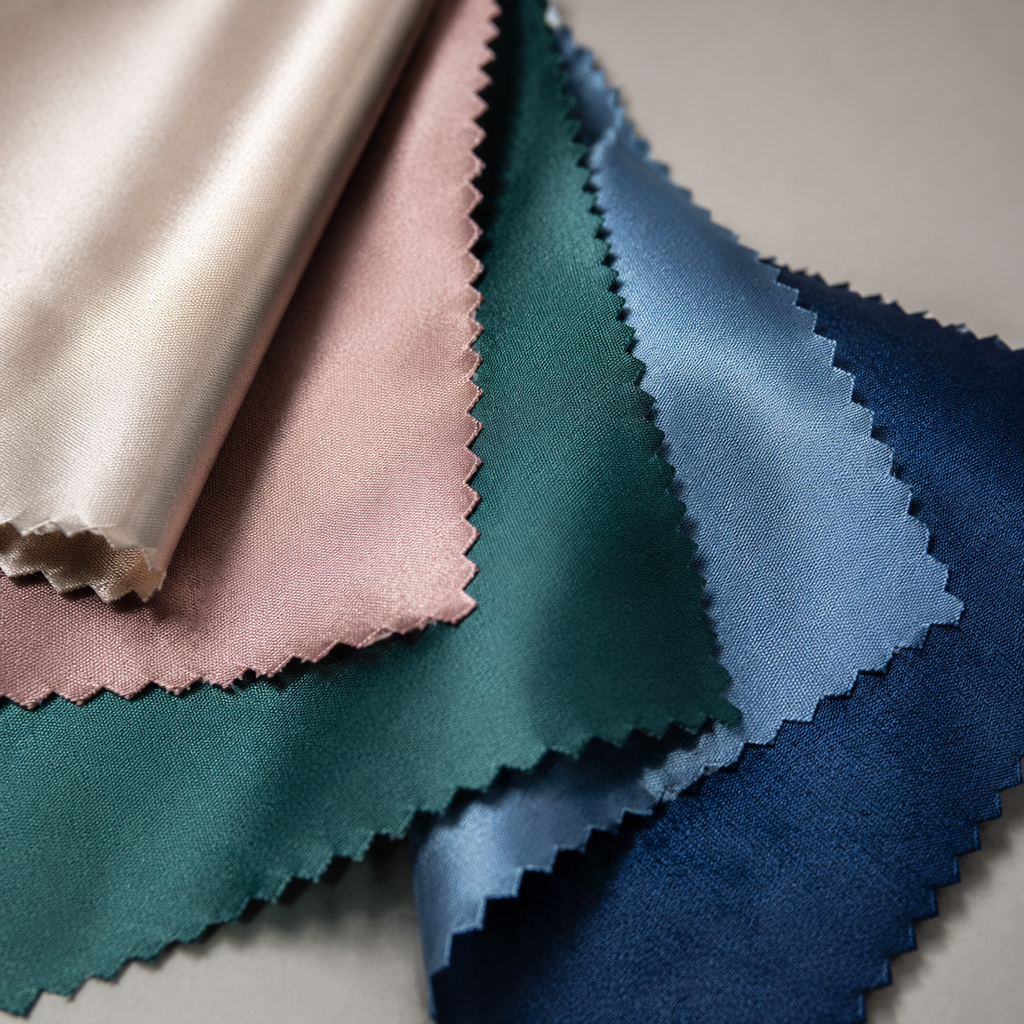
Polyester satin drapes stiffly, holds creases, and pills after repeated wear. Silk satin (mulberry, charmeuse) drapes fluidly but is fragile and expensive. A satin evening dress OEM will quote you different prices for the same weave because the fiber differs. Specify fiber content by percentage: "100% polyester satin, 190 gsm" is a spec; "satin" is not.
Weight matters. A 120 gsm satin is sheer and limp; a 220 gsm satin holds structure. Finish matters too — a crepe-back satin has a matte reverse, while a charmeuse finish is glossy on both sides. Ask for a swatch card with weight, fiber, and finish written on each swatch. Then put that exact spec in your tech pack.
Myth 2: Low MOQ Means Low Cost
A factory offering a 50-piece MOQ is not saving you money. Setup costs — pattern digitizing, marker making, fabric cutting, machine configuration — are fixed. Spread those costs over 50 units instead of 500, and your per-unit price rises sharply. A low MOQ is a pricing feature, not a discount.
What to do instead: negotiate a tiered MOQ. Commit to 300 pieces across a color run, or accept a higher per-unit price for the first batch with a rebate on reorders. Some low-MOQ manufacturers also charge a separate sample development fee to recover setup costs — ask for that line item explicitly. If your volume is genuinely under 100 units per style, a satin evening dress OEM is likely the wrong route; see the section on when this fails.
Myth 3: A Sample Is a Guarantee of Production Quality
A sample is made by the most skilled operator in the factory, on a calibrated machine, with your fabric set aside. Production runs use different operators, different machines, and fabric from a different dye lot. The sample proves the design works; it does not prove the factory can repeat it.
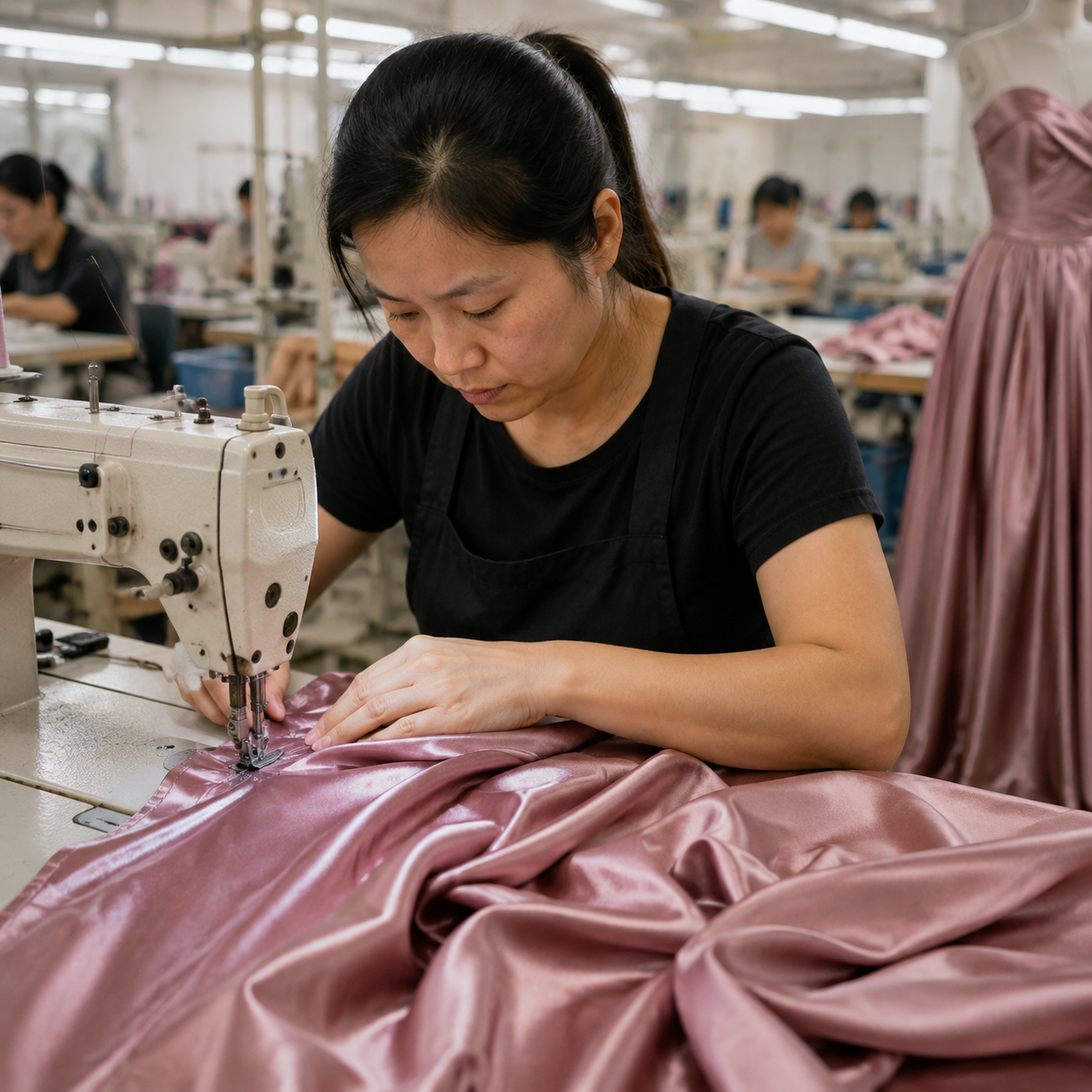
Verify production consistency with three checks. First, request a pre-production sample from the actual fabric lot and the actual pattern used for bulk. Second, require an inline inspection at 30% completion — a third-party inspector checks measurements, stitching, and fabric defects against your quality agreement. Third, enforce a final random inspection per AQL 2.5 before shipment. The sample is a starting point, not a promise.
Myth 4: Cheaper Fabric Saves Money
A lower fabric price per yard is the fastest way to inflate your return rate. Satin’s hand-feel and drape come from fiber, weave, and finish — not from the word "satin" on a spec sheet. A poly charmeuse at 16 momme drapes like cardboard; a 22-momme silk charmeuse moves differently and costs more. The failure mode is invisible until the garment is worn: puckered seams, static cling, or a sheen that photographs as cheap.
Specify fiber content by percentage, weave (charmeuse, duchesse, crepe-back), weight in g/m², and finish (dyed, printed, wrinkle-resistant). Demand a shade band and a hand-feel swatch against your reference. If the fabric fails drape or color-fastness, the garment fails — and you absorb the return shipping.
Cost Factors That Move Your Quote
Fabric is the largest lever, but it is not the only one. These variables move your per-unit price up or down:
| Factor | What changes the price | How to verify |
|---|---|---|
| Fabric weight | 16 vs. 22 momme silk charmeuse; poly vs. silk | Request a fabric spec sheet with g/m² and fiber % |
| Order volume | 50 vs. 500 units per colorway | Ask for a tiered price break at 100, 250, 500 |
| Construction detail | Boning, cups, or lining add labor minutes per unit | Count seams and components in the tech pack |
| Embellishment | Beading or lace appliqué adds hand-work hours | Specify stitch density and placement tolerance |
| Finishing | Wrinkle-resistant or water-repellent treatments add a process step | Confirm the treatment and its test method |
| Lead time | 30 vs. 60 days; air freight vs. sea freight | Get Incoterms and a dated production schedule |
A low MOQ of 50 pieces often carries a 20–40% per-unit premium over 250 pieces. If you need small batch production, accept the premium or consolidate colorways into one production run. Never ask for a quote without a graded spec sheet — you will get a number that moves after sampling.
Standards and Certifications to Demand
Three standards matter for satin evening dresses. Demand them in writing before you approve a production sample.
OEKO-TEX Standard 100 — Certifies that the finished fabric and trims are free from harmful substances, including restricted azo dyes and formaldehyde. The certificate number is publicly searchable in the OEKO-TEX database; if the supplier cannot provide one, treat the claim as unverified.
ISO 105-C06 — Color fastness to washing. Satin, especially deep jewel tones, bleeds. Specify a test at 40 °C with a multi-fiber strip; require a rating of 4 or higher for color change and staining.
ASTM D3786 — Bursting strength for knit fabrics; for woven satin, use ASTM D5034 (breaking strength). This catches fabric that looks fine but tears at a seam after three wears.
For US sales, also confirm the Textile and Wool Acts labeling requirements — fiber content, country of origin, and care instructions must appear on the garment label. A supplier who cannot produce these documents on request is a sourcing risk, regardless of sample quality.
Lifecycle and Replacement Economics
A satin evening dress fails in one of three ways: seam slippage at the side seam, water marking from a single spill, or color fade after two or three professional cleanings. Each failure sends the garment to the back of the closet, and each is preventable by specification.
Seam slippage is the most common failure. Satin’s smooth weave lets yarns slide under tension. Specify seam slippage resistance per ASTM D434 — a minimum of 0.25 inch separation at 15 lbf for woven fabrics. This test costs nothing at the sampling stage and prevents the "split seam at the gala" return.
Water marking is a care issue, not a defect. Satin is a plain-weave construction with high luster; any moisture leaves a visible ring. The fix is in the care label: dry clean only, and specify that the cleaner presses with a protective cloth. Include this instruction in your tech pack’s care section, not just on the hang tag.
Replacement economics favor durability over price. A dress that survives 10 wears costs less per wear than one that survives 3, even at a 40% higher unit cost. Specify a fabric weight of 16–19 momme for charmeuse or 90–110 g/m² for crepe-back satin — heavy enough to drape, light enough to move. Verify the weight with a GSM scale at the factory before bulk production.
The dress that lasts is the one you specified, not the one you hoped for.
Validation Methods: How to Verify Claims
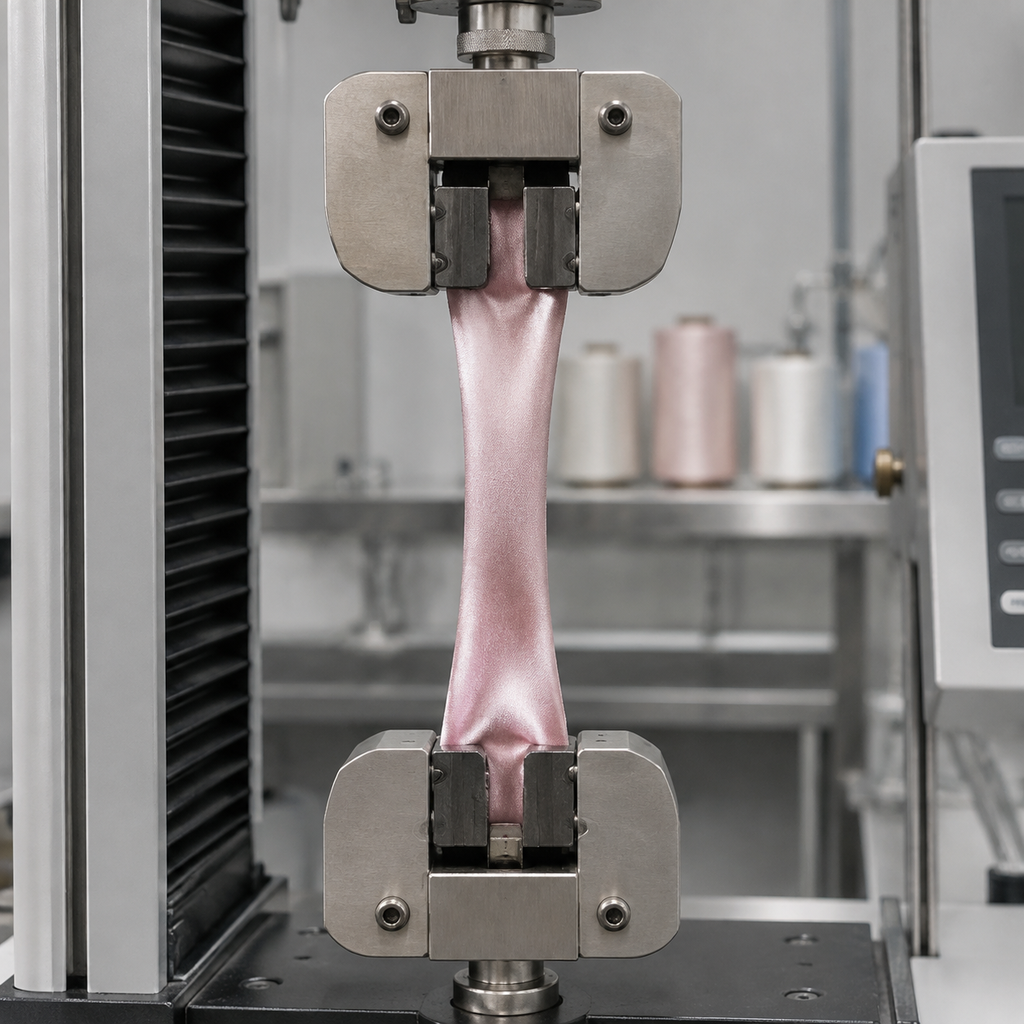
A sample proves the factory can make one dress. It does not prove they can make 500 identical ones. Verify the claims that matter with these tests.
Fabric composition. Claimed "100% silk" can be 80% silk, 20% polyester. Test per ISO 1833 — a fiber identification test that quantifies the blend. Cost is roughly $50–80 per fabric. Do this on the production fabric, not the sample fabric, because mills switch lots.
Colorfastness. ISO 105-C06 at 40 °C tests color loss in laundering. For evening wear, also demand ISO 105-E04 (colorfastness to perspiration) — a dress worn for hours against skin will show dye transfer if the test fails. Both tests take about a week.
Dimensional stability. Satin shrinks or stretches. Test per ISO 5077 — measure the garment or fabric before and after washing. Acceptable change is ±3% for woven satin. A dress that shrinks 5% in the bodice will not fit after one cleaning.
Production inspection. Use the statistical sampling plan from ISO 2859-1. Set the acceptance limit at 2.5 for major defects and 4.0 for minor defects — this determines how many pieces to pull and how many failures are tolerable. Do a mid-production inspection at 50% completion and a final inspection before shipment.
Seam strength. ASTM D1683 measures seam breaking force. For satin, require a minimum of 15 lbf. This catches the seam slippage problem before it reaches your customer.
Each test costs $30–100. The cost of one return, plus the lost customer, exceeds the entire testing budget.
When a Satin Evening Dress OEM Is the Wrong Choice
This route fails when your volume is too low to justify the process. If you need fewer than 50 units per style, the per-unit cost of pattern grading, sample development, and factory setup will exceed what a local seamstress charges. Small batch production works, but it has a floor.
It also fails when you need rapid trend replication. A satin evening dress OEM runs on a 6–10 week lead time from tech pack to shipment. If your model is "see a trend on Instagram, sell it in three weeks," this factory is the wrong tool.
Finally, it fails when your brand cannot commit to a spec. If you have no tech pack, no graded spec sheet, and no quality agreement — the three documents from Part 1 — a factory will quote you a price that assumes the lowest quality materials and the loosest tolerances. You will pay for that assumption in returns.
Choose this route when you have volume, a defined spec, and a lead time that allows for testing.
RFQ Checklist
Send these documents and specs with your request for quote. Missing items will be quoted at the factory’s discretion, not yours.
| Document / Spec | What It Must Contain |
|---|---|
| Tech pack | Flat sketches, construction details, trim specs, stitch count per inch |
| Graded spec sheet | Measurements for every size, with tolerances (±0.5 cm for seams, ±1 cm for lengths) |
| Fabric spec | Fiber content, weave, weight (g/m² or momme), finish, source mill |
| Color spec | Pantone reference or physical swatch; acceptable ΔE tolerance |
| Quality agreement | AQL levels, inspection points, defect definitions |
| Standards list | ISO 105-C06, ISO 5077, ASTM D434, ASTM D1683, ISO 1833 |
| Care label spec | Washing instructions, dry clean only, pressing notes |
| Incoterms | FOB, EXW, or DDP — state which, and the port |
| Lead time | Required delivery date, and the penalty for late shipment |
| MOQ | Your quantity per style, per color |
A complete RFQ gets you a firm quote. An incomplete one gets you a number you cannot hold anyone to. Request a quote with these documents and the factory will respond with specifics, not guesses.


Comments