
Start with the Recommendation
Evaluate a lace bustier manufacturer on measurable specifications, verifiable standards, and documented production capability — not on the beauty of a sample. A stunning sample proves only that the factory can make one garment with focused attention. It says nothing about repeatability across 300 pieces, color consistency between dye lots, or seam integrity after ten wears.
Our recommendation: before you request a quote, define your product in writing. Then grade the manufacturer against that document — fiber content, stretch percentage, seam slippage limits, AQL levels, and lead time. If a factory cannot commit to numbers in writing, walk away regardless of sample quality.
The sections that follow give you the exact specifications to demand, the standards to cite, and the checklist to send. Use them as your evaluation framework.
What You Need Before Contacting a Manufacturer
Three documents must exist before you send a single inquiry. Without them, you will receive quotes that cannot be compared and samples that do not match your intent.
Tech pack. The technical package defines every construction detail: pattern pieces, stitch types, seam allowances, boning channel width and placement, strap attachment method, and trim placement. Reference our article on sample development for the full breakdown of what a complete tech pack contains.
Bill of materials (BOM). List every component with a specification: lace fabric by fiber content and weight, lining fabric, boning material (spiral steel vs. plastic), hook-and-eye closures, straps, and thread. Include supplier names or acceptable equivalents. A BOM without fiber percentages is a guess.
Quality spec. This document states the acceptable limits for defects, color variation, and dimensional tolerance. It references the AQL levels and test standards covered later in this article.
Send all three together. A manufacturer who receives a complete package can quote accurately on the first pass. One who receives only a sketch will quote defensively — padding prices to cover unknowns.
Lace and Fabric Specifications: What to Define
"Lace" is not a specification. It describes a category with enormous variation in fiber, construction, stretch, and durability. Define all four properties in your tech pack.
Fiber content. Specify the exact blend: for example, 85% nylon, 15% spandex. Nylon provides strength and dye affinity; spandex provides recovery. A lace with less than 10% spandex will not hug the body through a full day of wear. State the percentage and require the manufacturer to certify it.
Construction. Lace is made by different methods — Leavers, Schiffli, raschel knit, or chemical (burnout) — each with distinct drape and stretch characteristics. Specify the construction method and the stitch count per inch. A raschel lace at 12 stitches per inch will behave differently from a Leavers lace at 20.
Stretch and recovery. Define stretch as a percentage of relaxed width: "stretches to 150% of relaxed width at 5 N force." Recovery — the ability to return to original dimensions — matters more for a bustier than initial stretch. Specify recovery within 5% of original width after 10 stretch cycles.
Colorfastness. Lace sits against skin and undergoes friction, perspiration, and washing. Specify AATCC 16.3 for lightfastness and AATCC 15 for perspiration resistance, each with a minimum rating of 4.0.
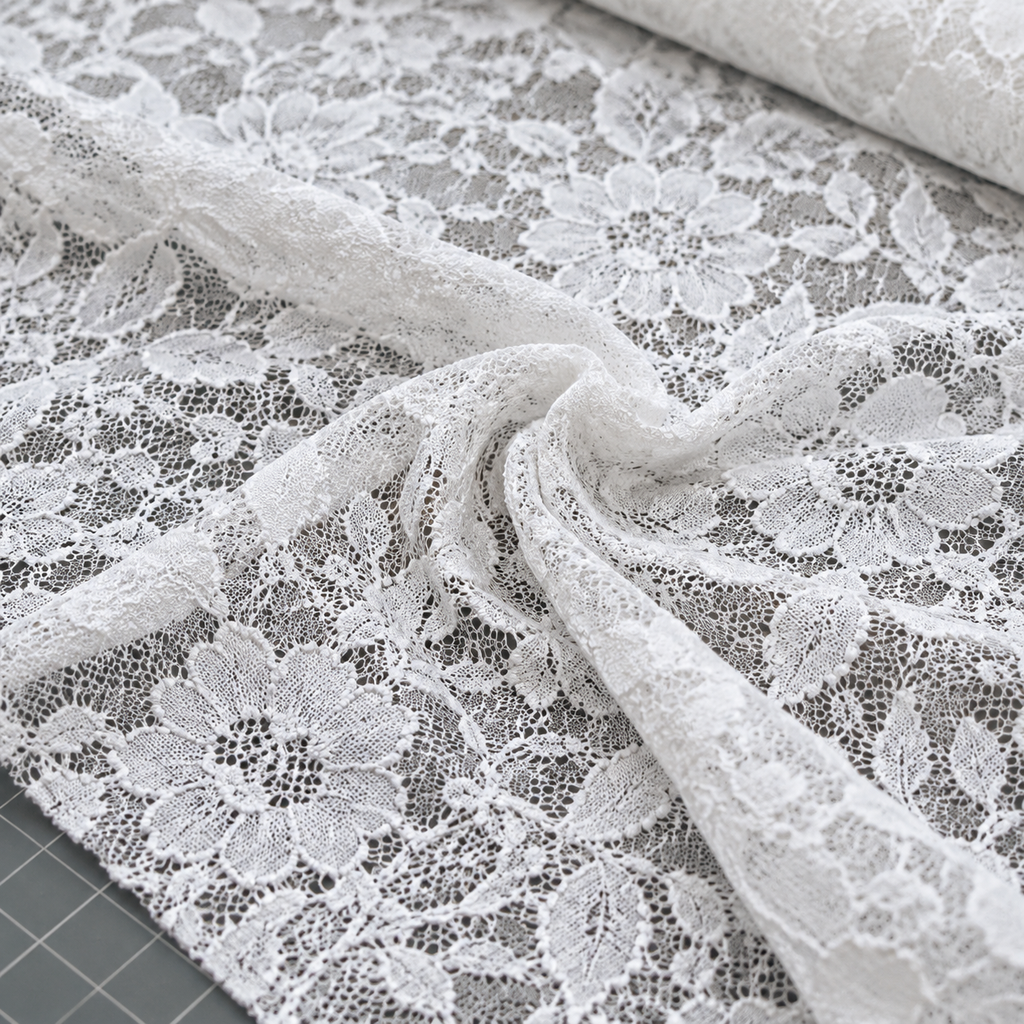
Without these four definitions, your manufacturer will select lace based on price and availability — and you will discover the mismatch at the first fitting.
Construction and Seam Strength for Lace Bustiers
Lace bustiers fail in predictable places: seams that slip under tension, stretch that does not recover, and boning channels that tear. Each failure has a test method and a pass/fail limit.
Seam slippage. Lace’s open structure means seams can pull apart at the stitch line under tension. Test per ASTM D434, which measures how far a seam opens under a specified load. For a bustier, require no more than 6 mm seam opening at 15 N force. Above that, the garment will gap at the side seams during wear.
Stretch recovery. A bustier must return to shape after each wear. Test per ASTM D2594, measuring fabric stretch and growth after repeated extension. Require less than 5% permanent growth after 10 cycles at 80% of maximum stretch. Higher growth means the garment bags out by the third wear.
Boning channels. Boning channels take repeated stress at the waist and underbust. Specify channel width at 2 mm greater than the boning width, with a double-stitched seam at 8 stitches per inch. Require a seam strength test per ASTM D1683, with a minimum of 100 N before seam failure.
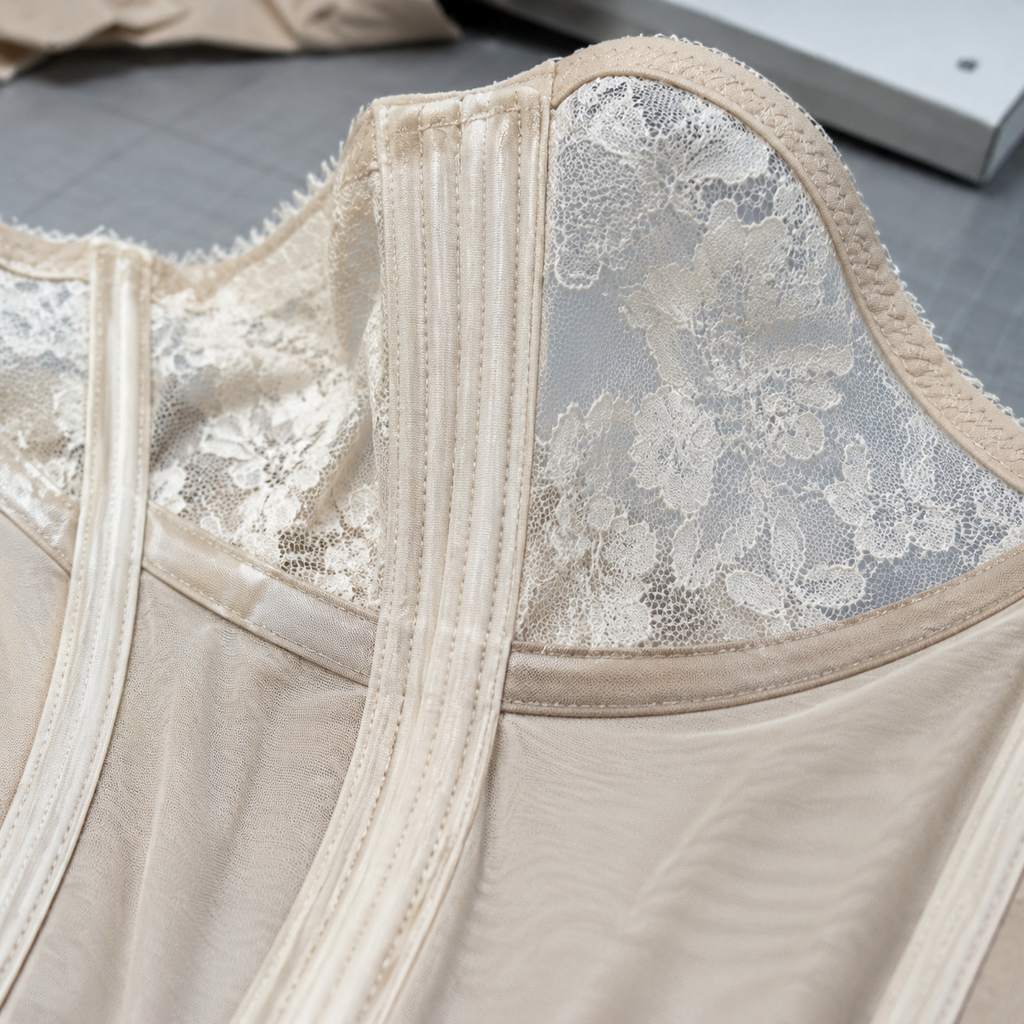
State these limits in your quality spec. A manufacturer who cannot meet them lacks the equipment or skill for structured lace garments.
Standards and Certifications to Demand
A lace bustier that fails on skin contact or seam integrity is a return, not a sale. Three standards cover the risk surface, and each is verifiable by document, not by promise.
OEKO-TEX Standard 100 certifies that the finished garment — including lace, lining, and boning channels — contains no restricted levels of harmful substances. Demand the certificate for the specific product class (Class 1 for infant, Class 2 for direct skin contact; your bustier is Class 2). A supplier who cannot produce a current certificate for your exact article is not compliant.
ASTM D434 measures seam slippage — the tendency for seams to pull apart under stress. For a lace bustier, request a limit of 6 mm maximum slippage at 178 N (40 lbf) for the side seams and underbust. This is the same test referenced in the construction section above.
AATCC 16.3 tests colorfastness to light. Lace dyes, especially on nylon and polyester blends, fade fast. Specify a minimum rating of Grade 4 after 20 AFU (AATCC fading units) for all colors, and verify it on the production dye lot, not the lab dip.
Ask for test reports from an accredited third-party lab (e.g., SGS, Bureau Veritas, Intertek). In-house "test reports" are marketing documents.
MOQ, Lead Time, and Small Batch Production
For lace bustiers, plan on a MOQ of 100–300 pieces per color per style. The driver is lace fabric: mills cut lace in rolls, and a single roll typically yields 80–120 bustiers depending on pattern repeat. Below 100 pieces, you pay for the full roll whether you use it or not.
Standard lead time is typically 45 to 60 days from approval of the tech pack to shipment, broken down roughly as: fabric sourcing and dyeing (15–20 days), cutting and sewing (20–25 days), finishing and inspection (10–15 days). Lace with custom embroidery or a bespoke color match adds 10–15 days to the front end.
If your volume is below 100 pieces per color, look for a manufacturer with a small batch production line — typically 30–50 pieces per color. Expect a 20–30% unit price premium, because the line changeover cost is spread over fewer garments. Ask the supplier to name their small-batch MOQ in writing; many quote it only after you ask.
Cost Factors That Move Your Quote
Four cost drivers dominate a lace bustier quote, in this order of impact:
| Cost driver | Relative impact on unit price | What changes it |
|---|---|---|
| Lace fabric | 40–50% | Fiber content (nylon vs. cotton), pattern complexity, custom vs. stock lace |
| Labor | 25–35% | Seam count, boning channels, cup construction, trim attachment |
| Trims and findings | 10–15% | Hooks, eyes, boning, straps, elastic — branded hardware adds 30–50% to this line |
| Finishing and QC | 5–10% | Hand-finishing of lace edges, AQL inspection level, packaging |
Lace fabric is the lever. A stock nylon lace at 80 g/m² costs roughly $3–5 per meter; a custom jacquard lace with a registered pattern runs $8–15 per meter. A bustier uses 0.5–0.7 meters, so the fabric swing alone can move your unit cost by $3–8.
Labor cost scales with construction complexity. A simple four-seam bustier with no boning runs 20–25 minutes of sewing time; a fully boned, underwired style with a lace overlay runs 45–60 minutes. Ask your manufacturer for the standard allowed minutes (SAM) per style — it is the single most useful number in their quote.
Quality Control: AQL, Grading, and Inspection
Set your acceptance quality limit at AQL 2.5 for major defects and 4.0 for minor defects, per ISO 2859-1 (the international standard behind AQL). Major defects are those that make the garment unsellable — broken boning, seam separation, color mismatch. Minor defects are cosmetic — loose threads, slight puckering, uneven lace alignment.
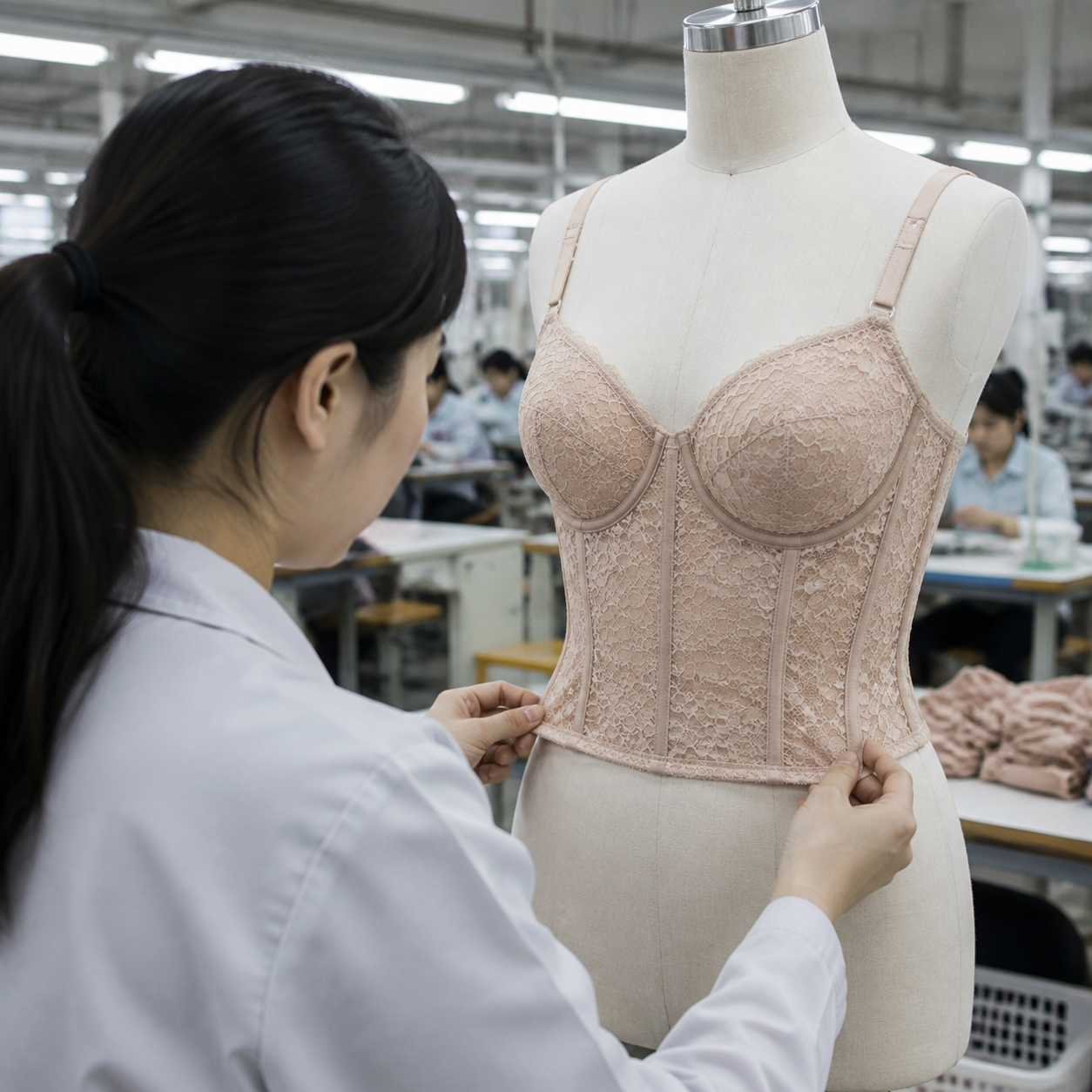
Inspection happens at two points. In-line inspection during sewing catches defects while they are fixable; final random inspection (typically on a 10–20% sample of the production lot) determines whether you accept the shipment. Use a third-party inspector (QIMA, AsiaInspection, or the manufacturer’s own QC if you trust their reports) and require a written report with defect photos.
Grading is the internal step before inspection: the factory sorts every garment into Grade A (pass), Grade B (seconds, sellable at discount), or reject. Your contract should state that only Grade A garments ship, and that Grade B pieces are not counted toward your order quantity. Verify this by checking the factory’s grading records during your audit or inspection visit.
A Typical Sourcing Scenario
Here is a typical scenario, framed as a composite rather than any single job. A brand founder needs 300 lace bustiers in two colors — black and ivory — for a capsule collection. They have a tech pack, a BOM, and a quality spec already drafted. The manufacturer quotes 150 pieces per color, which meets the 100–300 piece MOQ range typical for this product family.
The founder specifies 80 g/m² nylon-spandex lace with 2 mm seam allowance and 6 mm seam slippage resistance, per ASTM D434. The manufacturer confirms the fabric meets OEKO-TEX Standard 100 and that colorfastness will be verified per AATCC 16.3. The founder requests a pre-production sample in each color, approves both, and the factory runs the order.
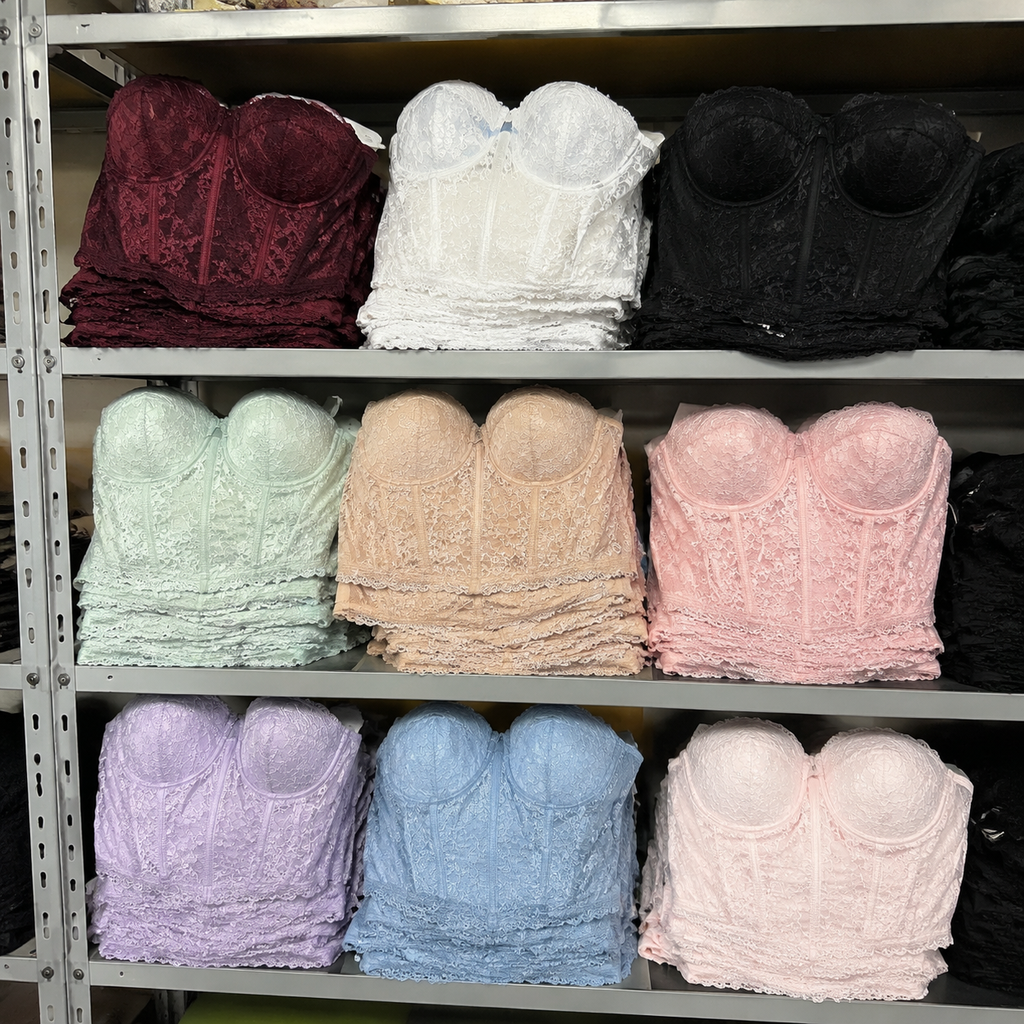
The decision points that matter here are the ones the founder locked in before production: the fabric weight, the seam standard, and the sample-approval gate. Each one converts a subjective preference into a checkable pass/fail criterion. The founder also confirms the inspection level and defect thresholds with the factory in writing before the line starts — not at the packing stage — so both sides are working from the same acceptance criteria.
The factory ships at 45 days from sample approval. The founder receives the goods, checks the packing list against the purchase order, and the order closes without a claim. The pattern is consistent: the more precise the spec, the fewer the surprises.
When a Lace Bustier Manufacturer Is the Wrong Choice
This route fails under three conditions. First, as covered in the small-batch discussion above, very low volume pushes per-unit cost up and erodes quality control leverage. Second, if you need specialized lingerie construction — molded cups, underwire channels, or elasticated scalloped edges requiring dedicated machinery — a general womenswear factory lacks the equipment and trained operators. Third, if your compliance position is weak — no OEKO-TEX certification, no AATCC 16.3 lightfastness data — you risk customs holds or retail rejection. In those cases, a specialist lingerie manufacturer or a domestic small-batch shop is the better route, even at higher cost.
Frequently Asked Questions
What does a sample cost, and is it refundable?
Sample costs typically range from $50 to $150 per style, depending on lace complexity and construction. Many factories deduct the sample fee from the production order if you place a minimum quantity. Confirm this in writing before paying.
Can you work with a lower MOQ than 100 pieces per color?
Some factories offer small batch production at 50–80 pieces per color, but expect a 15–25% unit price increase. Ask for the price break at 100, 200, and 300 pieces per color to see where the curve flattens.
What is the typical lead time for a lace bustier order?
Standard lead time is 45–60 days from sample approval. Fabric dyeing and lace yardage are the longest steps. If you need faster delivery, ask about fabric stock or pre-dyed lace, which can cut lead time to 30 days.
What customization is possible?
You can change color, lace pattern, lining, boning placement, and trim. What you cannot easily change is the base block pattern — significant silhouette changes require new grading and sampling, which adds 10–15 days and $100–$200 in sample fees.
RFQ Checklist
Send the manufacturer’s engineer the following, grouped by category:
Documents
- Tech pack with flat sketches and measurements
- BOM listing all materials and trims
- Quality spec with AQL levels and grading rules
Fabric and Lace
- Fiber content and weight (e.g., 80 g/m² nylon-spandex)
- Construction type and stretch percentage
- Colorfastness requirement per AATCC 16.3
- OEKO-TEX Standard 100 certification or test report
Construction
- Seam allowance (e.g., 2 mm) and seam slippage limit (e.g., 6 mm per ASTM D434)
- Boning channel width and boning material
- Stretch recovery requirement for lace panels
Commercial
- Target MOQ per color and total order quantity
- Required lead time and Incoterms
- Inspection standard (ISO 2859-1) and inspection point
Samples
- Number of pre-production samples needed
- Sample approval deadline and sample fee policy
Send this list with your initial inquiry. A factory that responds with questions rather than a quote is doing its job; one that quotes without asking is a risk.


Comments