
Start with the Recommendation
A one shoulder mini dress must survive a minimum seam strength of 120 N per ASTM D1683 on the shoulder attachment and side seams, verified on production lots — not just on the pre-production sample. That single number reframes the OEM decision: the entire garment’s weight hangs on one strap and one side seam, so seam and strap integrity under repeated wear outranks fabric hand or aesthetic finish. A dress that fails at the strap after three wears costs more in returns and chargebacks than any per-unit savings from a lower quote. Evaluate every candidate manufacturer against their ability to document seam strength, stretch recovery, and fabric shrinkage before you compare price. The manufacturer that cannot produce those numbers cannot produce a reliable one shoulder mini dress.
What You Need Before Contacting a Manufacturer
Before sending a single RFQ, three documents must exist. First, a tech pack — flat sketches with measurements in centimeters, construction callouts, stitch type per seam, and grading specs for sizes XS–XL. Second, a bill of materials (BOM) listing every component: fabric, thread, zipper, strap hardware, and care label, each with a supplier or acceptable substitute. Third, a quality specification that names the acceptable tolerance for shrinkage, colorfastness, and seam slippage, plus the AQL level you will inspect to. Without these, the manufacturer fills the gaps with their own assumptions, and you pay for the difference later. For a deeper walkthrough of tech pack anatomy and measurement conventions, see our article on sample development. The RFQ is not the starting point — it is the output of this preparation.
Fabric and Trim Specifications for One Shoulder Dresses
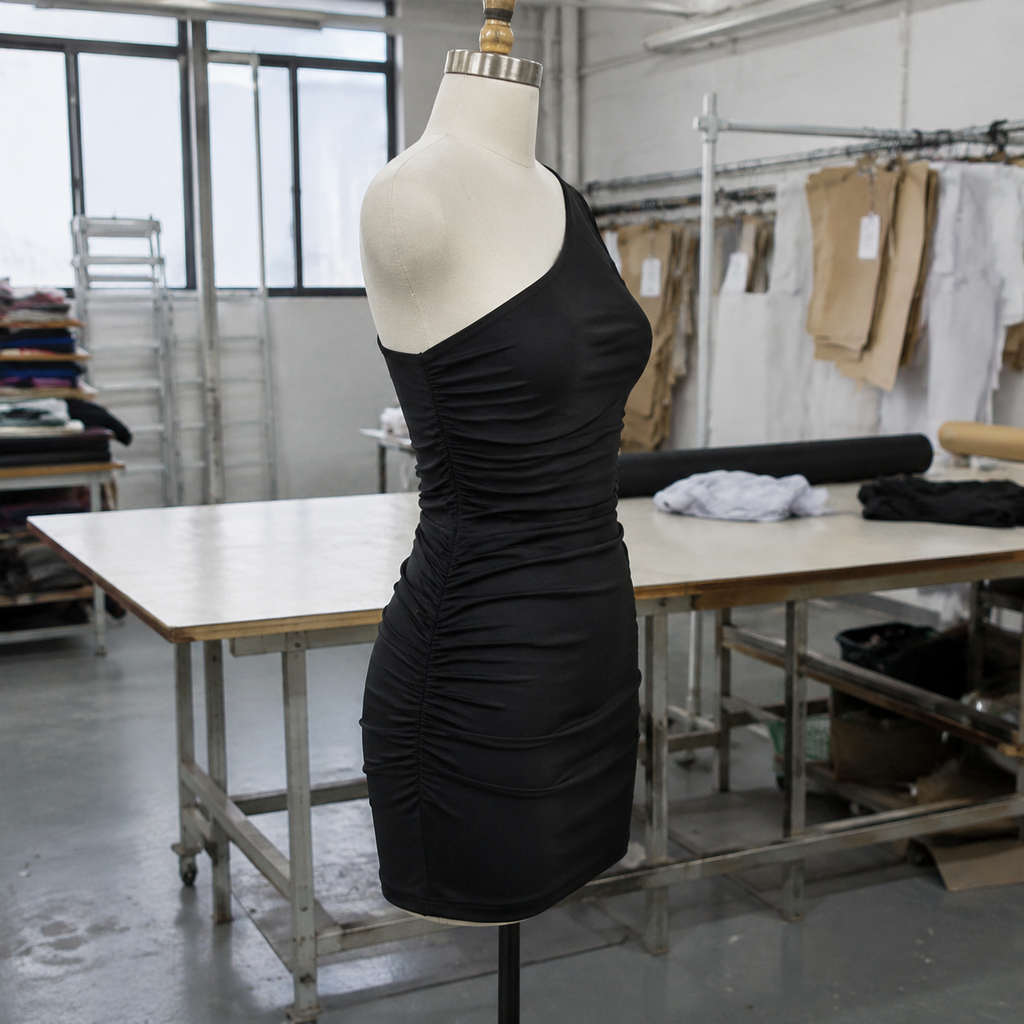
The one shoulder silhouette demands fabrics with specific measurable properties, not vague descriptors like "stretchy." Specify stretch recovery — the fabric must return to at least 90% of its original dimensions after 100% elongation, tested per ASTM D3107. If you are using a woven satin or tulle, specify seam slippage of no more than 3 mm at 100 N per ASTM D434; anything higher and the side seam will gap under the asymmetric load. For knit fabrics, specify shrinkage of no more than 3% in both directions after three home launderings per AATCC 135. Trim specifications matter equally: the shoulder strap elastic must withstand 10,000 cycles of extension without losing more than 10% of its initial force, per ASTM D4964. Write these numbers into the BOM and the quality spec — a manufacturer who balks at these standards is signaling they cannot meet them.
Construction and Seam Strength for One Shoulder Silhouettes
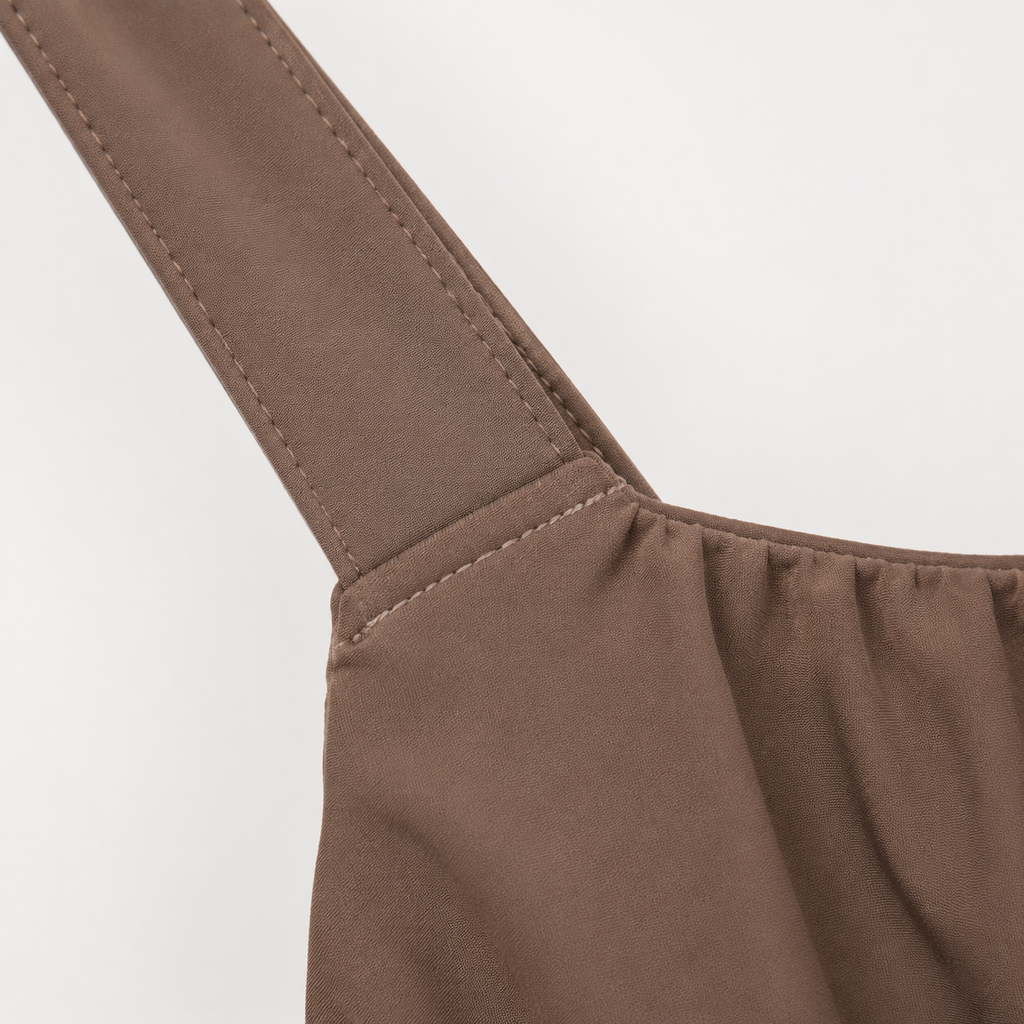
The one shoulder dress is structurally unique because all gravitational load transfers through a single strap and one side seam, creating asymmetric stress that a standard two-strap dress never experiences. The consequence is that the shoulder strap attachment is the highest-risk seam in the garment. Specify a bar tack of at least 12 stitches per 25 mm at the strap junction, reinforced with a fusible interlining, and require a seam strength of 120 N minimum per ASTM D1683 on that joint. The side seam — which carries the entire hem weight on one side — needs a French seam or flat-felled seam with a minimum of 8 stitches per 25 mm, not a plain overlock. Specify the stitch type (e.g., 301 lockstitch or 504 overedge) in the tech pack, because stitch type determines both strength and stretch. If the dress includes a boned bodice or corset-style top, specify the boning channel construction to prevent the bone from piercing the outer fabric.
Standards and Certifications to Demand
OEKO-TEX Standard 100 is the baseline for any one shoulder mini dress sold in the EU or US; it restricts harmful substances across four product classes, and your dress should meet Class II (direct skin contact). Demand the certificate number, not a vague claim, and verify it on the OEKO-TEX database. For colorfastness and physical performance, specify AATCC Test Method 16.3 for lightfastness (a minimum of 4.0 on the grey scale after 20 AFU) and AATCC 61 for colorfastness to laundering. If you sell into the US, ASTM D3786 for bursting strength and ASTM D4964 for stretch recovery matter more than the fabric’s fiber content alone. The consequence of skipping these is simple: you cannot compare quotes from different factories because each tests differently. A factory that cannot name the standard and the test method it runs is not equipped to meet your spec.
MOQ, Lead Time, and Small Batch Production
For a one shoulder mini dress in woven satin or tulle, expect MOQs of 200–300 pieces per colorway from a mid-size China factory; a factory that offers below 100 pieces is either a sample house or will inflate unit cost by 40–60%. Lead time runs 45–60 days from tech pack approval, with fabric dyeing adding 15–20 days of that. Small batch production (100–200 pieces) is viable only if you accept a higher unit price and a longer lead time, because the factory must re-set cutting and sewing lines for your order. The trade-off is real: small batches let you test a silhouette without committing to 300 units, but they do not let you test the market at a competitive price point. If your forecast is under 100 units, the OEM route is likely the wrong one — see the conditions later in this article.
Cost Factors That Move Your Quote
Fabric is the dominant cost driver, typically 40–50% of the ex-works price for a one shoulder mini dress; a satin with a high thread count or a tulle with a specific stiffness will push that higher. Labor runs 25–35%, and the one shoulder silhouette inflates this because the asymmetric construction requires more hand-finishing at the armhole and waist seam. Trims — zippers, boning, shoulder pads — account for 10–15%, and finishing (pressing, inspection, packaging) the remaining 10–15%. The ranking matters because it tells you where to negotiate: a 5% reduction in fabric cost moves your quote more than a 5% reduction in labor. If a factory quotes labor above 40%, question the construction method; if fabric is below 35%, question the fiber quality or the yield. Ask for a cost breakdown by these four categories in your RFQ — a factory that cannot provide one is hiding margin.
Quality Control: AQL, Grading, and Inspection
Set your acceptance quality limit at 2.5 for major defects and 4.0 for minor defects under ISO 2859-1, the statistically valid sampling standard for womenswear. On a 500-piece run, that translates to pulling 50 units and rejecting the lot if more than 5 show major flaws. For this silhouette, define major defects explicitly: a shoulder strap seam that twists at the attachment point, a zipper that gaps when closed, or a hem that pulls at the side seam. Grading is a separate operation — it sorts finished pieces into firsts, seconds, and thirds — and your contract should state that only firsts ship. Require a pre-shipment inspection report with photographs of each defect type found, and reserve the right to bring in a third-party inspector (SGS, Bureau Veritas) at your expense. 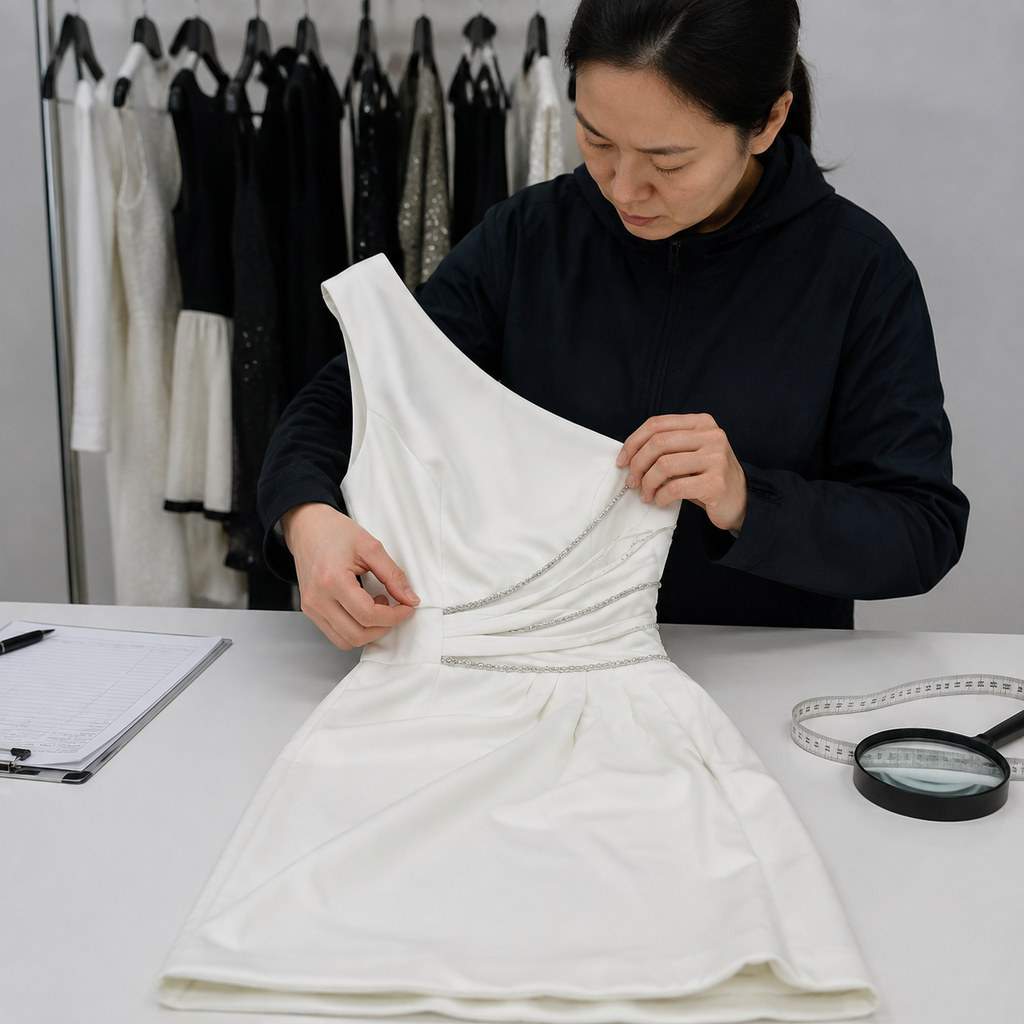 A factory that agrees to third-party inspection without resistance is signalling confidence in its own quality system.
A Typical Sourcing Scenario
A typical scenario runs like this. A brand founder has a sketch and a mood board, but no tech pack, and wants 300 units of a satin one shoulder mini dress in two colorways. The first RFQ goes to three manufacturers; two respond with quotes that vary by 40 percent, and the third asks for a tech pack before quoting. The brand pauses, builds the tech pack with the construction specs from earlier sections — 25 mm seam allowance on the shoulder attachment, 3 mm stretch recovery on the bodice fabric — and resends. The quotes now cluster within 12 percent of each other, and the lowest is from a factory that flagged a fabric substitution that would cut cost by 18 percent but fail the required seam slippage test. The brand rejects the substitution, accepts a slightly higher quote, and orders a pre-production sample before committing to the full run. The sample passes AQL 2.5 inspection at the factory, ships under the agreed Incoterms, and the brand reorders at 600 units after the first sell-through. The lesson is consistent: the RFQ quality, not the factory list, determines the outcome.
When a One Shoulder Mini Dress OEM Is the Wrong Choice
This sourcing route fails under specific conditions. If your volume is below 100 units per style, the per-unit cost of pattern grading, sample development, and factory setup will exceed what a local cut-and-sew shop charges for a single run. If your design requires extreme stretch — a bodycon one shoulder dress with more than 40 percent elongation — a standard woven or satin factory lacks the equipment and expertise; you need a dedicated knitwear or activewear manufacturer. If your launch timeline is under six weeks from concept to delivery, the sample iteration cycle alone will consume it. And if you cannot commit to a tech pack with measurable specs, you are paying OEM rates for a manufacturer to do your design work — which is ODM pricing, and you should source it as such.
Frequently Asked Questions
What is the typical MOQ for a one shoulder mini dress?
For a woven satin or tulle style, 200–300 units per colorway is the common floor at Chinese OEM factories. Some small batch specialists accept 100 units, but expect a 20–30 percent higher unit cost to cover setup and grading.
How long does sampling take?
A first sample typically takes 10–15 days, and a revised sample another 7–10 days. Budget for two rounds minimum, so plan 3–4 weeks from tech pack approval to production-ready sample.
Can I use my own fabric supplier?
Yes, but specify this in the RFQ. The factory will quote a "cut-make-trim" price, and you bear the fabric cost and delivery risk. Verify the factory’s cutting yield — typically 85–90 percent for a one shoulder mini — before committing.
What if my design has no tech pack?
Ask for ODM services instead. The factory will develop the pattern and specs from your reference images, and you pay a development fee. The result is a factory-owned design, which limits your ability to move to another manufacturer later.
How do I verify the factory’s quality claims?
Request a pre-production sample and a third-party inspection per ISO 2859-1 at AQL 2.5 for major defects. Do not rely on the factory’s own QC report.
RFQ Checklist
Send the manufacturer a single document packet containing:
Tech pack
- Flat sketches with front/back views and measurement points
- Graded size spec table (bust, waist, hip, length) with tolerances
- Construction details: seam types, stitch density (stitches per inch), hem allowance
- One shoulder strap attachment method and reinforcement spec
Bill of materials
- Fabric: fiber content, weight (gsm), width, color reference, stretch recovery if knit
- Trims: zipper length and type, thread, lining, labels
- Approved supplier names for each component
Quality spec
- AQL level (2.5 major / 4.0 minor) per ISO 2859-1
- Inspection points: seam slippage, colorfastness, dimensional stability after wash
- Required certifications: OEKO-TEX Standard 100, or specific ASTM/AATCC test methods
Commercial terms
- Target MOQ per colorway and total order quantity
- Required lead time from sample approval to delivery
- Incoterms (FOB, EXW, DDP) and delivery port
- Payment terms (typically 30% deposit, 70% before shipment)


Comments