
The first question you ask a supplier is not about fabric or stitching. It is the minimum order quantity. That single number determines whether you can test a design without betting the season, whether you can reorder a bestseller within three weeks, and whether you can hold a factory to AQL 2.5 on a 200-piece run. A wholesale factory quoting 1,000 pieces per style will push you into dead stock or force you to compromise on fabric. A small batch manufacturer quoting 50 pieces per style gives you room to iterate, but you pay for that flexibility in unit cost and lead time. The MOQ is the constraint that shapes everything else, so start there.
The MOQ Threshold That Changes Your Supplier Relationship
Once you cross a factory’s minimum order quantity, your leverage shifts. Below it, you are a sample client. Above it, you are a production client. That distinction matters because a production client gets priority on the sewing line, access to the factory’s fabric suppliers, and a contract that specifies defect rates and delivery dates. A sample client gets a tech pack review and a quote that assumes you will not return. Most mid-size China factories set their MOQ between 300 and 1,000 pieces per style per colorway. A small batch manufacturer typically operates at 50 to 200 pieces per style. The difference is not just the number. It is the entire commercial relationship.
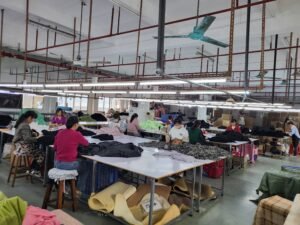
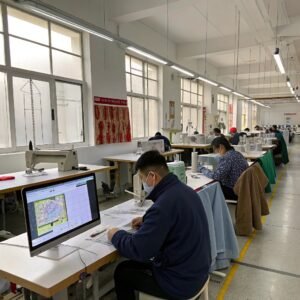
A factory running 300-piece minimums has a cutting table optimized for marker efficiency at that volume, a sewing line balanced for 30 operators, and a quality control team that inspects in batches of 50. A small batch factory running 50-piece minimums has a smaller cutting table, a flexible sewing team that can switch styles mid-shift, and a QC process that inspects every piece individually. The cost structure of each is fundamentally different, and that cost structure is what determines your unit price.
Why Low MOQ Clothing Manufacturers Charge More Per Unit
A factory’s cost per unit is a function of fixed costs divided by volume. The cutting marker, the pattern grading, the sample development, and the machine setup are all fixed costs. If you spread those costs across 1,000 pieces, the per-unit overhead is negligible. If you spread them across 50 pieces, the overhead is significant. A small batch manufacturer does not have lower fixed costs. They have the same pattern software, the same cutting equipment, and the same sewing machines. What they have is a willingness to absorb those costs at lower volume, which means they charge a higher unit price to compensate. The question is whether that higher unit price is worth it. If you are launching a new style and you do not know if it will sell, paying 30% more per unit on a 50-piece run is cheaper than paying 30% less per unit on a 1,000-piece run and selling 500 of them at a loss. The math depends on your sell-through rate, not on the unit cost alone.
How MOQ Affects Your Reorder Lead Time
A small batch manufacturer can usually turn around a reorder in 15 to 25 days because they keep your patterns on file and they do not need to re-cut the marker or re-grade the sizes. A wholesale factory running 1,000-piece minimums may take 45 to 60 days for a reorder because they need to schedule your production around larger clients, source fabric in bulk, and run a full production line. If you are selling a product that moves quickly and you need to reorder within a month, a low MOQ supplier is not a luxury. It is a requirement. If you are selling a product that moves slowly and you can afford to order a season’s worth of inventory upfront, a wholesale factory’s lead time is acceptable. The reorder cycle should dictate your supplier choice, not the other way around.
The Quality Control Difference Between Small Batch and Wholesale
A small batch manufacturer inspects every garment because they cannot afford to ship defects on a 50-piece order. One defect is 2% of your order. A wholesale factory inspects in batches because they are running 1,000-piece orders, and a 2% defect rate is 20 pieces, which is within their acceptable tolerance. The AQL standard, which is the international quality control framework, allows 2.5% major defects in a batch. A small batch manufacturer will often exceed that standard because their business model depends on repeat orders from clients who cannot absorb returns. A wholesale factory will often meet that standard and no more, because their clients are large enough to absorb some returns. If you are building a brand where quality is the differentiator, a small batch manufacturer gives you tighter quality control. If you are building a brand where price is the differentiator, a wholesale factory gives you lower unit cost.
When to Switch From Small Batch to Wholesale
The transition point is not a number. It is a decision based on demand certainty and cash flow. If you have a style that sells through at 80% within 30 days, you should move it to a wholesale factory and order 1,000 pieces. The lower unit cost will improve your margin, and the demand certainty justifies the inventory risk. If you have a style that sells through at 40% in 30 days, keep it at a small batch manufacturer and reorder in 100-piece increments. The higher unit cost is offset by the lower inventory risk. The mistake is to switch suppliers based on volume alone. A style that sells 1,000 pieces over six months is not a candidate for a wholesale factory if the demand is unpredictable. You will end up with 500 pieces of dead stock and a cash flow problem. The decision to switch should be based on sell-through rate, not on total volume.
How to Evaluate a Small Batch Manufacturer’s Capacity
A factory that quotes 50-piece minimums should still have the capacity to scale to 500 pieces if your demand increases. Ask them what their maximum production capacity is per month. Ask them how many sewing operators they have. Ask them what their average lead time is for a 200-piece order versus a 50-piece order. If they cannot scale, you will need to switch suppliers when your volume increases, and that means new pattern development, new sample approval, and new quality control standards. A good small batch manufacturer has a production floor that can handle 500 to 1,000 pieces per month, even if their minimum is 50. That gives you room to grow without changing suppliers.
The Fabric Sourcing Advantage of Wholesale Factories
A wholesale factory sourcing 1,000 yards of fabric gets a better price than a small batch manufacturer sourcing 100 yards. That price difference is passed on to you in the unit cost. If your design uses a standard fabric that is available from multiple mills, the price difference may be 10 to 15%. If your design uses a custom fabric that requires a specific mill, the price difference may be 30 to 40% because the mill’s minimum order quantity for that fabric may be 500 yards, and the small batch manufacturer cannot meet it. In that case, the small batch manufacturer will either source a similar fabric or charge you a premium to meet the mill’s minimum. If fabric sourcing is critical to your product, a wholesale factory may be the better choice even if the MOQ is higher.
The Pattern Development Cost in Small Batch Production
Every new style requires pattern development, sample making, and grading. A small batch manufacturer will charge you for these services because they cannot amortize the cost across a large production run. A wholesale factory may include these services in the unit price if your order volume is high enough. The pattern development cost for a simple t-shirt is $50 to $100. For a complex jacket with multiple panels and lining, it is $200 to $500. If you are developing 10 styles, the pattern development cost can add $1,000 to $5,000 to your total cost. A small batch manufacturer will itemize this cost. A wholesale factory will bury it in the unit price. Ask for an itemized quote so you can compare the true cost.
The Risk of Minimum Order Quantity Creep
Some factories quote a low MOQ to win your business and then increase it on the second order. This is common with factories that are desperate for cash flow and will accept any order to keep the line running. Once they have your patterns and your business, they will push for higher volume on the next order. Protect yourself by signing a production agreement that specifies the MOQ for at least three orders. If the factory refuses, find another supplier. A factory that changes its MOQ mid-relationship is a factory that will also change its quality standards and lead times.
How to Use a Small Batch Manufacturer to Test a Wholesale Factory
If you are considering a wholesale factory but you are not sure about their quality, run a 100-piece test order with a small batch manufacturer first. Develop the pattern, approve the sample, and produce 100 pieces. Then take that approved sample to the wholesale factory and ask them to match it. If they can match the quality at a lower unit cost, switch. If they cannot, you have a fallback supplier. This strategy costs more upfront because you are paying for pattern development twice, but it reduces the risk of a 1,000-piece order that does not meet your quality standards.
The Decision Framework for Choosing a Supplier
Start with your sell-through rate. If you do not know it, start with a small batch manufacturer and test. Once you have data, calculate your break-even point. If your break-even point is below 300 pieces per style per month, stay with a small batch manufacturer. If it is above 500 pieces per style per month, move to a wholesale factory. If it is between 300 and 500, evaluate based on lead time, quality control, and fabric sourcing. Do not let the factory’s MOQ dictate your business model. Let your demand data dictate your supplier choice.
The MOQ is a constraint, but it is not the only constraint, and it should not be the first one you optimize for. Optimize for cash flow, quality, and speed to market. The MOQ will follow.
The Hidden Costs of Low MOQ Manufacturing
A low MOQ is not free. You pay for it in higher unit costs, limited fabric options, and sometimes in quality consistency. A factory running 50-piece orders is switching styles frequently, which means their sewing operators are less specialized and may produce inconsistent stitching. A factory running 1,000-piece orders has operators who sew the same seam for days, which produces consistent quality. If you are selling a premium product where stitching consistency matters, a small batch manufacturer may not be the right choice. If you are selling a product where the design and fabric matter more than the stitching, a small batch manufacturer is fine. Know what you are paying for.
How to Negotiate MOQ With a Wholesale Factory
If you want to work with a wholesale factory but their MOQ is too high, negotiate a trial order. Offer to pay a higher unit price for a 300-piece order instead of 1,000. The factory may accept because they want to build a relationship. If they refuse, ask if they will produce a smaller order if you pay for the fabric minimum yourself. Some factories will agree to this because it removes their inventory risk. If they still refuse, move on. A factory that is inflexible on MOQ at the beginning of a relationship will be inflexible on quality and delivery later.
The Bottom Line on MOQ and Supplier Choice
The minimum order quantity is the starting point of every conversation with a clothing manufacturer. It determines your unit cost, your lead time, your quality control standards, and your fabric options. A small batch manufacturer gives you flexibility and lower risk but at a higher unit cost. A wholesale factory gives you lower unit cost and better fabric sourcing but at higher volume and higher risk. The right choice depends on your sell-through rate, your cash flow, and your quality requirements. Do not choose a supplier based on their MOQ alone. Choose based on what the MOQ enables you to do. If a 50-piece MOQ lets you test a style and reorder within three weeks, it is worth the higher unit cost. If a 1,000-piece MOQ lets you achieve a 40% margin and you have the demand to support it, it is worth the inventory risk. The MOQ is a tool. Use it to build your business, not to limit it.
What to send us
If the specifications above match what you are sourcing, send your tech pack to Orange Sea Clothing. If the pack is not written yet, sketches and a reference sample are enough to start — sample development covers the design review, fabric and trim sourcing, pattern making and the first prototype, so you see fit and construction before you commit to a production run.

Comments