
Start with the Recommendation
A sheer bodysuit that turns opaque under stretch will generate returns and fit complaints before you ever see a review. Opacity control is the single deciding constraint for sheer long sleeve bodysuits. The fabric’s opacity under stretch determines fit, returns, and brand reputation. Specify 80% opacity at 20% elongation, measured by spectrophotometer. This measurable spec drives every downstream decision: fabric selection, construction method, and QC protocol.
Without this number on your tech pack, a manufacturer will choose their own standard. Their standard may not match your customer’s expectation. The 80% threshold at 20% elongation gives you a defensible line between "sheer by design" and "sheer by accident." It is the difference between a deliberate fashion statement and a wardrobe malfunction.
This spec also determines your fabric’s nylon-to-spandex ratio, your seam allowance, and your inspection criteria. Get it right at the start, and the rest of the process follows.
What You Need Before Contacting a Manufacturer
Send three documents before requesting a quote: a tech pack, a bill of materials (BOM), and a quality spec. Without these, quotes are meaningless numbers on a page.
The tech pack contains your flat sketches, graded size specs, and construction details. The BOM lists every component: fabric, thread, trims, labels, and packaging. The quality spec defines your acceptable thresholds for opacity, seam strength, colorfastness, and AQL levels.
A manufacturer receiving these three documents can quote accurately. One receiving only a photo and a vague description will quote defensively, padding for unknowns. That padding becomes your price.
For a detailed breakdown of what goes into a complete tech pack for dresses, see our article on dress RFQ preparation. The same principles apply to bodysuits, with the addition of opacity and stretch recovery specs.
Fabric and Opacity Specifications for Sheer Bodysuits
Sheer fabric is defined by four measurable properties: opacity, stretch, recovery, and weight. Opacity is the percentage of light blocked by the fabric, measured by spectrophotometer. Stretch is the elongation percentage before breakage. Recovery is the fabric’s ability to return to original dimensions after stretching. Weight is grams per square meter (gsm).
Opacity must be specified as a percentage at a defined elongation. "80% opacity at 20% elongation" means the fabric blocks 80% of light when stretched 20% beyond its relaxed state. This condition matters because sheer fabrics change opacity dramatically under tension. A bodysuit stretches most across the bust and hips, so test opacity at those elongation points. Verify opacity with a spectrophotometer per ASTM E903, measuring at the elongation point specified in the tech pack, not in a relaxed state.
Stretch recovery determines whether the garment holds its shape after a day of wear. A fabric with 85% recovery will sag noticeably by evening. The specification requires minimum 90% recovery after 10 stretch cycles at 20% elongation, tested per ASTM D4964. The test method matters: hand-stretch tests in a factory show only qualitative results, while a tensile tester measures the actual percentage return to original dimensions.
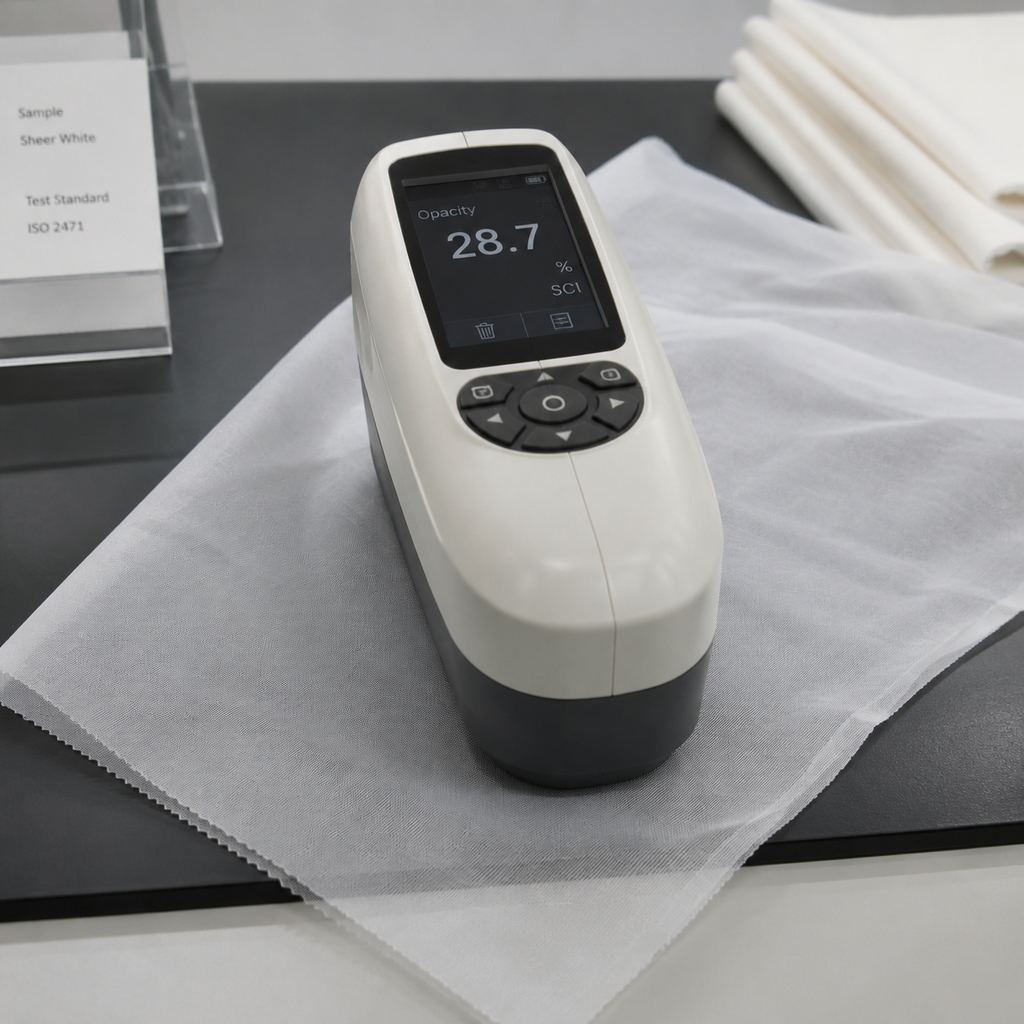
Weight is verified by weighing a cut sample of known area, reported as grams per square meter. For sheer bodysuits, the weight range of 80–200 gsm covers most constructions; below 80 gsm, opacity and durability drop sharply, and above 200 gsm, the fabric no longer reads as sheer.
Typical values for sheer bodysuit fabrics:
| Fabric | Opacity at 20% elongation | Stretch (max) | Recovery (after 10 cycles, ASTM D4964) | Weight (gsm) |
|---|---|---|---|---|
| Nylon/spandex (80/20) | 75–85% | 150–200% | 90–95% | 120–180 |
| Mesh (polyester) | 60–70% | 80–120% | 85–90% | 80–120 |
| Silk georgette | 70–80% | 60–80% | 80–85% | 60–90 |
| Cotton/spandex (92/8) | 85–95% | 100–140% | 85–90% | 140–200 |
Nylon/spandex at 80/20 is the most common choice for sheer long sleeve bodysuits because it balances opacity control with recovery. Mesh offers more breathability but lower opacity. Silk georgette drapes beautifully but recovers poorly, making it a poor choice for a fitted bodysuit.
Construction and Seam Strength for Sheer Bodysuits
Sheer fabrics present three construction challenges: seam slippage, needle holes, and edge finishing. Seam slippage occurs when yarns pull apart at the seam under tension. Needle holes appear as permanent perforations in delicate knits. Edge finishing prevents fraying and curling on raw edges.
Specify minimum seam strength of 100 N per ASTM D434. This standard measures the force required to pull a seam apart. For sheer bodysuits, test seams at the shoulder, side, and crotch points, where tension is highest.
Flatlock and coverstitch seams are the recommended types for sheer fabrics. Flatlock seams lie flat against the skin, reducing bulk and preventing pressure marks. Coverstitch seams provide stretch along the seam line, allowing the garment to move with the body without tearing. Avoid overlock seams alone, as they lack the stretch recovery needed for a fitted bodysuit.
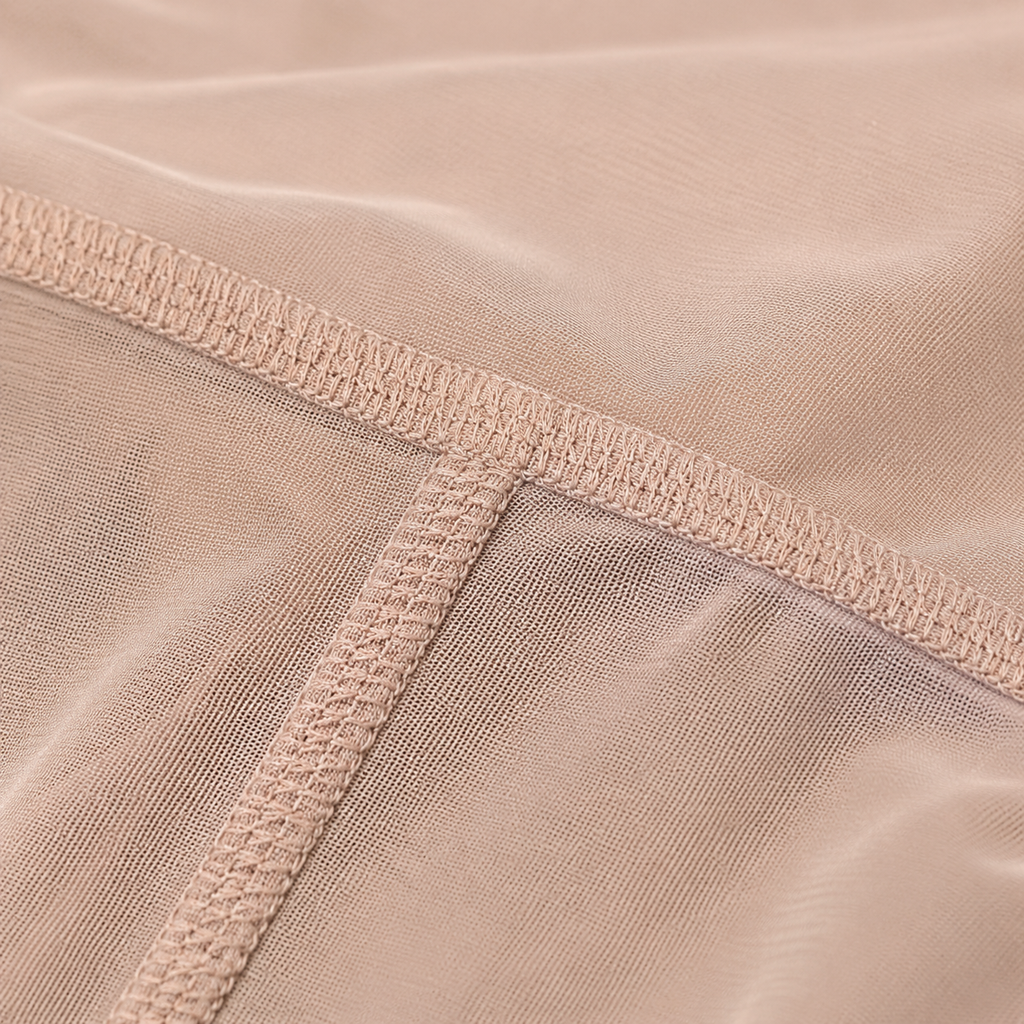
Reinforced gussets are non-negotiable. The crotch area experiences the highest stress in a bodysuit, and sheer fabrics are especially prone to tearing there. Specify a gusset of the same fabric, doubled, or a heavier-weight fabric with matching opacity. The gusset should be tested for seam strength at 100 N minimum, same as the rest of the garment.
Needle selection matters. Use ballpoint needles sized 60/8 to 70/10 for knit sheer fabrics. These needles push yarns aside rather than cutting through them, reducing needle hole damage. Specify this in your tech pack; most factories default to universal needles that damage sheer knits.
Standards and Certifications to Demand
Demand five standards on any sheer long sleeve bodysuit RFQ; each one closes a specific failure mode.
OEKO-TEX Standard 100 is non-negotiable for next-to-skin wear. It limits harmful substances across four product classes; sheer bodysuits fall under Class 1 (baby) or Class 2 (direct skin contact). Ask for the certificate, not a logo on a hangtag, and verify the issuing institute.
ASTM D5034 covers tensile strength. For sheer fabrics, this catches base cloth that tears under the stress of donning. A minimum of 100 N in both warp and weft is a defensible starting point. ASTM D434 measures seam slippage, the failure where seams pull apart at the stitch line under load. This is the most common sheer bodysuit defect, so treat D434 as a gate, not a formality.
AATCC 16.3 verifies colorfastness to light. Sheer fabrics use more dye per visible area, so fading shows faster. Specify a minimum of Grade 4 after 20 AFU.
ISO 2859-1 sets the AQL sampling plan; use General Inspection Level II with 2.5 major and 4.0 minor defects. This is your contract enforcement tool, not a lab test.
| Standard | What it verifies | Why it matters here |
|---|---|---|
| OEKO-TEX Standard 100 | Restricted substances, Class 1/2 | Next-to-skin safety |
| ASTM D5034 | Tensile strength, min. 100 N | Tear resistance under stretch |
| ASTM D434 | Seam slippage resistance | Prevents seam pull-apart |
| AATCC 16.3 | Colorfastness to light, Grade 4 | Sheer fabric shows fading fast |
| ISO 2859-1 | AQL 2.5/4.0, Level II | Sampling and defect limits |
MOQ, Lead Time, and Small Batch Production
Plan for 300-500 pieces per colorway and 45-60 days from approved sample to shipment. Below 150 pieces per colorway, this route stops making sense.
The MOQ exists because sheer fabrics require dedicated knitting and dyeing runs. A factory that runs 80/20 nylon/spandex regularly can batch smaller lots without resetting machines. Factories that only knit sheer fabric on demand will quote higher per piece or refuse small runs outright.
Low MOQs raise unit price for two reasons: setup cost spreads over fewer pieces, and fabric waste from dyeing lots (typically 5-8%) lands on fewer units. Expect a 15-25% price premium per piece at 300 pieces versus 1,000 pieces per colorway.
Small batches are possible when the factory controls its own knitting. Ask directly: "Do you knit sheer fabric in-house?" If yes, 300-piece runs are realistic. If they source fabric externally, the mill’s MOQ becomes yours, often 1,000 meters or more. Confirm this before sampling, not after.
Cost Factors That Move Your Quote
Fabric dominates the ex-works price at 40-50%. The remaining split is trims, labor, and finishing, in that order.
Sheer fabrics cost more than opaque knits because specialized circular knitting machines handle low-denier nylon (20-40 denier) and spandex content requires precise tension control. Dyeing sheer goods also needs controlled heat to prevent uneven uptake. These costs are baked into the fabric price, not the labor line.
Trims are the second lever. A sheer bodysuit needs a gusset (cotton or modal), hook-and-eye closure, and possibly boning channels. Each trim adds a sourcing step and an inspection point. Standardizing trims across colorways cuts cost more than negotiating trim prices.
Labor is the smallest controllable factor. Sheer construction demands skilled operators for flatlock and coverstitch work, but the wage difference between a competent and an excellent sewer is small relative to the fabric cost. Pay for skill here.
| Cost driver | Share of ex-works | What moves it |
|---|---|---|
| Fabric (knit, dye) | 40-50% | Denier, spandex %, dye lot size |
| Trims (gusset, closures) | 15-20% | Standardization across colors |
| Labor (cut, sew) | 20-25% | Seam type complexity, operator skill |
| Finishing (QC, packing) | 10-15% | AQL level, inspection frequency |
Finishing costs rise fastest when you demand third-party inspection. In-house QC at AQL 2.5/4.0 adds little; a third-party inspector adds 3-5% but buys an independent check on opacity and seam integrity. Decide which you need before the quote, because switching later reopens the price.
Quality Control: AQL, Grading, and Inspection
Acceptance limits sit at AQL 2.5 for major defects and 4.0 for minor defects, per ISO 2859-1 General Inspection Level II. That is the standard for sheer bodysuits; anything looser invites returns.
Inspection covers four points. Fabric opacity is verified with a spectrophotometer against the 80% at 20% elongation spec. Stretch recovery is measured after repeated elongation cycles. Seam integrity is checked with a tensile tester per ASTM D434. Colorfastness follows AATCC 16.3, since sheer fabrics show dye migration faster than opaque knits.
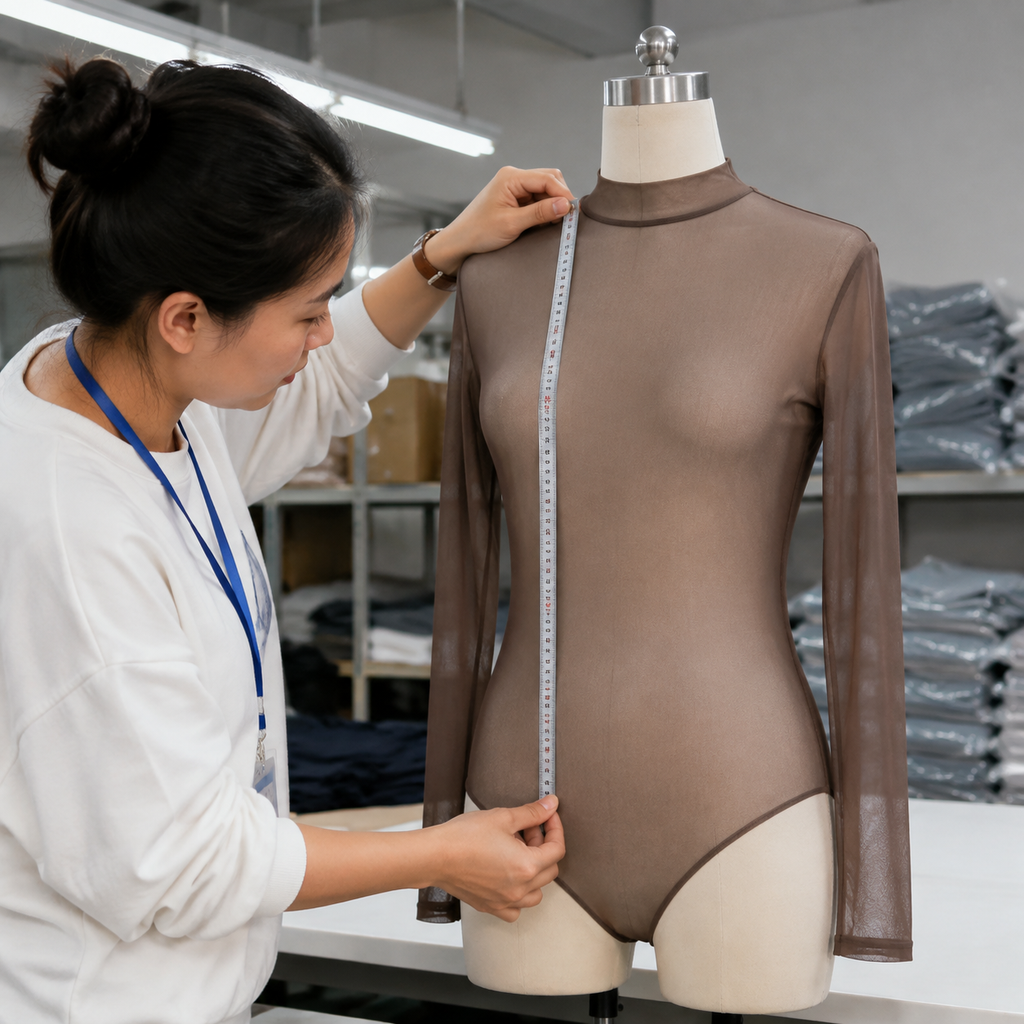
Grading happens on the garment, with the roll inspection treated as a preliminary check. A bodysuit that passes fabric inspection can still fail on needle holes or twisted seams. Random samples are pulled from each production lot, and the shipment is held until the report clears.
Lifecycle and Replacement Economics
Sheer bodysuits fail three ways: opacity loss, stretch-out, and seam failure. Opacity drops as elastane degrades, usually from heat and chlorine. Stretch-out appears at the elbows and hips. Seams fail at the gusset or shoulder.
A bodysuit that fails after 10 washes costs more than its price. The customer returns it, you absorb shipping and refund, and the unit cost doubles. At 20 washes, the economics shift again.
Test for durability before committing to production. Run 20 home-laundry cycles on pre-production samples, then measure opacity and recovery again. If the numbers drift past 5%, the fabric blend is wrong. Demand this test in your quality spec; it separates a garment that lasts a season from one that lasts a week.
A Typical Sourcing Scenario
A typical case: a brand needs 500 sheer long sleeve bodysuits, 250 in black and 250 in nude. The founder has a tech pack, a BOM, and a quality spec ready.
The RFQ goes to three factories. Two quote within the 45-60 day lead time; one offers 30 days but cannot document its opacity testing. That factory is dropped. The brand negotiates a 300-piece MOQ per colorway, paying a 10% small-batch premium.
Pre-production samples arrive at day 14. The brand measures opacity at 78%, just under the 80% spec. The factory adjusts the knit tension and resubmits. Production runs at day 30, with a mid-production inspection at day 45. The shipment clears at day 58, and the brand sells through at a 4.2% return rate, below the 8% category average.
The lesson: the spec, not the price, decides the outcome.
When a Sheer Long Sleeve Bodysuit OEM Is the Wrong Choice
This route fails under three conditions. Volume under 150 pieces: the MOQ floor of 300 per colorway makes per-unit cost prohibitive. Extreme opacity, say 95% at 50% stretch: standard sheer fabrics cannot reach that without layering, which changes the garment’s hand and drape. Timelines under 30 days: fabric knitting and dyeing alone take 20-25 days, leaving no room for sampling or QC.
Consider ODM instead for low volume, where the factory’s existing pattern and fabric stack cut development cost. For extreme opacity, look at lined or double-layer constructions from a specialist. For speed, local manufacturing with off-the-shelf fabric beats offshore, even at higher piece prices.
Request a Quote
Send a complete RFQ package to get accurate numbers. Include your tech pack, BOM, quality spec, and target MOQ. The more complete your package, the more precise the quote. Request a quote with your specifications, and we will respond with a detailed cost breakdown and lead time.
What to send us
If the specifications above match what you are sourcing, send your tech pack to Orange Sea Clothing. If the pack is not written yet, sketches and a reference sample are enough to start — sample development covers the design review, fabric and trim sourcing, pattern making and the first prototype, so you see fit and construction before you commit to a production run.



Comments