
Start with the Recommendation
A feather dress that sheds after three wears fails your customer, and the return lands on your margin, not the factory’s. Source from a China-based manufacturer that runs feather-specific quality control and offers MOQ flexibility, because feathers shed, crush, and fade differently than standard garment materials. The supplier must test attachment strength and feather integrity under conditions that match real wear, not just seam quality on a flat bench.
Define these specs upfront: feather type and length, density per square meter (typically 800 to 1,200 feathers per m² for full coverage), attachment method (glued, stitched, or both), and backing fabric weight in grams per square meter. Expect MOQs of 100 to 300 pieces per color and lead times of 45 to 60 days from tech pack approval. A manufacturer with dedicated feather production lines will quote tighter tolerances on attachment pull strength and feather retention than a generalist will.
Verify their QC process includes AQL 2.5 for major defects and 4.0 for minor ones, with feather attachment tested by a 500-gram pull test on production lots, before you commit.
What You Need Before Contacting a Manufacturer
Three documents matter before you request a quote: a tech pack, a bill of materials (BOM), and a quality specification. Feather dresses demand more detail in each than standard womenswear.
Tech pack. Include flat sketches with feather placement zones, direction of lay, and coverage areas. Mark where feathers stop at seams, necklines, and hems. A vague sketch invites interpretation, and interpretation becomes cost overruns.
BOM. List every component: feather type, length, and grade; backing fabric; lining; thread; and adhesive if used. Feathers are priced by grade and length, so an incomplete BOM produces a quote that cannot be compared across suppliers.
Quality spec. Define acceptable shedding rates, color consistency between feather lots, and attachment strength. State the test methods you expect the factory to run. Without this document, the factory’s QC standard becomes your risk.
Send all three together. A manufacturer that asks clarifying questions on your spec is usually more reliable than one that quotes immediately.
Feather and Fabric Specifications: What to Define
Feather dresses require four measurable specifications: feather type, length, density, and attachment method. Each affects cost, durability, and appearance.
Feather type. Marabou, ostrich, rooster, and goose feathers behave differently. Marabou is soft and fluffy but crushes easily. Ostrich has a defined quill and holds shape longer. Rooster feathers are stiff and structured. The specification should name the type explicitly, since visual references alone leave room for substitution during sourcing.
Length. Measured in millimeters, feathers range from 30 mm for short, dense coverage to 150 mm for dramatic movement. Length drives both cost and shedding rate. A 100 mm feather will shed noticeably more than a 60 mm feather over the same wear cycle.
Density. State feathers per square meter or grams per square meter. This is the number most buyers omit, and it is the one that separates a $40 dress from a $120 dress. Density also determines whether the base fabric shows through during movement.
Attachment method. Gluing, stitching, or channeling. Specify which, and define the seam strength required. Stitched attachment typically holds 2–3 times longer than glued under repeated wear.
| Feather Grade | Length | Density (feathers/m²) | Typical Use | Cost Index |
|---|---|---|---|---|
| A | 100–150 mm | 800–1,200 | Runway, editorial | 1.0 |
| B | 60–100 mm | 1,200–1,800 | Retail, event wear | 0.7 |
| C | 30–60 mm | 1,800–2,500 | Trim, accents, cost-effective | 0.5 |
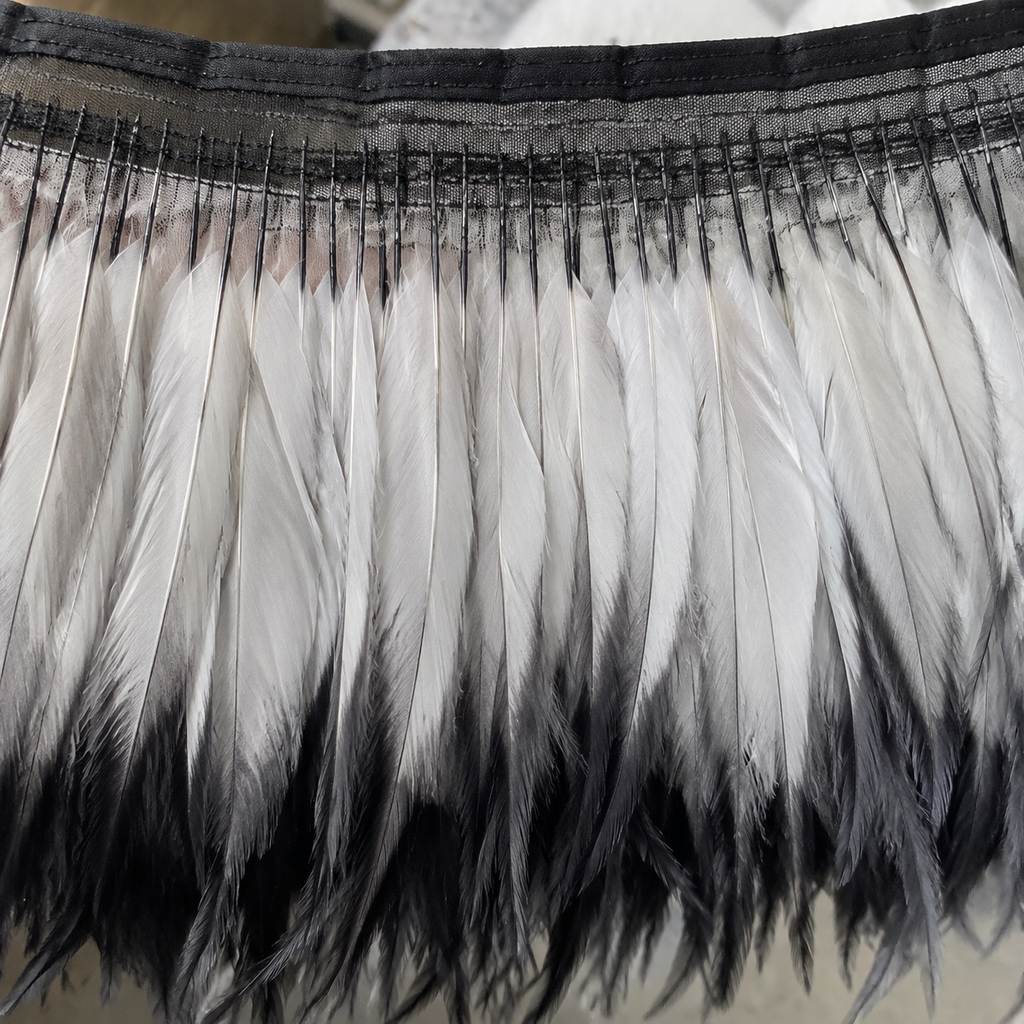
Grade selection should follow the garment’s expected lifecycle. For a one-season party dress, Grade C offers cost savings of roughly 50% against Grade A while still delivering visual fullness at close range. For investment pieces meant to survive multiple wears and dry cleaning cycles, Grade A holds its silhouette longer because longer feathers resist crushing and matting. Grade B suits the middle range: event wear worn two to five times where the buyer wants movement without runway-level cost. Verify the grade on the pre-production sample, since feather lots vary by season and supplier.
Construction and Attachment Methods for Feather Dresses
Three attachment methods dominate feather dress construction. Each has different durability and cost implications.
Gluing. Feathers are bonded to the fabric with a flexible adhesive. Fast and inexpensive, but the bond degrades with dry cleaning and heat. Expect shedding within 10 to 15 wears. Suitable for one-season styles, not investment pieces.
Stitching. Feathers are sewn onto the base fabric, either individually or in pre-made strips. Stronger than gluing, with a typical lifespan of 30 to 50 wears. Labor cost runs 30 to 50 percent higher than gluing. Specify stitch density: 4 to 6 stitches per feather quill, using nylon thread with a minimum breaking strength of 10 N.
Channeling. Feathers are inserted into fabric channels or quilted pockets. This is the most durable method, holding feathers in place for 50-plus wears, but it restricts movement and adds weight. Use for structured silhouettes, not fluid drapes.
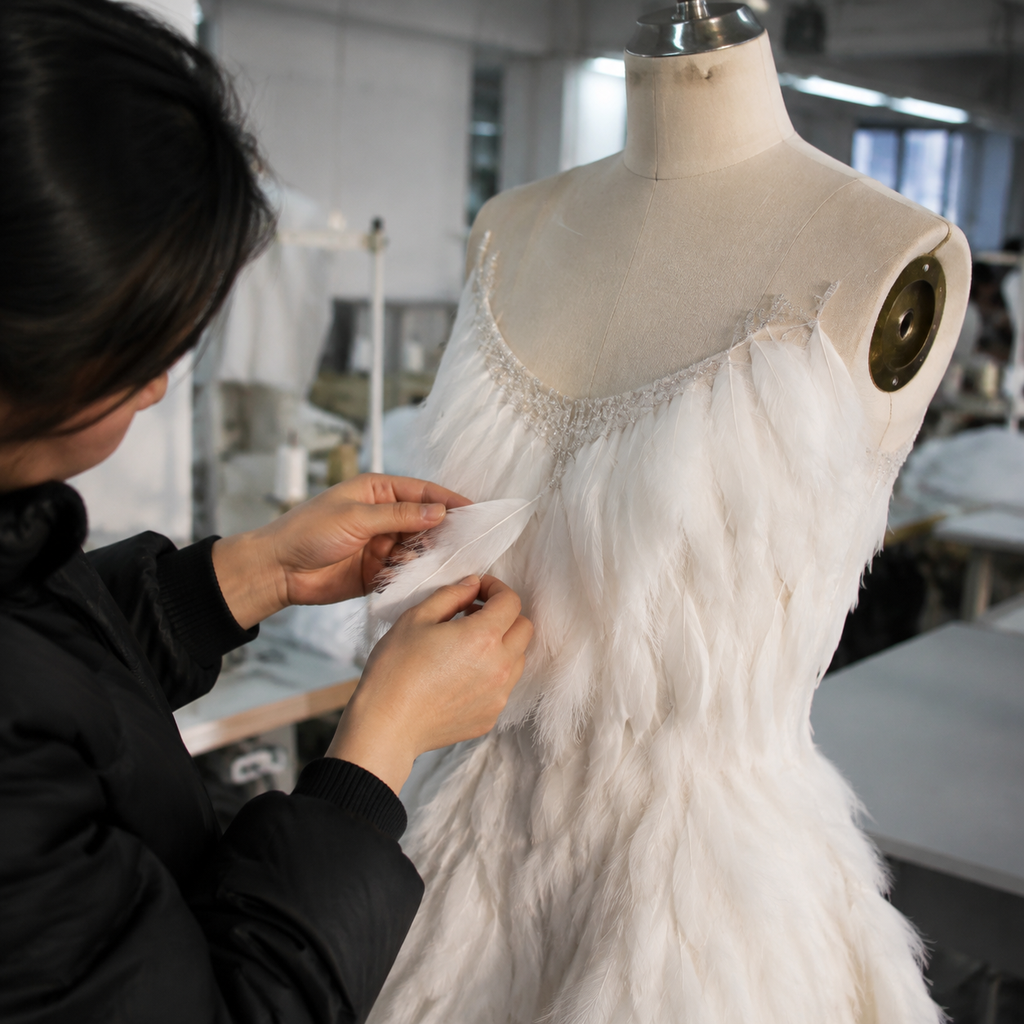
Verify seam strength on production lots as well as on the pre-production sample. Test per ASTM D434 for seam slippage and ASTM D5034 for breaking strength. A feather dress that sheds at the seam after three wears fails your customer, regardless of how the feathers look on day one.
Standards and Certifications to Demand
Feather dresses sit at the intersection of textile and animal-product regulations, so the certification list is shorter than for most garments but non-negotiable. Demand OEKO-TEX Standard 100 for the fabric and trims, which limits harmful substances across all four product classes. For feather attachment strength, specify ASTM D5034 for fabric seam breaking force and ASTM D434 for seam slippage; both give you a number to hold the factory to rather than a vague "secure" claim. Colorfastness to light matters for dyed feathers, so require AATCC 16.3, tested to at least 20 hours for evening wear that will see multiple wears under event lighting. If you sell into the EU, confirm the feathers meet REACH Annex XVII restrictions on chromium VI in leather and textiles, which can appear in some dyed feather lots. Ask for the test report, not a certificate number. A factory that cannot produce a dated report from an accredited lab for each production lot is a red flag.
MOQ, Lead Time, and Small Batch Production
Feather dresses typically carry a minimum of 100 to 300 pieces per color, with 150 being the most common starting point among mid-size China factories. Lead time runs 45 to 60 days from tech pack approval, and that window assumes feather stock is already on hand. If the factory must source a specific feather grade or color, add 10 to 15 days. Small batch production is available, but it changes the economics. Factories that accept 50-piece runs usually charge a 20 to 30 percent premium per unit and may require you to cover feather waste, which runs 10 to 15 percent of material for hand-placed feathers. Ask for the lead time breakdown in writing: feather sourcing, cutting, attachment, and final inspection. A factory that cannot separate those stages cannot give you a reliable date. For seasonal launches, book production slots 90 days out; feather lines run slower than standard garments because attachment is hand labor.
Cost Factors That Move Your Quote
Feather type drives cost more than any other variable, followed by density and attachment method. Ostrich feathers cost three to five times more than turkey or marabou, and the price gap widens with length and dye quality. Density, measured in feathers per square meter, directly scales material cost. Attachment method matters less in materials than in labor hours; hand-stitching runs roughly double the labor of gluing. The table below gives typical ex-works cost ranges for a mid-length dress at 60 to 80 percent feather coverage.
| Cost Driver | Specification | Cost Impact (USD per dress) |
|---|---|---|
| Feather type | Ostrich, 100–150 mm | $45–$80 |
| Feather type | Turkey or marabou, 100–150 mm | $15–$30 |
| Density | 800–1,200 feathers per m² | +$20–$40 over base |
| Density | 1,200–1,600 feathers per m² | +$40–$70 over base |
| Attachment | Glue only | Base labor |
| Attachment | Hand-stitched | +$12–$25 labor |
| Labor | Grading and sorting feathers | $5–$10 |
Get the quote itemized by these lines. A flat per-dress price hides whether you are paying for ostrich or receiving turkey. Confirm the feather grade matches your spec before you approve the sample.
Quality Control: AQL, Grading, and Inspection
The acceptance quality limits from the earlier section apply here, so the focus shifts to what the inspector actually checks. Major defects are detached feathers, exposed adhesive, or broken quills. Minor defects cover uneven density or slight color variation within a panel.
Inspection points differ from standard apparel. Attachment integrity is checked on 100% of high-stress zones: shoulder seams, waistline, and hem. The shedding test is the one that catches most problems. A gloved hand rubbed against the feather direction ten times should release no more than three feathers. Color consistency is verified by comparing adjacent feather batches under D65 daylight, which is the standard illuminant for textile color assessment.
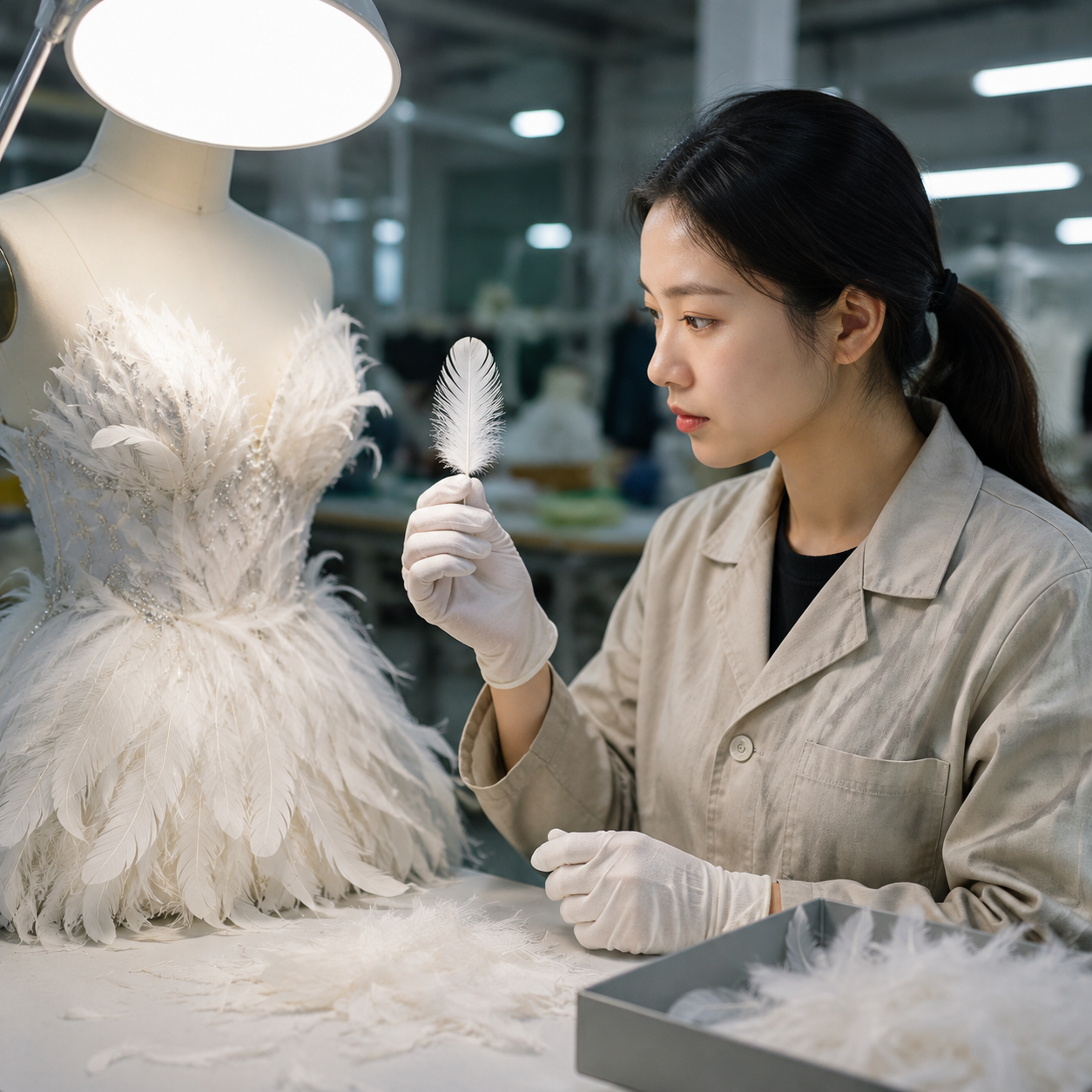
Grading follows your pre-production sample. The inspector needs the approved sample, the tech pack, and the AQL table on site. Without them, grading becomes opinion. With them, it is a pass-fail decision you can enforce.
Lifecycle and Replacement Economics
Feather dresses fail in predictable ways. Shedding appears first, usually at seams and friction points. Crushing follows from storage or sitting; the barbs lose their loft and the silhouette flattens. Color fade shows after 20–30 wears, faster if the garment sees direct sunlight or dry cleaning.
Repairs make sense only for isolated damage. Replacing a shoulder panel of feathers costs roughly 15–20% of the original garment price, assuming the same feather lot is still available. That is the catch. Feather dye lots shift between seasons, so a repair may not match. When the dress is 40% or more of the way through its usable life, replacement beats repair.
Plan for a 15–30 wear lifecycle for event use. Order spare feather yardage at production time if you expect alterations or rentals. It is cheap insurance against an unmatchable repair.
Pitfalls to Avoid
Pitfall 1: Specifying feather type without density. A tech pack that says "ostrich feather" invites a quote based on the cheapest density available. The result is a dress that looks thin and sheds fast.
Avoidance move: state density in grams per meter of trim or feathers per square meter. Tie the density to a visual reference on the approved sample.
Pitfall 2: Ignoring attachment durability. Glue-only attachment fails in transit or after a few wears. Stitching costs more but survives the garment’s lifecycle.
Avoidance move: specify the attachment method per zone. Glue for low-stress areas, stitching or channeling for seams and hems. Require a pull test on the pre-production sample.
Pitfall 3: Accepting a vague MOQ. A manufacturer who says "MOQ around 200" leaves room to move the goalpost after sampling.
Avoidance move: get the MOQ in writing per color and per style, including the penalty for splitting an order across colorways. Confirm whether the MOQ applies to fabric or to finished pieces.
When a Feather Dress Manufacturer Is the Wrong Choice
Custom feather dress manufacturing fails under three conditions. First, very low volume. Below 50 pieces per style, the setup cost for feather sourcing and attachment tooling outweighs any per-unit savings. Buy stock or semi-custom instead. Second, a tight timeline. Feather sourcing alone takes 2–3 weeks, and the full production cycle runs 45–60 days. If you need garments in 30 days, this process will not deliver. Third, lack of QC capability. If you cannot dedicate staff to inspect attachment integrity and shedding on arrival, the defect rate will reach your customer before you catch it. In those cases, a domestic manufacturer with shorter logistics and easier returns is the better call.
Request a Quote
Send us your RFQ package and we will price it within three business days. Include your tech pack, the feather grade and density from the spec table, your AQL levels, and the target MOQ per colorway. If you have an approved sample, ship it with the package. The more complete the package, the tighter the quote. Request a quote with those documents attached.
What to send us
If the specifications above match what you are sourcing, send your tech pack to Orange Sea Clothing. If the pack is not written yet, sketches and a reference sample are enough to start — sample development covers the design review, fabric and trim sourcing, pattern making and the first prototype, so you see fit and construction before you commit to a production run.


Comments