
The Mesh Crop Top That Sampled Well and Ladder-Ran in Wear
A buyer approves a mesh crop top on hand feel and a color swatch. The spec reads "stretch mesh." Production arrives: the hem bags out after two wears, seams snag and ladder on the first wash, and the lining edge shows as a hard shadow line through the fabric. At that point the options are a rework run that delays the drop, a return authorization that eats the margin, or a markdown. None of them recover the season.
The fix is not a stricter factory audit. Specify the mesh before anything else: knit structure, fiber blend, weight in g/m², and stretch recovery under a stated condition. Those four items determine whether the top performs. Silhouette, trims, and colorways are decisions for after the fabric is locked, because changing the fabric after sampling restarts the pattern.
Everything else in this article ranks below that.
How We Rank the Decisions: Dealbreakers, Then Important, Then Nice-to-Have
On a mesh crop top, some decisions cannot be undone after a sample is approved without rewriting the pattern or reordering fabric. Those are dealbreakers, and they sit at the top of the ladder. Items that can be corrected in a sample revision — crop length, grading, color — rank as important: costly to fix, but fixable. Trims, labels, and branding affect appearance and not performance, which is why they sit last.
Fabric and edge construction both rank as dealbreakers on this garment specifically, because open-knit structure behaves differently at a cut edge than woven fabric does. A wrong hem method is not a finish choice on mesh; it is a structural failure waiting to happen. For general document requirements, the tech pack article covers what to include and why.
Dealbreaker One: Mesh Structure, Fiber and Stretch Recovery
Mesh is a family, not a single fabric. Power mesh is a dense, fine-gauge warp knit with a tight loop structure and strong compression. Warp-knit tricot mesh is lighter and more open, with good drape but less shape retention under tension. Fishnet and hole-knit structures have large, defined openings: they look strong on a hanger and snag readily in wear. Each behaves differently in three properties that matter on a crop top: snag resistance, shape retention, and sheerness.
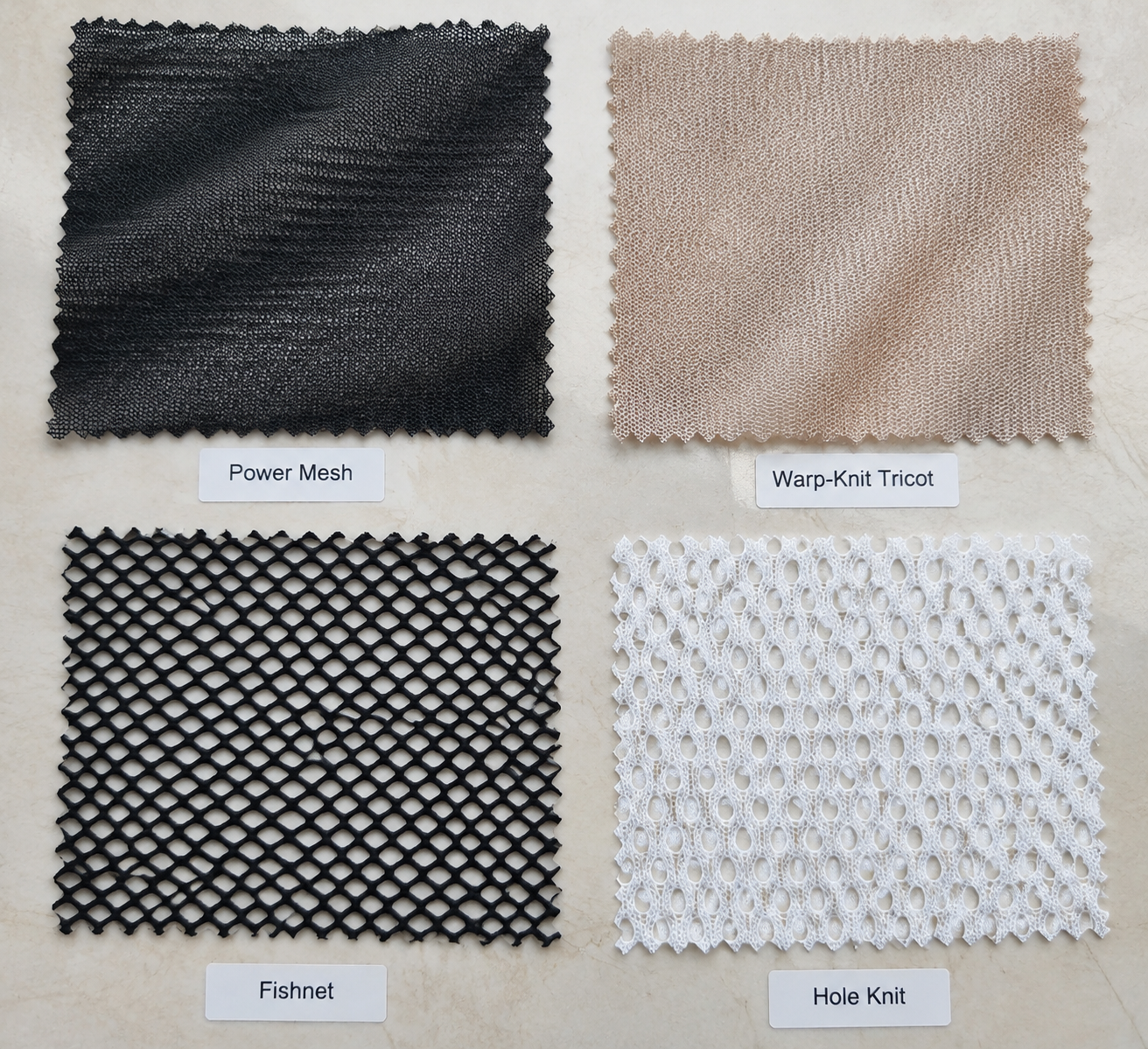
Fiber blend drives the other two. Nylon/spandex holds color better and has a softer hand than polyester/spandex; polyester costs less and performs well in sublimation print. Spandex content sets the potential for stretch: it determines how much elongation the knit structure can accommodate and how readily the fiber returns force. What spandex content cannot tell you on its own is how the finished fabric actually behaves — which is why the measured stretch percentage and recovery must be stated separately, by direction (warp and weft) and at a defined load. A fabric quoted as "80% nylon / 20% spandex" without those figures is not a complete specification.
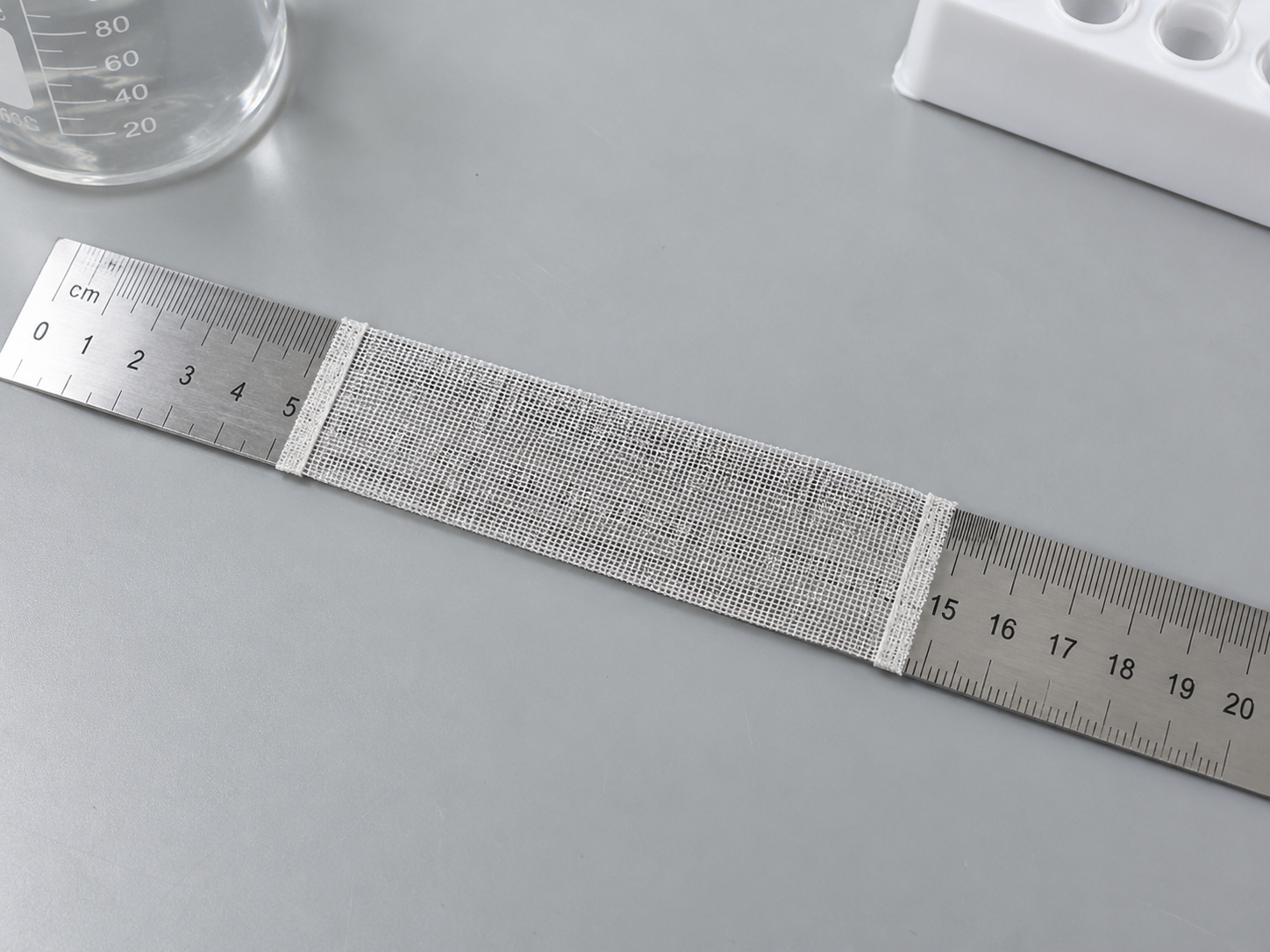
Weight in g/m², measured at standard atmospheric conditions per ISO 139 (20 °C, 65% RH), tells you how the fabric will behave at the cut edge and how much it will show through at the seam. Recovery, the percentage returned after extension and release at a stated load, tells you whether the top holds its shape through a shift or a set. Snag resistance is tested under ISO 8295 or the ICI Mace Snagging method; Martindale pilling falls under ISO 12945-2. Verify both on a bulk-fabric lab report, not on a pre-production swatch, because finishing lots vary.
The trade-off is direct: a lighter, sheerer mesh photographs better and costs more in durability. A heavier power mesh at 180–220 g/m² survives repeated wear; a 60 g/m² open-knit reads as lingerie and behaves like it.
Dealbreaker Two: Edges, Seams and Whether the Top Is Lined
Mesh fails first at hems, necklines, and seam allowances. Open-loop knit gives a needle a narrow land to catch, which is why stitch density and needle size are spec items, not floor decisions. A ballpoint needle at 75/11 or 80/12 is standard for fine mesh; a universal needle shreds the loops. Stitch density stated in stitches per centimeter needs to appear on the tech pack, not left to the operator.
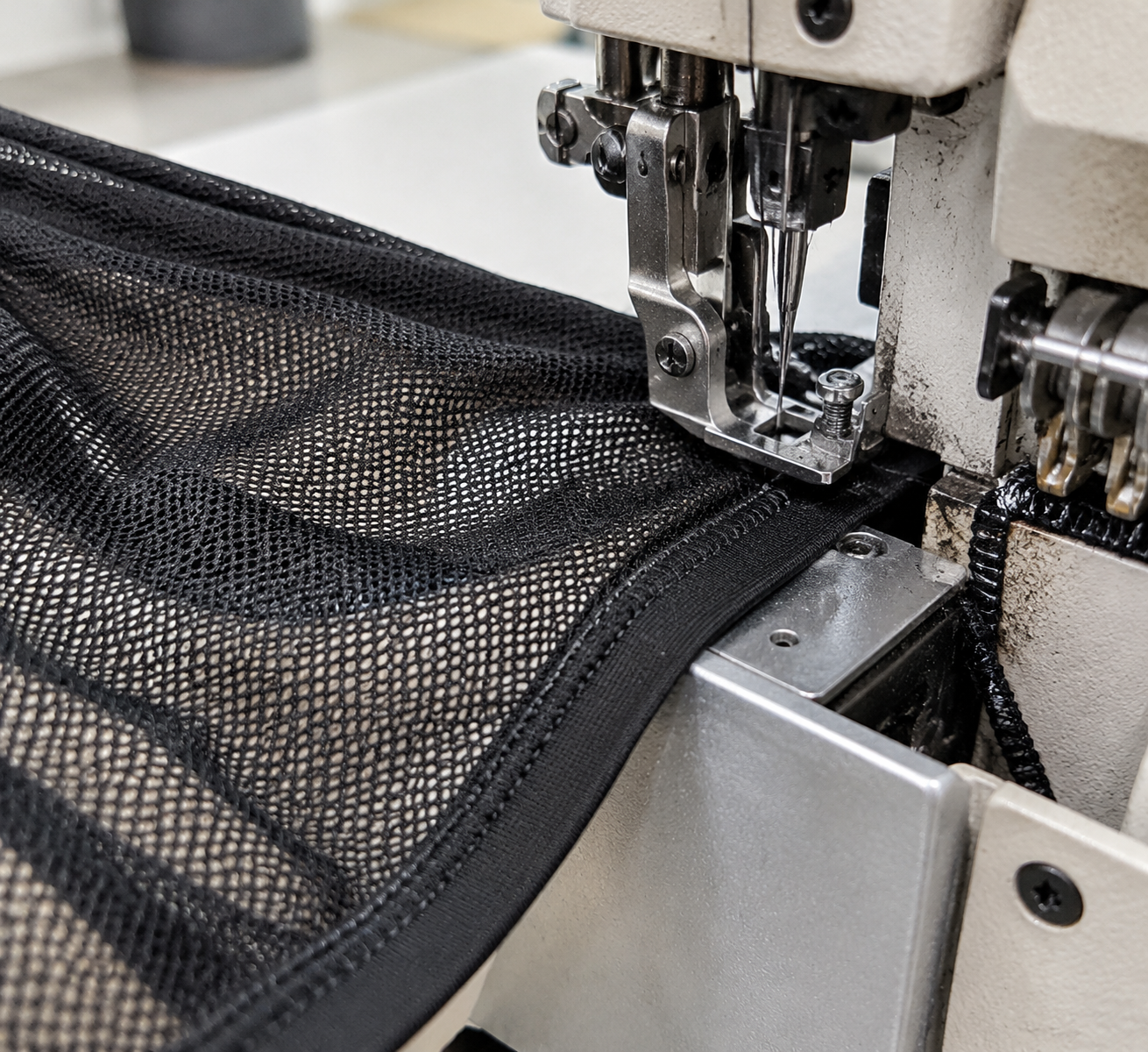
Edge method changes pattern and consumption. A clean-finished hem requires a stable stitch and enough seam allowance to turn; fold-over elastic adds material and a visible band; binding changes the finished width at the edge; bonded or heat-sealed edges remove thread entirely and work best on finer, single-layer mesh. The seam-type comparison for knit garments is covered in our bodysuit and swimwear article, which is the reference for that decision. What is specific to crop tops is the interaction between sheerness and coverage: a single-layer mesh panel at the midriff reads as intentional; a lining that stops 10 mm short of the hem reads as a defect.
Lining changes the pattern, the fabric consumption, and the sewing time. A lined top and an unlined top are different cut files. The consequence is that lining choice has to be resolved before we can quote: it is not a revision-round decision.
Important: Crop Length, Grading and How Mesh Relaxes
Crop length is the fit variable most often misread, because "crop" describes a look rather than a number. State it as a point of measure from a named reference point, high-point shoulder to hem being the usual one, and give a value per size rather than a single target. The reason is mechanical: stretch mesh recovers differently across a size range, so a grade rule copied from a woven block will not hold. Grading on a stretch knit needs the fabric’s stated stretch percentage as an input, and the bodycon versus A-line article covers that stretch-grading logic in full. Specify relaxation after wash too, since open-structure knit can shrink or grow depending on heat and tension. ISO 6330 wash procedure with ISO 5077 dimensional change is the pair that measures it, and the result tells you whether your grade rules survive a customer’s first laundry cycle. All of this is fixable in a sample revision, which is why it sits below the dealbreakers.
Important: Color, Print and Compliance on a Sheer Fabric
Dye does not sit on mesh the way it sits on a solid knit. Color strength shifts with layering, so a single-layer panel over skin reads lighter than the same fabric doubled, and light colors let skin tone show through. Print behaves the same way: sublimation and screen print can crack or distort when the substrate stretches, so a print placed across a high-stretch zone needs its own sample check. Verify with ISO 105-C06 for wash colorfastness, ISO 105-X12 for rubbing and ISO 105-E04 for perspiration, each run on the bulk fabric rather than the swatch. Fiber content labeling for the US falls under the Textile and Wool Acts, as covered in the bodycon article. OEKO-TEX is a buyer’s choice rather than a default, and adding it narrows the mill and dye options, which can move your color range and your minimum. Ranked here because a color revision costs one sample round, not a pattern rebuild.
Selection Table: Matching Mesh Type to the Top You Are Making
| Mesh type | Typical weight (g/m²) | Typical stretch % and direction | Best use for a crop top | Verification |
|---|---|---|---|---|
| Power mesh | 150–220 | 80–120%, crosswise | Structured, body-hugging crop; lining panel | ISO 139 mass per unit area; ISO 12945-2 pilling |
| Warp-knit tricot mesh | 60–120 | 40–80%, crosswise | Light layering piece; printed crop | ISO 139; snag test on bulk lot |
| Fishnet / hole knit | 80–150 | 50–90%, crosswise and lengthwise | Statement and festival pieces | Visual hole-count check; ISO 12945-2 |
| Bonded / double-layer mesh | 180–260 | 30–60%, crosswise | Opaque crop without lining | Bond strength check; ISO 6330 with ISO 5077 |
Confirm every figure on the actual roll; these are general market ranges, not a substitution for a bulk-fabric report.
Warp-knit tricot mesh at 60–120 g/m² fits most fashion crop tops, because it holds a print, layers cleanly and stays light against the skin. Power mesh earns its weight only when the top is cut close and must hold shape without a lining. Fishnet and bonded structures suit statement pieces, where the look is the reason for the garment.
Nice-to-Have: Trims, Branding and the OEM versus ODM Route
Woven labels, hang tags, polybag and carton detail, custom elastic or hardware, and heat-transfer neck labels all improve the product without deciding whether it works. On mesh, heat-transfer labels are usually preferable to a woven tag, since a sewn tag can scratch through an open knit. The OEM versus ODM choice matters more than any trim: bringing your own pattern and spec gives you the fit you already sell, while starting from an existing ODM block saves sample rounds at the cost of sharing a silhouette. Minimums depend on fabric and trim sourcing, and we do not state a figure without a quote. The sample cost article covers where that money goes. These sit last because a wrong label is a reprint, not a rebuild
When a Mesh Crop Top Is the Wrong Choice
Some briefs should not come to us. A line built for heavy-wash durability or rough-use wear is one: open-structure knit abrades and snags in a way no seam finish prevents, and a workwear or active-scrub program will generate returns we cannot spec our way out of. Full opacity without lining is another, because light-colored mesh over skin shows tone unless you add a layer or accept the coverage. Orders below the quantity at which a mill will run or reserve a dedicated mesh fabric are a third, and there we will tell you so at quote stage rather than sample into a dead end. A stock-fabric wholesaler serves that buyer better. So does a knitwear specialist if the design needs woven-grade tailored structure, canvas-like body or a cut-and-sew shape mesh cannot hold.
A Typical Mesh Crop Top Project, Start to Approval
A typical brief, not one we handled: a brand wants a fitted crop top, sheer through the body, opaque enough at the neckline to skip a bra. From the table we would start at power mesh, 180–220 g/m², stretch percentage stated in both directions and measured per ISO 139, because that weight holds shape through a crop length better than the lighter sheers. Edge method next: fold-over elastic at the neckline and hem, single-layer body, no lining. Then the spec items that decide whether the sample is right: stretch percentage in percent with its direction, and crop length as high-point shoulder to hem per size, in centimeters.
One detail left vague turns into a sample round. If the brief says "sheer" without a lining decision, the first sample comes back sheerer than the buyer pictured, the pattern changes if a lining panel is added, and that is a second fitting instead of the first.
Mesh Crop Top OEM: Questions Buyers Ask
Can you copy a mesh from a sample I send?
Yes, if you also send the reference for structure, fiber blend and weight, because hand feel alone does not identify a knit. We read the sample as a starting point and confirm the spec with you before running fabric.
Do you need a tech pack, or will a sample do?
A sample gets us moving; a tech pack gets us to the right first sample. The document requirements are covered in our tech pack article. On mesh, the gap that costs the most is the missing stretch percentage and direction.
How do you stop mesh from snagging at the seams?
By specifying the construction before sampling: needle size, stitch density and edge finish are chosen for the knit, and the bulk-fabric lab report including ISO 12945-2 pilling is checked rather than the swatch.
Can a mesh crop top be made in small batches?
It depends on the fabric. If we source a mesh already stocked by the mill, small runs are workable; if the mesh is custom-knit to your color, the minimum is set by what the mill will run. We quote against your quantity rather than stating a figure here.
What changes if I want it lined?
Pattern, fabric consumption and sewing time all change, and the lining choice also decides whether the top stays opaque in light colors. Settle it before we quote.
What to Send Us Before We Quote a Mesh Crop Top
Fabric
- Knit structure (power mesh, tricot, fishnet, bonded)
- Fiber blend
- Weight in g/m²
- Stretch percentage and direction
- Swatch or reference garment
Construction
- Edge finish at neckline, hem and armhole
- Lining: yes or no
- Seam and stitch notes
- Closures and hardware
Fit
- Size range
- Crop-length point of measure per size
- Grade rules
Color and print
- Pantone or lab dip reference
- Print method
- Test requirements
Labels and packing
- Woven or heat-transfer labels
- Hang tags
- Polybag and carton details
Quantity and markets
- Target quantity per color and size
- Destination markets
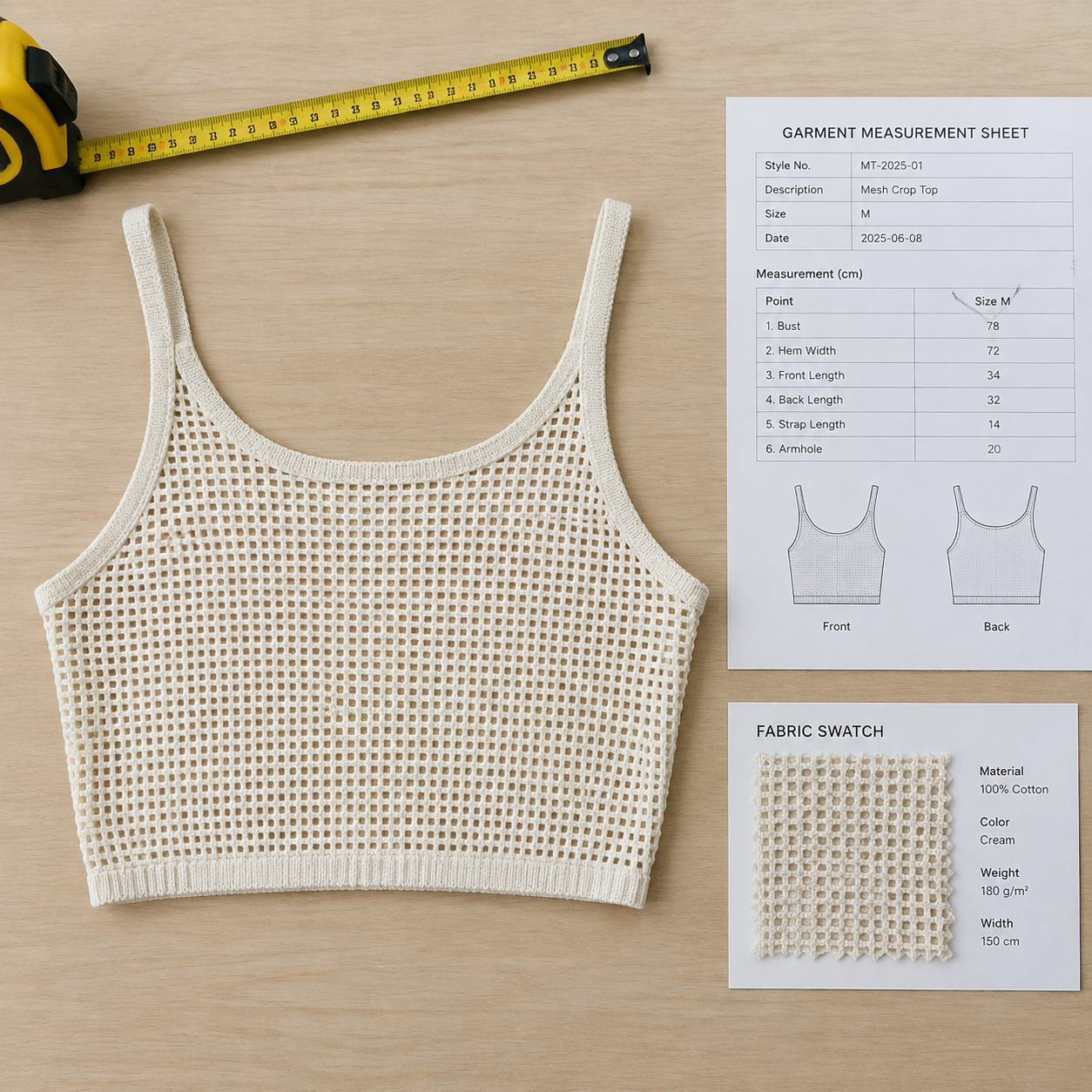
Send these and request a quote when you are ready; where a detail is still open, we will ask rather than guess.
What to send us
If the specifications above match what you are sourcing, send your tech pack to Orange Sea Clothing. If the pack is not written yet, sketches and a reference sample are enough to start — sample development covers the design review, fabric and trim sourcing, pattern making and the first prototype, so you see fit and construction before you commit to a production run.


Comments