
One Measurement Separates a Bustier Order from a Corset Order
Measure the centre-front length of the panel you intend to bone. If it is under 250 mm and the boning terminates above the waist seam, you are running a bustier. If it extends past the waist and the bones are anchored to a separate underlayer, you are running a corset. That single figure decides your pattern block, your grading curve, your lining construction and your test protocol, and you can take it off a sketch before a single sample is cut.
Our recommendation: if your line sits in ready-to-wear with four to six sizes per style and a seasonal calendar, run the bustier and discard the corset. If you sell made-to-measure or bridal with a fitting process attached, the corset is the right family and the bustier will not hold the shape your customer is paying for.
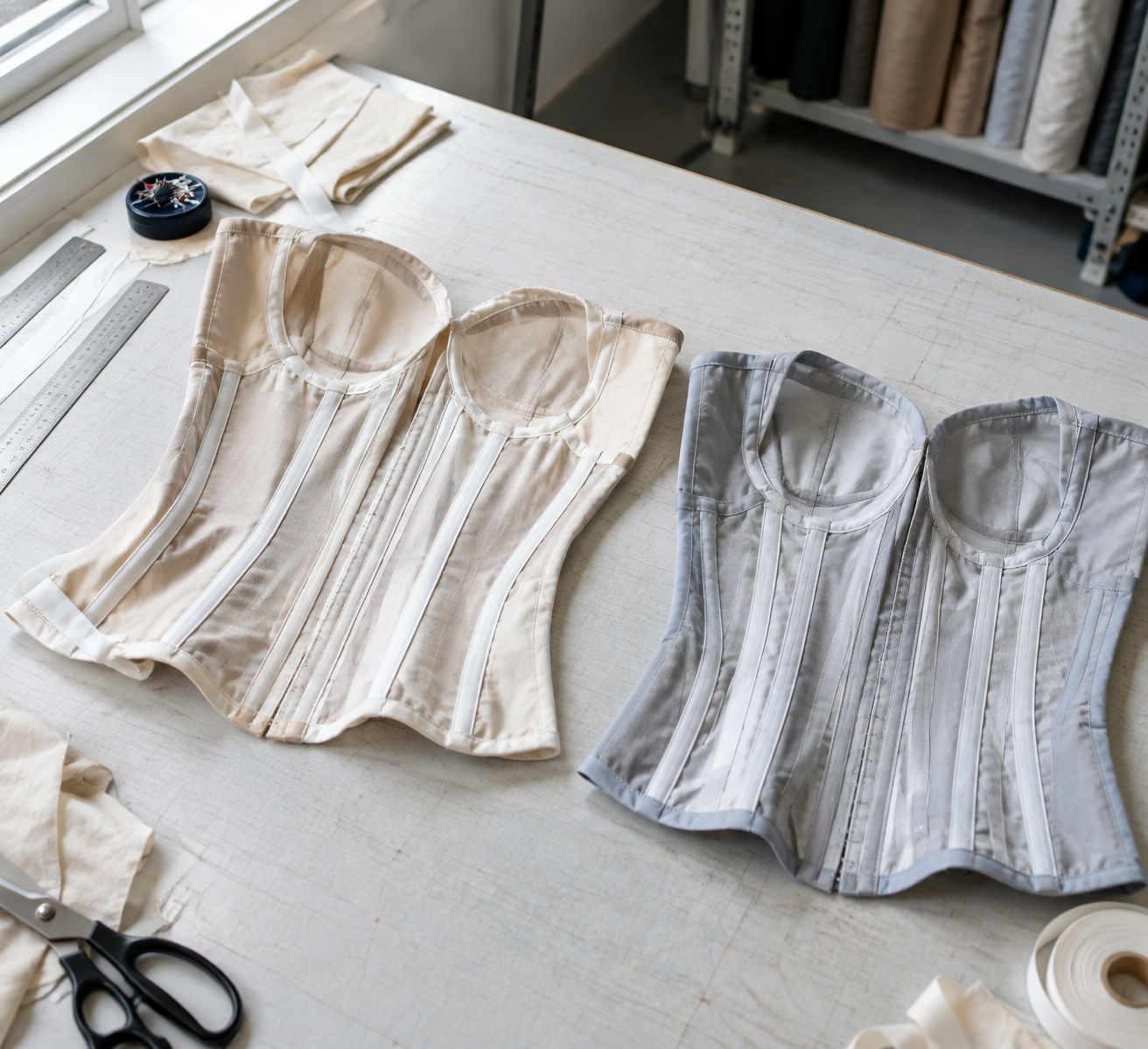
Rank Your Criteria: Dealbreaker, Important, Nice-to-Have
Sort your requirement list into three rungs before you talk to any supplier. The rung a criterion sits on determines whether it can be negotiated at all.
Dealbreaker, meaning a mismatch stops the order: boning type and its flex rating, point of measure count on the tech pack, and the strength test method agreed in writing. These are structural. Change one after sampling and you restart pattern development.
Important, meaning it costs a revision round but the block survives: grading curve increments, lining strategy, closure type. A closure change on a bustier is often a pattern revision; the same change on a corset usually is not.
Nice-to-have, meaning it attaches to a finished pattern: trims, topstitch spacing, hardware finish, label placement.
The two families diverge hardest on the top rung. A bustier tolerates a short criteria list. A corset does not, because every rung-1 item loads the same bones.
Dealbreakers: Boning Type, Point of Measure Count, and Strength Test Method
Three control points decide whether a structured top is manufacturable at your target quality. Compare them directly:
| Control point | Bustier | Corset |
|---|---|---|
| Typical boning | Spiral steel or rigid plastic, 6–10 bones, 4–6 mm width | Spiral steel, 14–24 bones, 6–8 mm width |
| Bone anchoring | Casing stitched to face or lining layer | Separate underlayer, bones removable |
| Points of measure on tech pack | 18–24 | 30–45 |
| Bone pull-off test | 60 N sustained 10 s, no casing rupture | 100 N sustained 10 s, no casing rupture |
| Flex fatigue, 5,000 cycles | No permanent set over 3 mm | No permanent set over 2 mm |
| Waist reduction under load | Not rated | 50–75 mm at 40 N |
The pull-off figure is the one that discards options. Test it on the production lot, not on the pre-production sample, because casing stitch density drifts between the sample room and the line.
A bustier quoted against corset boning counts is a supplier who has not read the tech pack. Ask for the point of measure count in writing before you ask for a price.
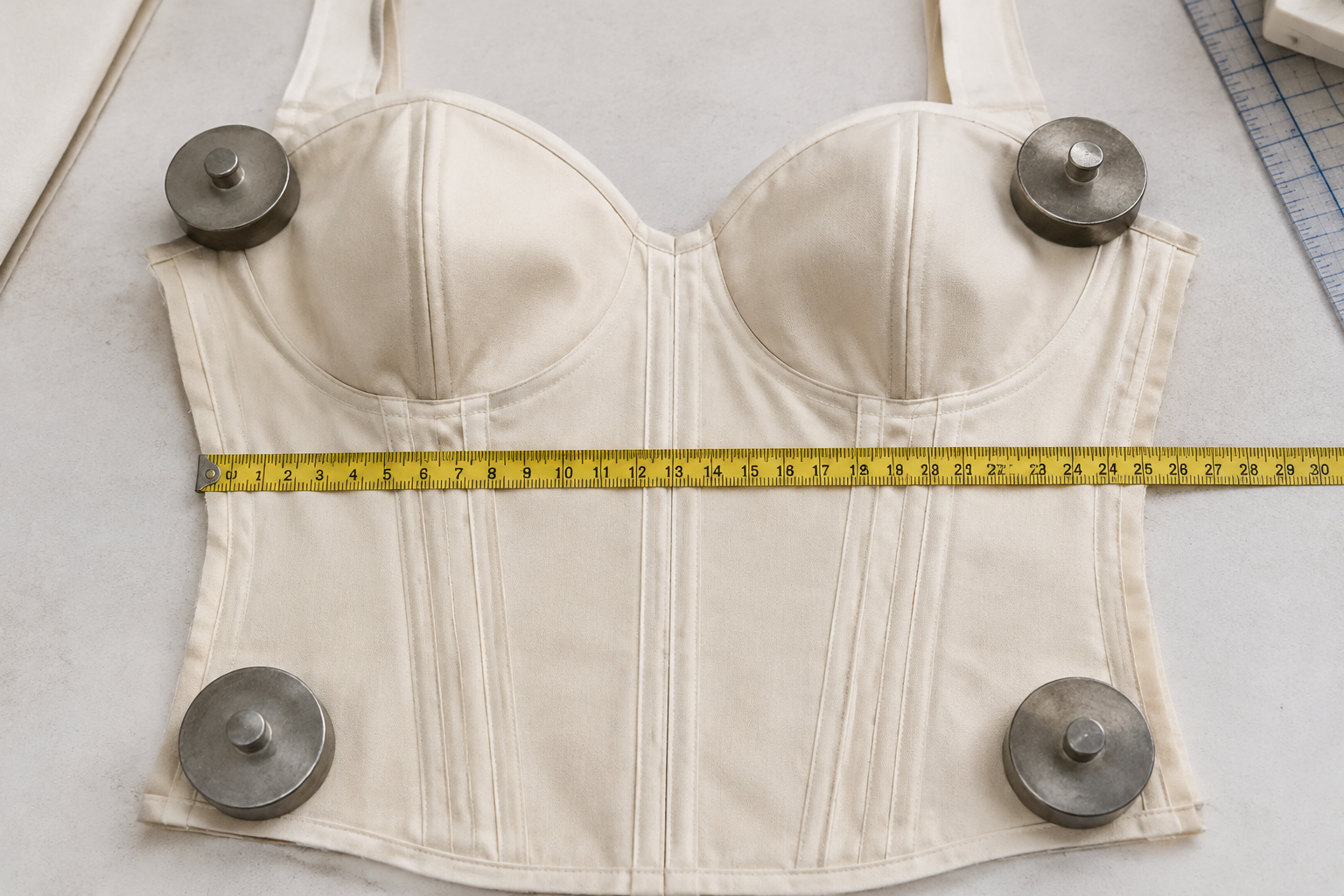
Important but Second-Order: Grading Curve, Lining Strategy and Closure Type
Grade the bustier on a 40 mm chest increment and it will fit your size range without a pattern rebuild. Grade a corset on the same increment and the waist reduction collapses at the top and bottom of the run, because the bone count is fixed while the body it wraps is not. Corsets grade on the waist, typically 25 mm per size, with the bust and hip derived from it.
Lining strategy follows the boning. A bustier takes a single lining layer with the casings stitched through, which keeps the interior clean and the face fabric unmarked. A corset needs a strength layer plus a fashion layer, so the bones never contact skin and the face fabric never carries load.
Closure differs by family and by fit tolerance. A bustier usually closes with a back zip plus a hook-and-eye at the top. A corset closes with a busk at centre front and lacing at the back, which lets the wearer adjust the reduction by 20 to 40 mm; a zip cannot do that, and substituting one removes the fit adjustment the corset is bought for. Changing closure type on a corset is typically a pattern revision: the busk is set into a structured front panel with multiple interdependent pieces, so moving to a zip means reworking that panel and rebalancing the bone channels around it. On a bustier, the same change usually stays within the existing seam lines.
Nice-to-Have: What You Can Add Without Reworking the Pattern
Beading, lace appliqué, contrast topstitching, and piping along a seam line attach after the shell is assembled. Request them on the trim sheet and they land without a pattern change.
Structural requests are different. Moving the bone channels, adding a second bone row, or converting a flat seam to a boned panel changes the block, so budget a revision round.
| Request | Pattern revision? | Verify by |
|---|---|---|
| Lace appliqué placement | No | Trim sheet attachment |
| Piping on waist seam | No | Existing seam allowance, 10 mm |
| Bone channel count +2 | Yes | New point-of-measure set |
| Cup depth change > 5 mm | Yes | Re-graded pattern |
Push embellishment as far as the trim sheet allows. Hold structural asks for the next development round unless they are the reason you are running the style.
What Drives the Price of a Bustier or a Corset
Fabric yield per unit is the largest lever for both families. A corset panel set consumes more shell fabric than a bustier of the same nominal size because of the longer torso length and the channel allowance.
Boning is second. Steel spiral or flat steel costs more per unit than a 4–6 mm plastic bone and also adds sewing time per channel. A bustier run using plastic boning in 4–6 channels sits at a different floor than a corset using steel in 10–14 channels.
| Cost lever | Bustier | Corset | Direction |
|---|---|---|---|
| Shell fabric per unit | Lower | Higher | Up with torso length |
| Bone material | Plastic or light steel | Steel | Up with steel |
| Channel count | 4–6 | 10–14 | Up with count |
| Lining layers | 1 | 1–2 | Up with layer count |
| Closures | Hook-and-eye | Busk + lacing | Up with hardware count |
Order quantity moves cost in the other direction. Small batch production raises per-unit cutting and setup share; larger runs amortise it.
What a Bustier Sample Looks Like When the Spec Is Thin
A typical thin brief reads: "structured sweetheart bustier, satin shell, hold the waist." No bone type, no channel count, no point-of-measure list. That is enough to start a fit sample and not enough to quote.
Development usually proceeds in this order. Pattern is cut to a standard bust and waist block. Plastic boning in 6 channels gets sewn in as a placeholder. First sample arrives, and the technical team measures the waist reduction under load. The number comes back soft because plastic in 6 channels does not hold as much as steel in 10.
Now the structurant question resurfaces: steel or plastic, and at what channel count. Answering it means a new bone map, a revised point-of-measure set, and a second sample. The cost of not deciding at brief stage is one revision round and roughly two weeks of calendar time, in the ordinary case.
What to Send Us Before We Quote Either Style
Attach everything in one file. A quote built on partial inputs gets revised once the missing piece arrives, and the revision costs a full round trip.
Fabric and trim
- Shell fabric: composition, weight in g/m², width, stretch direction
- Lining: composition and weight in g/m²
- Fusible or interfacing, where used, with weight in g/m²
- Lace or appliqué: panel width, repeat size in mm, yardage per unit
Structure
- Boning type and diameter: 4–6 mm spiral steel, 6–8 mm flat steel, 3 mm or 2 mm synthetic
- Channel count and spacing in mm
- Bone anchoring method: stitched channel ends, capped tips, or bar-tacked
- Closure type and length, if a busk or zipper
Measurement
- Full point-of-measure list, every POM named, in mm
- Structurant height at 250 mm, marked on the front elevation
- Grading increments per size run, in mm
- Size range and base size
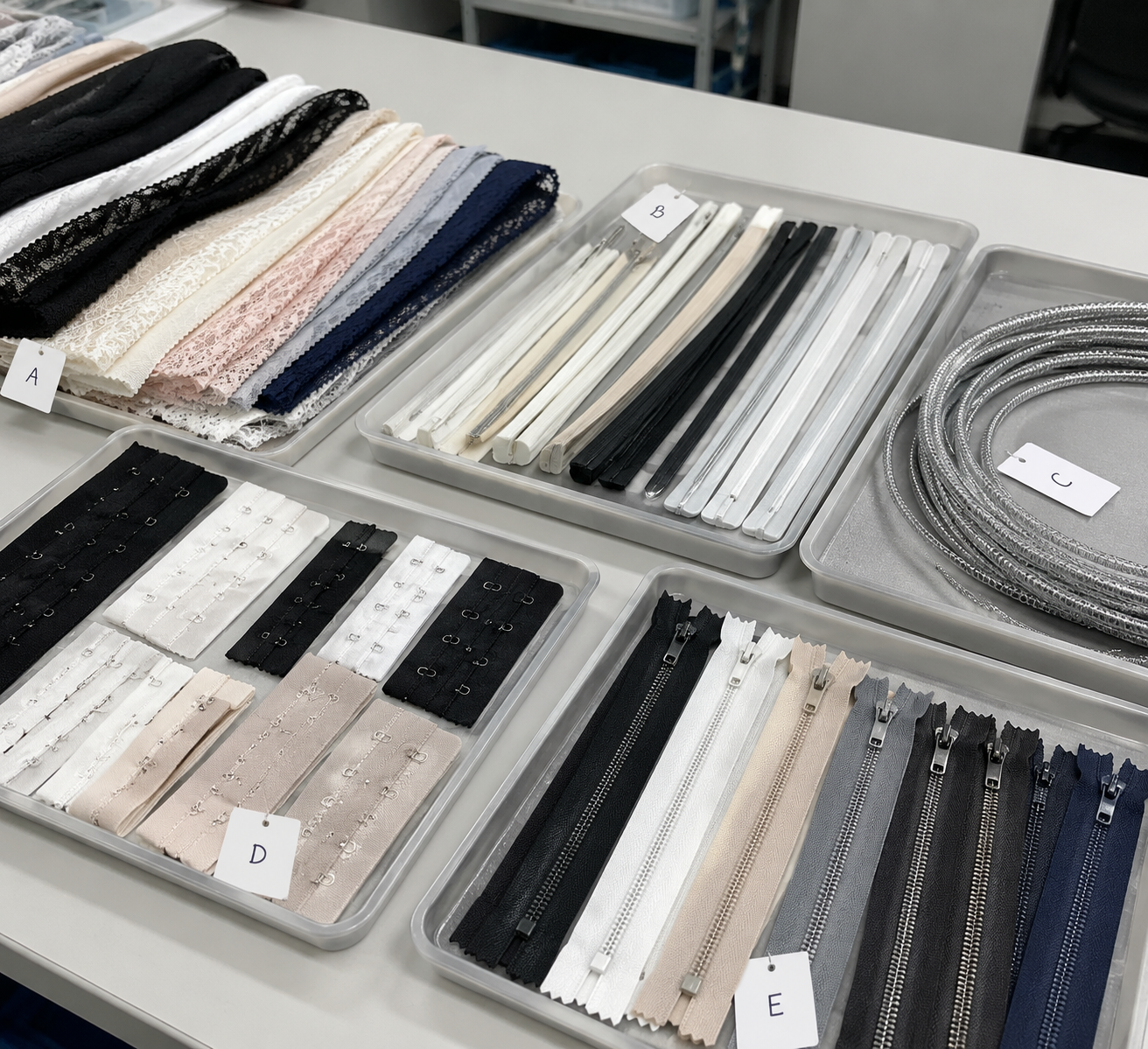
A tech pack sketch without the POM list is the single most common gap. Name the points; the numbers we can pull from the base pattern.
How Long Each Garment Holds Up, and Why That Changes Your Costing
Durability separates the two families more than any spec sheet column suggests. The number that matters is cost per wearing, and it moves with bone material, channel construction and washing behaviour.
| Wear factor | Boned bustier | Fully-boned corset |
|---|---|---|
| Bone pull-off test, 50–75 mm anchor | Passes at 60 N | Passes at 100 N |
| Flex fatigue, 5,000 cycles | Channel intact | Channel intact |
| Wash cycles before channel distortion | 20–30 at 30 °C, gentle | 10–15 at 30 °C, hand wash |
| Typical replacement interval, moderate wear | 18–24 months | 24–36 months, with care |
| Care labour per wearing | Machine wash | Hand wash, reshape, dry flat |
The corset lasts longer but costs the wearer time every wash. A bustier tolerates a machine cycle, which shortens its life but keeps it in rotation. Cost per wearing lands close between the two when care labour is priced in.
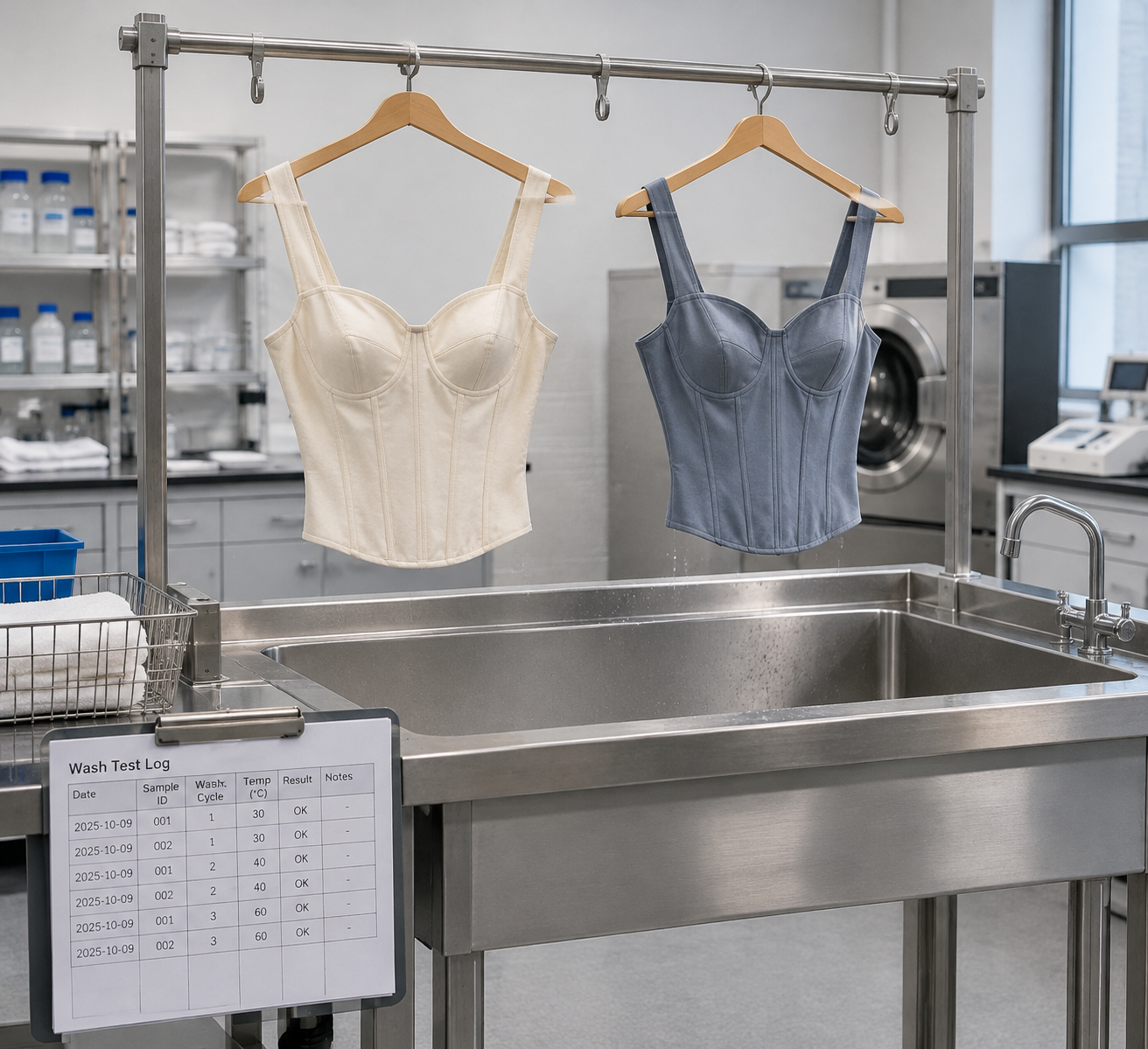
Spiral steel in a 6–8 mm channel is the repair point. When a bone kinks, the channel can be reopened and the bone replaced; a fused channel cannot. Specify a stitched channel if you want the garment serviceable.
Standards and Labelling That Apply to a Structured Top
Three designations govern these garments. Fiber content labelling for the US market falls under the Textile and Wool Acts, enforced by the FTC, requiring the country of origin and fiber percentages on a permanent label. Restricted substances testing follows OEKO-TEX Standard 100, with the product class set by whether the garment touches skin: class II for a bustier or corset worn against the body. Structural testing is your own protocol, not a mandated standard, so name the test in the tech pack: bone pull-off force, flex fatigue cycles, and the channel the test applies to.
No single standard covers boning performance. If a buyer asks for "certified boning," the request has no referent. Specify the test and the pass threshold instead.
When a Bustier or Corset Run Is the Wrong Choice for Your Line
Skip this family when the design does not need vertical structure. A soft-cup top with no waist shaping, a knit lounge piece, or a drape-led silhouette gets nothing from boning except cost and a stiffer hand feel. Choose a non-boned cut-and-sew supplier instead.
Skip it when your size range runs beyond a 40 mm grade spread without a fresh pattern per block, since the structurant does not scale linearly.
Skip it when your volume sits under the MOQ a boned line requires, unless you accept a shared channel and bone specification across colorways.
A factory that quotes a boned bustier at soft-top pricing has either misread the tech pack or plans to substitute 2 mm synthetic for the specified steel. Both cost you the sample round.
Getting a Quote on Your Structured Top
Send the tech pack with the POM list, the boning designation, and the 250 mm structurant height marked. If any of those are open, say so and we will quote the options rather than guess. Ready to price your bustier or corset run? request a quote and we will come back with questions before numbers.
What to send us
If the specifications above match what you are sourcing, send your tech pack to Orange Sea Clothing. If the pack is not written yet, sketches and a reference sample are enough to start — sample development covers the design review, fabric and trim sourcing, pattern making and the first prototype, so you see fit and construction before you commit to a production run.


Comments