

In-depth Analysis of Women’s Apparel Factory Quotations: Composition, Techniques, and Pitfall Avoidance Guide
For women’s apparel brands, e-commerce sellers, and offline buyers, women’s apparel factory quotations are not only the core basis for cost accounting but also an “invisible contract” for subsequent production, delivery, and after-sales cooperation. However, many buyers often encounter disputes when first encountering quotations because they cannot understand the process specifications and overlook hidden clauses. This article will break down the core components of women’s apparel factory quotations, share practical interpretation techniques, and identify common pitfalls to help you efficiently connect with factories.
I. Six Core Components of a Women’s Clothing Factory Quotation
A reputable women’s clothing factory’s quotation will clearly indicate information related to “Product – Cost – Delivery – Responsibilities,” without ambiguity. The following are the core modules that must be paid attention to:
- Basic Product Information: Clearly Define “What is Being Made”
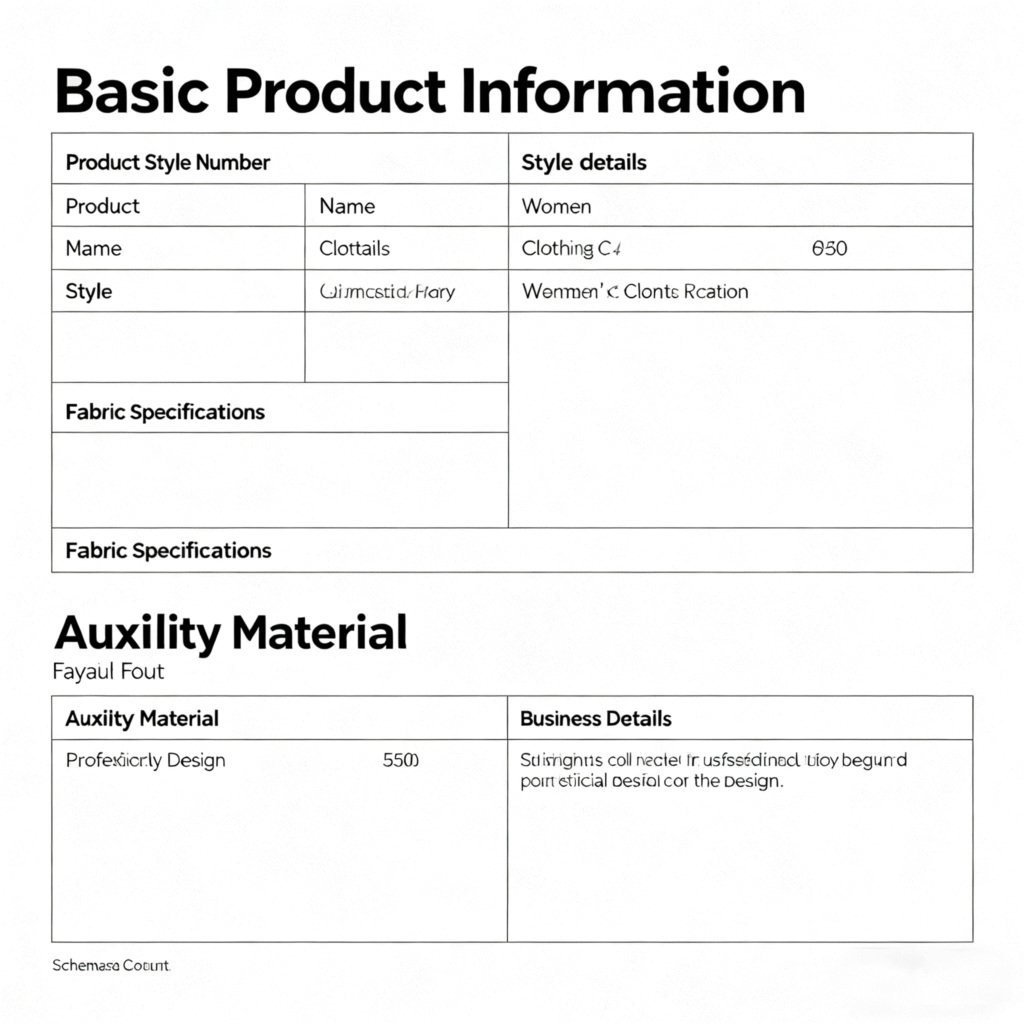
Core Content: Must include the product style number (corresponding to the buyer’s design draft), product name (e.g., “2025 Spring Pure Cotton Dress”), style details (e.g., “Round Neck, Three-Quarter Sleeves, Side Slit”), fabric specifications (crucial! Fabric composition and parameters must be specified, such as “100% Combed Cotton, 21 Count Double Ply, 130g/㎡”, “Chiffon: 100% Polyester Fiber, 75D”), and accessory details (buttons, zippers, embroidery, etc., such as “Resin Buttons Φ15mm, YKK Invisible Zipper”). Buyer’s Focus: Avoid factories only listing “pure cotton dress” or “chiffon top.” Request additional parameters such as yarn count, weight, and density. For the same fabric name, the cost and texture difference between 21-count cotton and 32-count cotton can be over 20%, easily leading to disputes later due to discrepancies between the product and the description. - Unit Price Composition: Breaking Down “Where the Money Goes”
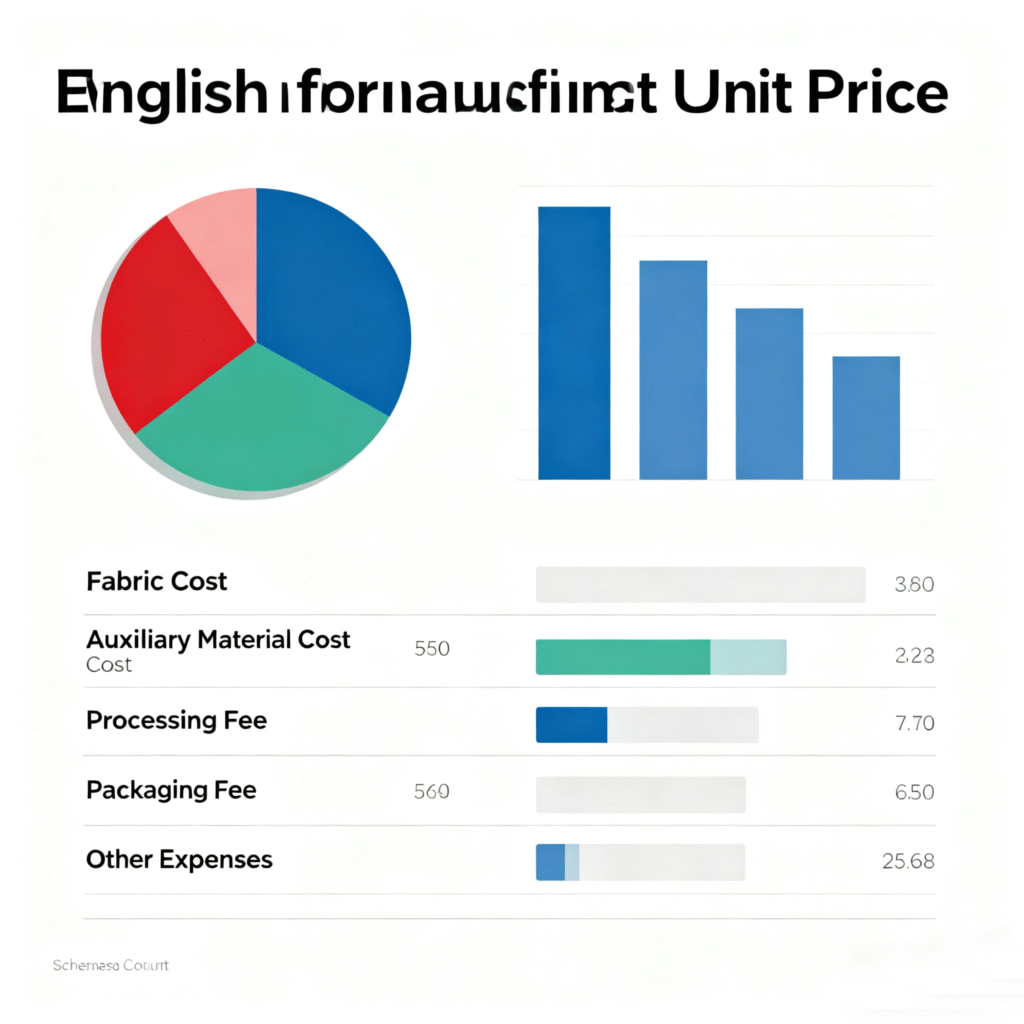
The “unit price” on a women’s clothing quotation is not a single number, but a composite of multiple costs. Reputable factories will list these costs item by item, with a common breakdown as follows:
Cost Items
Factory Labeling Example
Buyer’s Focus
Fabric Cost
“Fabric: 58 yuan/piece (including 8% cutting waste)”
Confirm whether fabric waste is included (women’s clothing cutting waste is typically 5%-12%, and can reach 15% for complex styles like pleated skirts) to avoid the factory adding extra charges later due to “unexpected waste.”
Material Costs
“Material: 12 RMB/piece (Buttons 2 RMB + Zippers 8 RMB + Hang Tags 2 RMB)” Verify that the brand and specifications of the accessories match the requirements (e.g., if “YKK zippers” are required, this must be stated in the quotation to avoid the factory using generic brands).
Processing Fees
“Processing Fee: 35 RMB/piece (Flatbed sewing + Overlocking + Hand Beading)” Clearly specify the processing details. For example, “Hand Beading” should be stated as “10 beads per skirt piece, 0.5 hours of labor per piece.” Complex processes (such as embroidery, hot stamping) should be listed separately to avoid vaguely stating “Processing Fee XX RMB”.
Packaging Fee
“Packaging: 3 RMB/piece (opp bag + hang tag + cardboard box)” Please confirm the packaging material (e.g., cardboard box thickness, opp bag transparency), and whether it includes a brand-customized hang tag/wash label (if factory printing is required, please specify “Hang tag printing fee 0.8 RMB/tag”).
Other Fees
“Sampling Fee: 300 RMB/style (first sample, modifications will be charged separately)”
“Shipping Fee: Collect on delivery / Shipping included (to Hangzhou warehouse)”
The sampling fee must specify “whether it includes the number of modifications” (usually 300-800 RMB/style for the first sample, 1-2 modifications are free, multiple modifications will incur additional charges); the shipping fee must specify “delivery area” and “logistics method” (e.g., “ZTO Express, including shipping to the Yangtze River Delta region”).
- Batch and Unit Price Tiers: Calculate the “Batch Advantage”
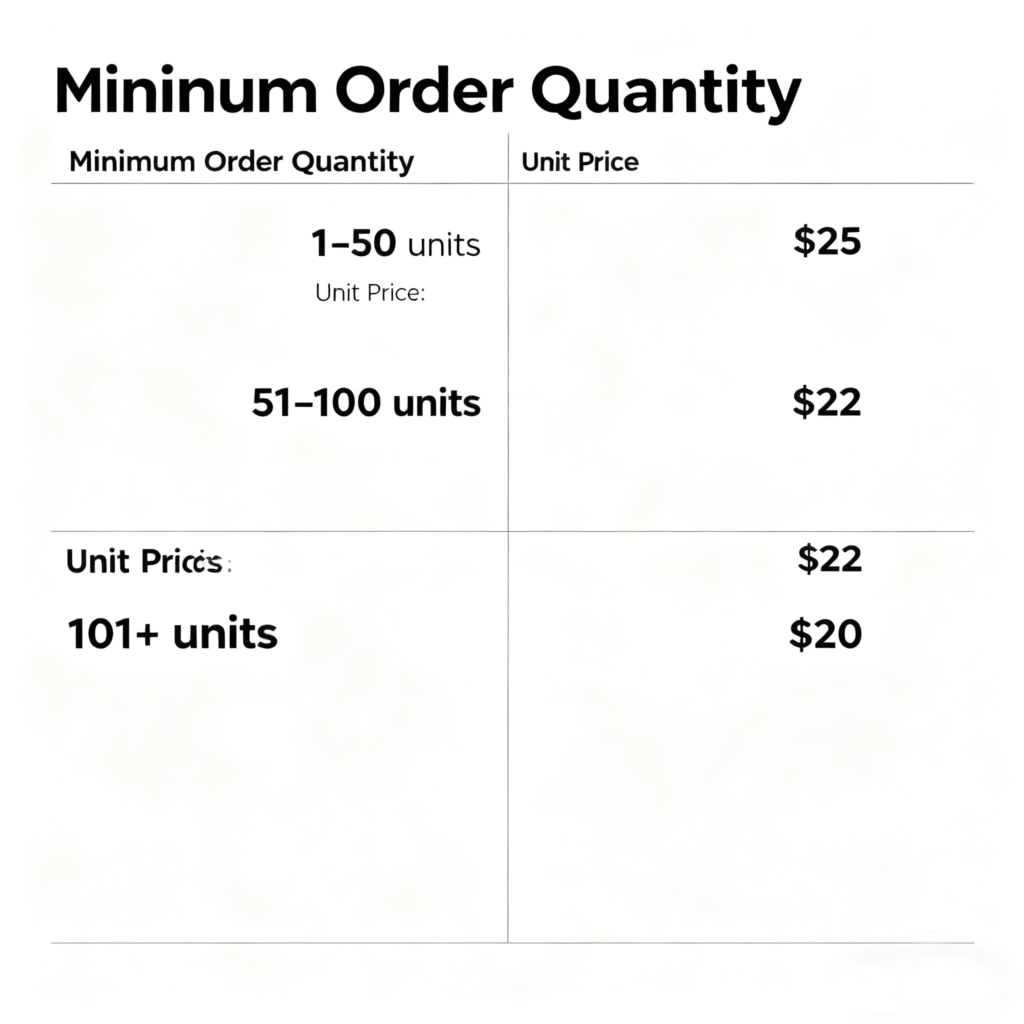
Factory prices will vary depending on the purchase quantity. The quotation must clearly specify the “Minimum Order Quantity (MOQ)” and “Batch Discount,” as shown in the following examples:
“MOQ: 200 pieces/style, single color, single size”
“Batch Tiers: 200-500 pieces: 108 RMB/piece; 501-1000 pieces: 102 RMB/piece; 1001 pieces and above: 98 RMB/piece”
Buyer’s Focus: Confirm whether the MOQ supports mixed sizes and colors (some factories allow “200 pieces of a single color, mixed with 3 sizes,” while others require “200 pieces of a single size”); if additional orders are planned later, it is necessary to inquire in advance whether the additional quantity enjoys the original batch discount (e.g., if the initial order is 300 pieces, and subsequent orders are 200 pieces, can the settlement be based on the “500-piece tiered price”?).
- Delivery Terms: Clearly Define “Delivery Date”
Key Information: Production cycle (e.g., “Delivery within 15-20 days after sample confirmation”), delivery milestones (e.g., “30% delivered before May 10th, remaining 70% delivered before May 20th”), and liability for delays (e.g., “0.5% compensation for each day of delay; order cancellation and claim for delays exceeding 7 days”).
Tip to Avoid: Be wary of vague statements like “delivery in approximately 20 days” from factories. Clearly define “from which day the production cycle begins” (usually based on “sample confirmation and prepayment by the buyer”). For seasonal products (e.g., summer clothing), consider adding an “expedited delivery clause” (e.g., “Delivery must be made before April 30th; expedited fee of 5 RMB per piece”).
- Payment Method: Agree on “How to Pay” Common payment percentages are as follows and must be clearly stated in the quotation:
“Prepayment: 30% (payable within 3 days of order confirmation), Final Payment: 70% (payable within 7 days of goods arrival and acceptance)”
“Monthly Settlement Customers: Orders placed in the current month must be settled by the 15th of the following month, requiring a guarantee of the company’s qualifications.”
Buyer’s Considerations: For first-time cooperation, it is recommended to avoid “prepayments exceeding 50%”. A negotiated arrangement of “30% prepayment + 50% cash on delivery + 20% after-sales guarantee (payable one month later)” can be considered to reduce losses due to quality issues. If the factory requires “full prepayment,” carefully assess the factory’s reputation (e.g., review past cooperation cases, conduct on-site production capacity inspections).
- Quality Standards and After-Sales Service: Defining “What If There Are Problems?”
The quotation must include basic quality agreements, such as:
“Quality Standards: Fabric free of snags, color difference ≤ 4 (according to GB/T 29862-2013 standard), no skipped stitches or open seams, garment size deviation within ±1cm.”
“After-Sales Service: Quality objections can be raised within 7 days of delivery, and the factory will be responsible for free repairs; if repairs are not possible due to workmanship issues, a full refund or replacement will be provided for the quantity of defective products.”
Key Reminder: If the buyer has special quality requirements (such as “infant and toddler clothing must meet Class A standards,” “export to Europe and America requires OEKO-TEX certification”), these must be clearly indicated in the quotation, and the factory’s relevant testing qualifications must be confirmed to avoid delivery failures due to non-compliance with standards.
II. Three Practical Tips for Deciphering Women’s Clothing Factory Price Lists
- Horizontal Comparison: Not Just Look at the “Unit Price,” But Also the “Value for Money”
The same women’s clothing item may have price differences of 10%-30% between different factories. In this case, it’s necessary to break down the unit price components for comparison:
Example: Factory A quotes 105 yuan/piece (fab 45 yuan + processing fee 35 yuan + accessories 15 yuan + packaging 5 yuan + shipping 5 yuan), Factory B quotes 98 yuan/piece (fab 38 yuan + processing fee 32 yuan + accessories 18 yuan + packaging 5 yuan + shipping 5 yuan) – On the surface, B is cheaper, but the fabric cost is 7 yuan lower. Further verification is needed to confirm whether B’s fabric is “100% combed cotton” (it may be a blended cotton), and whether the 3 yuan lower processing fee is due to simplified processes (such as replacing overlock with binding).
Tips: 1. Request a fabric color swatch and a sample garment from the factory. Combine this with the cost breakdown in the quotation to determine if price differences are reasonable and avoid “low-price traps.”
- Follow up on “vague items”: Avoid “verbal promises.”
If the quotation contains the following vague statements, immediately confirm with the factory and provide supplementary information:
Vague statement 1: “Fabric: High-quality pure cotton” → Follow-up questions: “What is the cotton’s thread count, weight, and whether it’s combed cotton? Does it contain elastic?”
Vague statement 2: “Processing fee: Calculated based on process complexity” → Follow-up questions: “What is the corresponding processing fee standard for specific processes (e.g., does it include lining, or is there any handcrafting)?”
Vague statement 3: “Delivery time: As soon as possible” → Follow-up questions: “What is the specific number of days? From which point does the calculation begin?”
Principle: All key agreements must be “written down” to prevent the factory from shirking responsibility by claiming “it was said verbally.”
- Calculating the “Total Cost”: Including Hidden Costs
Hidden costs that are easily overlooked by the buyer must be included in the total cost calculation, such as:
- Revision Fee: If design modifications are needed after sample confirmation (e.g., changing the collar, adding pockets), the factory may charge a revision fee of 50-200 RMB per modification. The “number of free revisions” must be specified in the quotation.
- Testing Fee: If the factory needs to provide fabric testing reports (e.g., composition testing, color fastness testing), some factories will charge a testing fee of 100-300 RMB per item.
- Storage Fee: If the buyer cannot pick up the goods in a timely manner after arrival, the factory may charge a storage fee of 0.5-1 RMB per piece per day. The “free storage period” (usually 3-7 days) must be clearly specified.
III. Four Common Traps in Women’s Clothing Factory Quotations and How to Avoid Them
- Trap 1: Misleading Fabric Labeling
Manifestation: The quotation states “pure cotton,” but the actual fabric used is a “cotton blend” (e.g., 70% cotton + 30% polyester); it states “chiffon,” but the actual fabric used is “imitation silk” (cost difference of over 30%).
Avoidance: Require the quotation to specify the fabric’s “implementation standard” (e.g., pure cotton fabric labeled GB/T 5325-2022, chiffon labeled FZ/T 43016-2014), and request the factory to provide fabric samples (labeled with style number and composition) for future acceptance.
- Trap 2: Hidden “Rush Fees” and “Revision Fees”
Manifestation: The quotation does not mention rush fees, but later, when the buyer requests early delivery, the factory adds a charge of “10-20 yuan/piece”; or initially verbally promises “free revisions,” but actually charges exorbitant fees for modifications.
Avoid this pitfall: Add the following to the “Other Fees” section of the quotation: “Rush Fee Standard: An additional X yuan per piece will be charged if delivery is required X days in advance; Free Revisions: X times, with an additional X yuan charged for each subsequent revision,” clearly specifying the fee standards.
- Pitfall 3: Excessively Flexible Delivery Time
Manifestation: The quotation states “20-30 days delivery,” without specifying the starting date. The factory delays delivery citing reasons such as “fabric not arriving” and “workers on leave,” without any compensation clauses.
Avoid this pitfall: Detail the delivery terms as follows: “Production cycle: Starting from the day after the buyer confirms the sample and pays a 30% prepayment, production must be completed and delivered to XX address within 25 days; Delay Compensation: For each day of delay, a penalty of 0.5% of the total order amount will be paid. If the delay exceeds 10 days, the buyer has the right to terminate the contract and demand a refund of the prepayment.”
- Trap 4: Vague Quality Standards
Manifestation: The quotation only states “meets industry standards,” without clearly defining the criteria for judging color difference, size deviation, and workmanship defects. Later, the factory refuses after-sales service, claiming “no problems to the naked eye.”
Avoidance: Include “Detailed Quality Acceptance Rules” in the quotation, such as: “Color difference: According to GB/T 29862-2013 ‘Textiles – Tests for Color Fastness – Relative Color Fastness,’ color difference grade ≥ 4; Size: Chest, waist, and length deviation within ±1cm; Workmanship: No skipped stitches or open seams, buttons secure (tensile strength ≥ 5N),” clearly defining the acceptance standards.
IV. Summary: The quotation is a “guarantee of cooperation,” not a “process document.” The core value of a women’s clothing factory quotation lies in transforming “verbal agreements” into “written rights and responsibilities.” When dealing with the factory, the buyer must adhere to three principles: do not overlook detailed specifications, do not trust verbal promises, and do not accept vague terms. Upon receiving a quotation, it is recommended to first verify that the product information matches your requirements, then break down the unit price to assess its reasonableness, and finally supplement and improve the delivery, after-sales, and compensation clauses. If necessary, consult your legal department for review. Only by thoroughly understanding, revising, and finalizing the quotation can you avoid later production disputes and achieve efficient cooperation with the factory.

Comments