
Start with the Recommendation
Evaluate a custom puffer jacket manufacturer on three things only: measurable specifications, verifiable standards, and documented processes. Anything else—marketing claims, photos of a clean floor, a salesperson’s assurance—is noise until it is backed by a number you can check.
This article walks through three duty scenarios that cover most sourcing decisions:
- High-volume OEM (5,000+ units per style) — where fill power and seam construction decide your cost per unit.
- Small batch and private label (200–500 units) — where MOQ flexibility and sample development are the gating factors.
- ODM with custom design — where design ownership and tech pack adaptation determine whether you actually own what you sell.
Read the scenario closest to your order, then use the standards, cost factors, and checklist in the sections that follow.
What You Need Before Contacting a Manufacturer
Do not send an inquiry until you have three documents. A manufacturer cannot quote accurately without them, and any quote given without them is a guess you will pay for later.
1. Tech pack. For a puffer jacket, this must include: flat sketches with all measurements in centimeters (not just a size chart), baffle construction (horizontal, vertical, or box), seam placement, zipper length and type (e.g., #5 molded plastic vs. metal), and pocket placement. Missing baffle detail is the most common cause of sample rejection.
2. Spec sheet. This is the measurable part: shell fabric weight in g/m², fill power (e.g., 650 FP), fill weight per size, and thread count where relevant. Every number needs a test method attached—ASTM D737 for air permeability, ISO 4920 for water repellency.
3. Quality agreement. This defines what "acceptable" means before production starts: AQL level (typically 2.5 for major defects), grading criteria for fill distribution, and inspection procedure (mid-production and final random inspection per ISO 2859-1).
Without these three, you are asking for a price, not a quotation.
Scenario 1: High-Volume OEM Production
You need 5,000+ units per style. Your leverage is volume; your risk is that the manufacturer cuts corners on fill and seam tape to hit your target price.
Verify fill power first. Ask for the down supplier’s certificate and the lot number. Then have a third-party lab test a sample per IDFB or EN 12131. A claim of 700 FP that tests at 600 FP changes your warmth-to-weight ratio and your cost per unit. Record the test result in your quality agreement.
Specify the shell fabric with numbers. For a 5,000-unit run, you want a 20–30 denier nylon with a minimum tear strength of 8 N per ASTM D1424, and a water repellency rating of at least 80 on the ISO 4920 spray test after three washes. Get the mill’s test report, not the manufacturer’s summary.
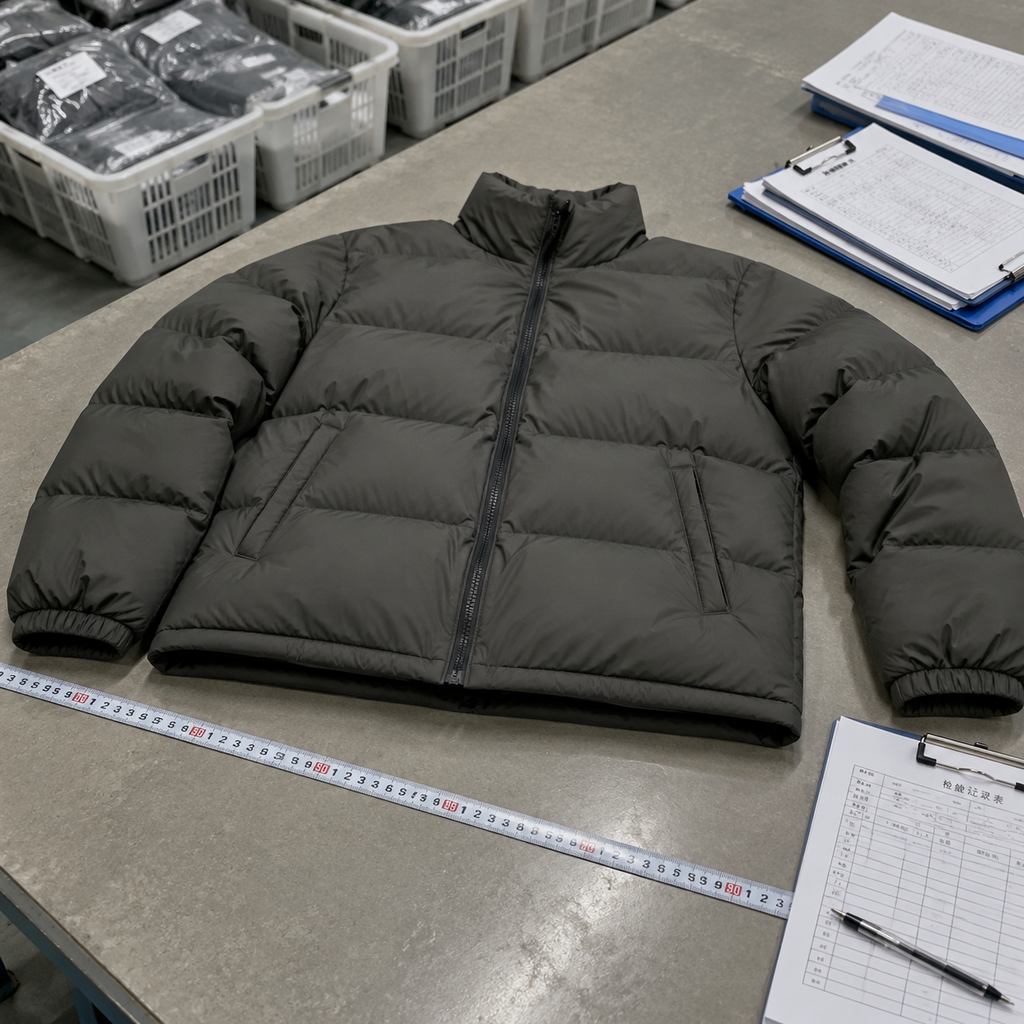
Seam construction is where jackets fail. Demand seam taping on all baffle seams and around the zipper. Verify by requesting a production sample cut open at the seam—tape should be continuous, not spliced. Check stitch density: 8–10 stitches per 3 cm is the usable range for downproof fabrics.
Verify capacity with documents. Ask for the production schedule for your order window, the number of down-filling machines (each handles roughly 150–250 jackets per shift), and a mid-production inspection date. A manufacturer who cannot show you a schedule cannot meet a deadline.
Scenario 2: Small Batch and Private Label
You need 200–500 units. The manufacturer’s MOQ is the first number to verify, but it is not the only one. Ask for the MOQ broken down: minimum fabric order, minimum trim order, and minimum production run. A factory that says "200 MOQ" but requires 500 meters of shell fabric (enough for ~800 jackets) has not actually lowered its MOQ.
Sample development is your quality gate. For small batches, the pre-production sample (PPS) is not optional. Insist on a PPS in the exact shell fabric, fill, and trims of the final order. Check fill distribution by weight: the jacket should be within ±5% of the spec sheet’s fill weight per size. Check baffle evenness by hand—lumps or thin spots indicate poor filling technique that will not improve at volume.
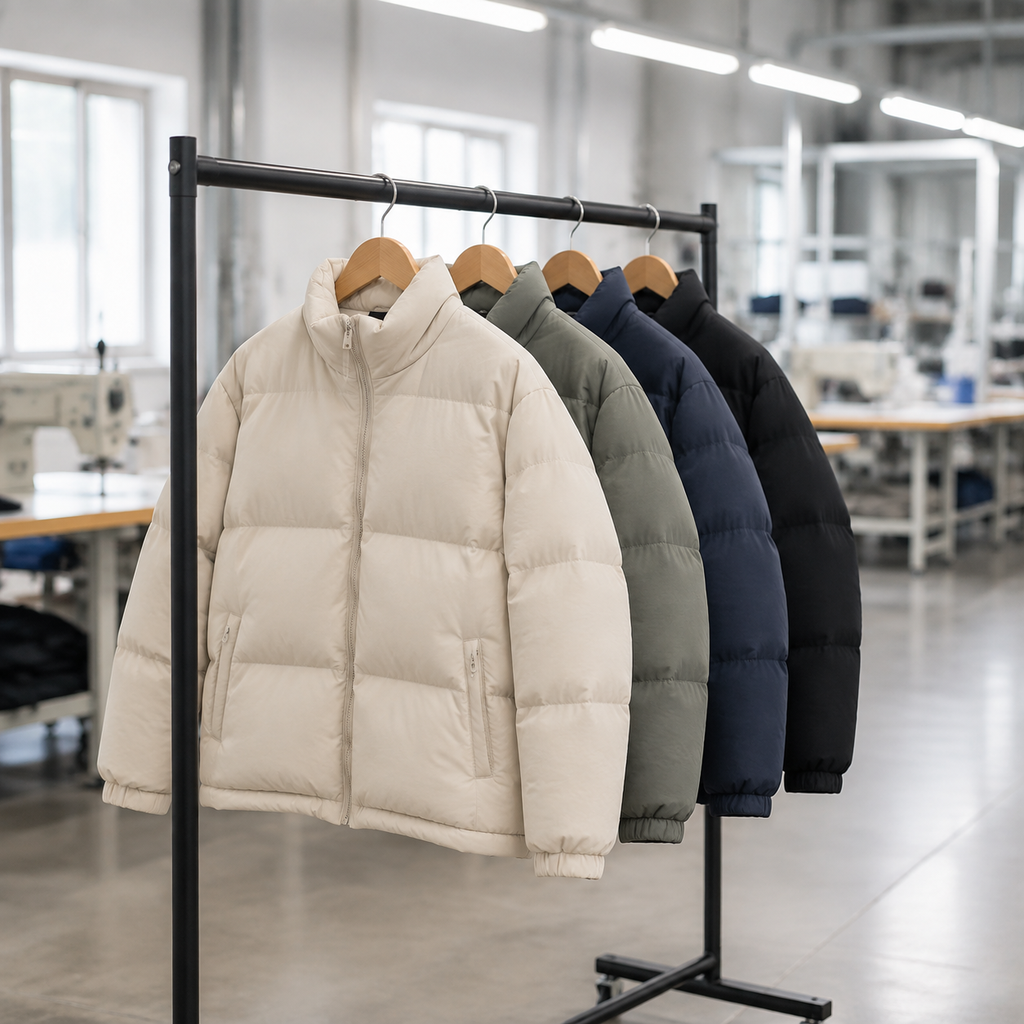
Verify small-batch capability without compromising quality. Ask whether the factory runs small batches on the same line as large orders or on a separate line. If it is the same line, ask how they handle fabric roll remnants—a 200-unit run may use only 60% of a fabric roll, and the manufacturer may try to substitute a different dye lot for the remainder. The avoidance move: specify that all units must come from a single dye lot, and verify with the fabric mill’s lot number on the packing list.
Scenario 3: ODM with Custom Design
When you license a manufacturer’s existing puffer design, the first question is ownership. Before sampling, get the design’s usage terms in writing: exclusive to your brand, or shared with other buyers? If exclusivity matters, expect a higher per-unit price or a development fee to buy out the design.
Your tech pack still matters. Even with an ODM base, you must specify the deviations: fill power, shell fabric weight, zipper type, and trim. Send a marked-up version of the manufacturer’s spec sheet rather than a from-scratch pack — it shortens the sample cycle.
Verify design capability by asking for three things: a lookbook of past ODM styles with the original tech packs, the fill weight and baffle construction for each, and a reference list of brands that licensed those designs. Confirm the manufacturer holds the pattern files and grading sets in-house; if they outsource pattern-making, lead time and revision control suffer.
Standards and Certifications to Demand
Four standards cover most puffer jacket risk. Demand each by designation, not by name alone.
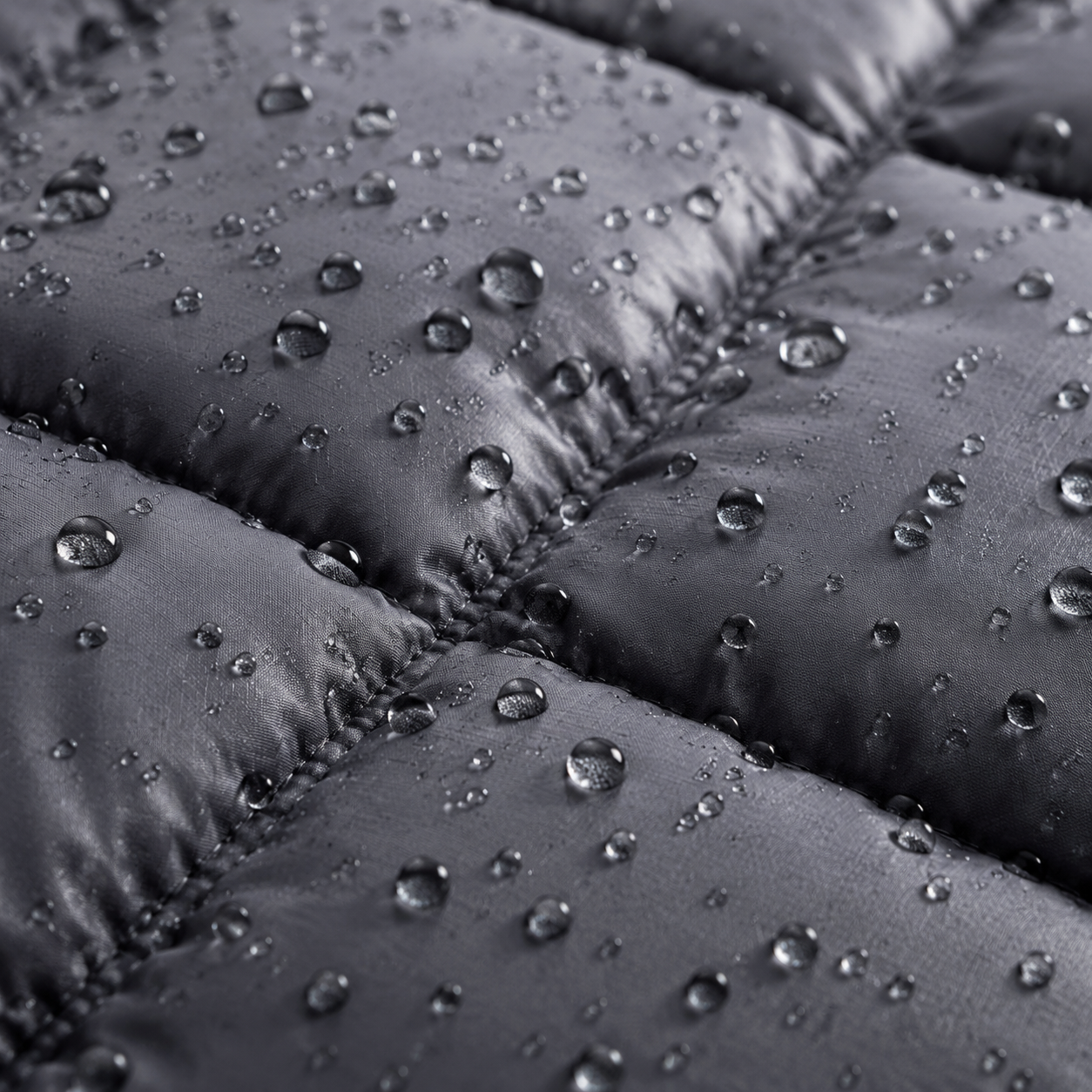
ISO 4920 — water repellency. Tested by spraying a panel and comparing the wetting pattern to reference photos. Verify the rating (e.g., ISO 4920:2012, grade 4) on the fabric supplier’s test report, not the manufacturer’s word.
ASTM D737 — air permeability. Measures cubic feet of air per square foot per minute through the shell. A tightly woven 20D nylon might read 5–10 CFM; a loose 40D weave can exceed 30 CFM. Your spec should state the target range, because it directly affects wind resistance.
OEKO-TEX Standard 100 — restricted substances. Covers dyes, finishes, and accessories. Check the certificate’s product class (I–IV); for outerwear, Class II applies. Confirm the certificate number on the OEKO-TEX database.
ISO 105-C06 — colorfastness. Tests dye migration under washing and perspiration. Demand a rating of 4 or higher on the grey scale for both color change and staining.
Ask for each certificate to be attached to the pre-production sample approval.
The Cost Factors That Move Your Quote
Five variables dominate your per-unit price. Each one you change shifts the quote.
Fill power — 650 FP down costs less than 800 FP. The spread is not linear; the jump from 700 to 800 FP typically costs more than 600 to 700.
Shell fabric weight — a 20D nylon shell uses less material by weight than a 40D, but the 20D often requires a lamination or coating for durability, which adds cost. Specify the denier and finish together.
Baffle construction — sewn-through baffles are cheaper and faster than box baffles. Box baffles use more fabric and labor, and they reduce cold spots. If your design requires box baffles, expect a meaningful increase.
Zipper quality — a YKK #5 coil zipper costs less than a #8 molded-tooth zipper. Water-resistant zippers add a further premium.
Trim — custom pulls, branded snaps, and embroidered patches each add a line item. Every trim SKU adds handling time.
Ask your manufacturer to quote each variable separately so you can see where the money goes.
MOQ, Lead Time, and Small Batch Production
Typical MOQs for puffer jackets range from 300–500 units per color per style for small-batch production, up to 1,000+ for OEM programs. Below 200 units, most factories will not quote unless you accept a development fee or a standard colorway.
Lead time splits into three components: sample development (7–14 days), fabric procurement (20–40 days, longer if the shell is custom-woven), and production (30–45 days). Small batches do not compress fabric lead time — the mill runs on its schedule, not yours.
| Checkable Item | What to Verify | Typical Small-Batch Value |
|---|---|---|
| MOQ per color | Written on the quotation, not verbal | 300–500 units |
| Sample lead time | Date on the sample approval form | 7–14 days |
| Fabric lead time | Mill’s shipping confirmation | 20–40 days |
| Production lead time | Factory’s production schedule | 30–45 days |
| Fill power tolerance | Test report per batch | ±10 FP of spec |
| AQL inspection level | Inspection report reference | Level II, 1.5/4.0 |
Confirm each number in writing before you commit. A factory that quotes a 20-day fabric lead time for a custom weave is either stocking the fabric or planning to substitute it.
Quality Control: AQL, Grading, and Inspection
Set your AQL at 2.5 for major defects and 4.0 for minor defects, per ISO 2859-1, General Inspection Level II. For puffer jackets, that means a lot of 500 units requires a sample size of 50; reject if you find more than 7 major defects.
Grading criteria must be written into the quality agreement before production. Check fill distribution by weighing the jacket before and after filling — tolerance is ±5% of the spec weight. Verify seam integrity by measuring seam strength on a tensile tester: minimum 150 N for shell seams, 100 N for lining seams. Check seam tape adhesion by peel test: 10 N/cm width minimum.
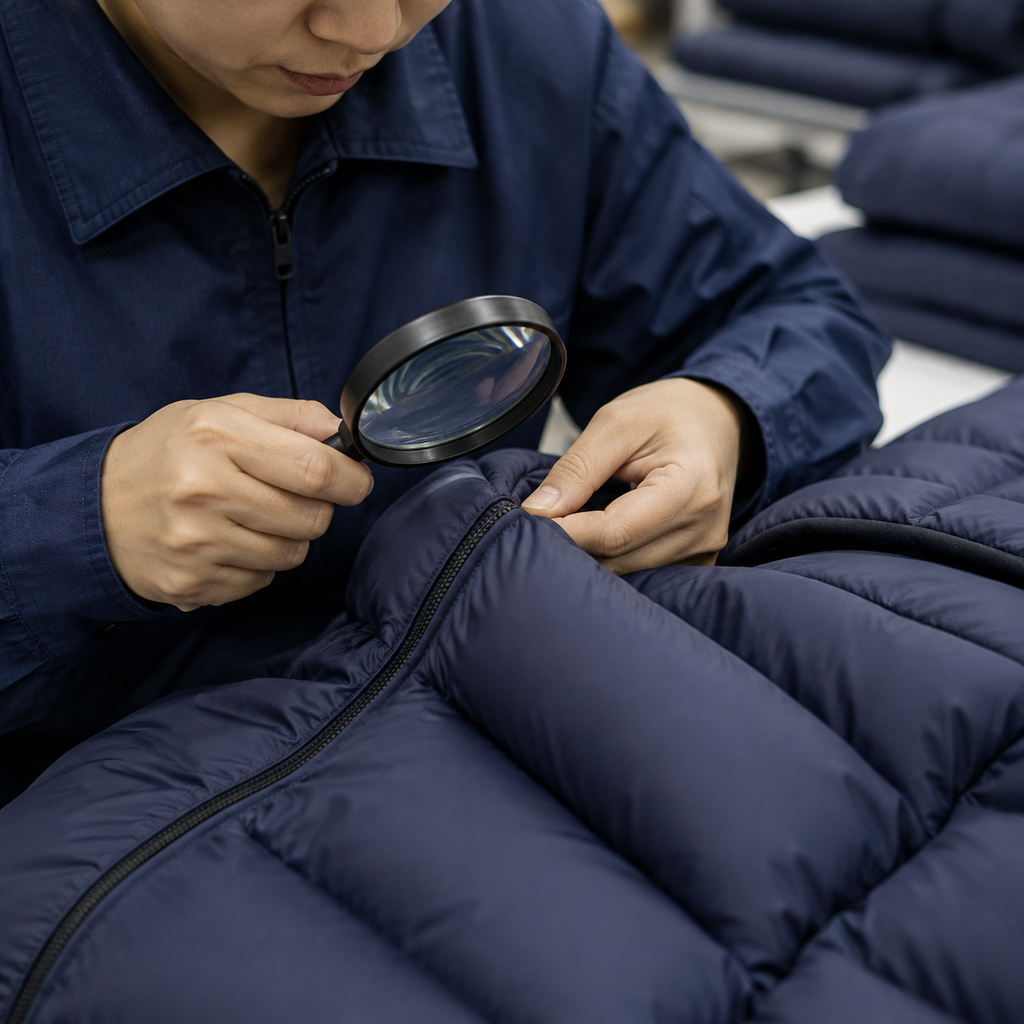
Inspection reports must show lot size, sample size, defect counts by category, and the AQL decision rule applied. Demand photos of each defect type found, not just a pass/fail summary. Record the inspector’s name and certification number on the report so the result is traceable.
Pitfalls to Avoid
Unverified fill power. A supplier may quote 700 fill power but ship 550. Avoidance: specify the test method (EN 12131) and the tolerance (±50 fill power) in your spec sheet. Require a certificate of analysis per lot, not per season. If the certificate is missing, reject the lot.
Missing seam tape. Puffer jackets leak fill through unsealed seams. Avoidance: write seam taping into the tech pack for all baffle seams and any seam that passes through the shell. Verify by inspecting the inside of the jacket — tape must cover the full seam length, not just the stress points. A 3 cm gap at the armhole is enough to lose fill over a season.
Vague MOQ terms. "MOQ 300" is meaningless without a unit. Avoidance: get the MOQ in writing as pieces per color per style, and confirm whether it applies to the first order only or to every reorder. Ask what happens if you order 250 — some factories accept it at a per-piece surcharge; others will not schedule the line. Record the answer in the quality agreement.
RFQ Checklist
Send the manufacturer’s engineer all of the following in one package:
Tech pack
- Flat sketches with measurements in cm
- Baffle construction diagram (horizontal, vertical, or box)
- Seam map with tape locations marked
Fill specs
- Fill power with test method (EN 12131) and tolerance
- Fill weight per size
- Down-to-feather ratio
Shell specs
- Fabric weight (g/m²)
- Weave construction and thread count
- Water repellency requirement (ISO 4920 rating)
Trim specs
- Zipper brand and size
- Cord, toggles, and hardware finishes
- Label placement and content
Quality standards
- AQL levels (2.5 major / 4.0 minor)
- Grading criteria for fill distribution and seam strength
- Required certifications (OEKO-TEX Standard 100)
Logistics
- Incoterms
- Target ship date
- Inspection point (mid-production, final, or both)
When a Custom Puffer Jacket Manufacturer Is the Wrong Choice
This route fails when your volume is under 150 pieces per style — the per-unit cost of pattern grading, sample development, and fill sourcing will exceed what the retail price can bear. It also fails when you need to replicate a trend within 3 weeks; a custom program runs 8–12 weeks minimum from tech pack to shipment. Finally, if you cannot produce a complete tech pack with measurements and construction details, you are not ready for custom manufacturing — you need a private label program with existing styles, not a factory building from your spec. In those cases, buy stock styles or work with a trading agent who handles the technical documentation for you.


Comments