

Women’s Clothing Factory in China: Industry Overview, Advantages & Future Trends
China has long been recognized as the world’s leading hub for apparel manufacturing.
As a Women’s Clothing Factory in China, we have witnessed the country’s rapid rise
in global women’s fashion production, supported by a complete industrial chain, efficient manufacturing systems,
and strong market responsiveness.
This article provides a comprehensive analysis of the development background, core competitiveness,
challenges, and future trends of women’s clothing factories in China, helping global buyers, brands,
and fashion startups better understand why China remains a key manufacturing destination.
Table of Contents
- Development Background & Current Situation
- Core Competitiveness of Women’s Clothing Factories in China
- Production Process & Quality Control System
- Challenges Faced by China Women Clothing Manufacturers
- Development Trends & Transformation Directions
- Conclusion & Industry Outlook
II. Development Background & Current Situation of China’s Women’s Clothing Factories
2.1 Historical Evolution
The evolution of the Women’s Clothing Factory in China can be divided into three stages.
In the early stage, factories mainly focused on small-scale processing driven by the reform and opening-up policy.
With the expansion of global trade, China gradually developed large-scale women’s clothing manufacturing capacity.
In the transformation stage, many factories shifted from pure OEM production to ODM services,
while exploring independent brand development. Today, China’s women clothing manufacturers are entering
a new stage of intelligent, digital, and personalized production.
2.2 Regional Distribution Characteristics
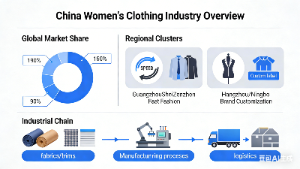
Women’s clothing factories in China are highly clustered by region:
- Southern China (Guangzhou, Shenzhen): Fast fashion, foreign trade, rapid sampling
- Eastern China (Hangzhou, Ningbo): Brand customization, e-commerce supply chains
These industrial clusters enhance supply chain efficiency and strengthen China’s global manufacturing competitiveness.
2.3 Industry Scale & Market Pattern
China is one of the largest exporters of women’s apparel globally, serving key markets such as Europe,
North America, Australia, and Southeast Asia. Enterprise types range from large brand-owned factories
to medium-sized foreign trade manufacturers and small customized workshops.
For buyers seeking reliable partners, choosing an experienced
women’s clothing factory in China
with stable production capacity is crucial.
III. Core Competitiveness of Women’s Clothing Factories in China
3.1 Complete Industrial Chain Support
One of the strongest advantages of a Women’s Clothing Factory in China
is its well-developed industrial chain.
- Upstream: Fabric, trims, and accessory suppliers
- Midstream: Cutting, sewing, ironing, and quality inspection
- Downstream: Packaging, logistics, and after-sales support
3.2 Cost Advantage & Production Efficiency
Through efficient resource allocation and mature production management,
China women clothing manufacturers maintain competitive costs while ensuring stable quality
and fast delivery cycles.
3.3 Technological Innovation & Intelligent Manufacturing
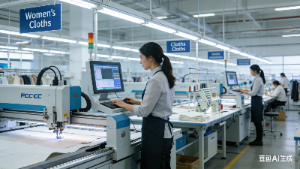
Modern women’s clothing factories in China actively adopt intelligent equipment such as CNC cutting machines,
automatic sewing lines, and digital production management systems to improve efficiency and reduce error rates.
3.4 Flexible Manufacturing Capabilities
From OEM and ODM production for global brands to small-batch customization for e-commerce sellers,
a professional women’s clothing factory in China can flexibly meet diversified order requirements.
Learn more about our ODM & OEM manufacturing services.
IV. Production Process & Quality Control System
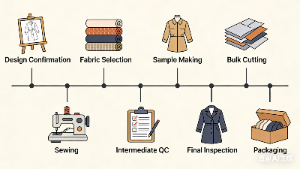
4.1 Full Production Process Overview
- Design confirmation and fabric selection
- Sample making and order approval
- Bulk cutting and sewing
- Intermediate quality inspection
- Final inspection, packaging, and warehousing
4.2 Quality Control Standards
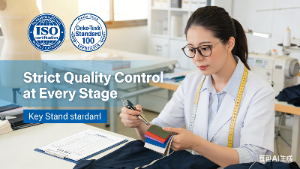
Reputable women clothing manufacturers in China follow strict quality control systems,
complying with international standards such as ISO and Oeko-Tex Standard 100.
Quality inspections are conducted at raw material, in-process, and final product stages
to ensure consistent quality.
V. Challenges Faced by China Women Clothing Manufacturers
5.1 External Pressures
Global trade fluctuations, tariff changes, and competition from emerging manufacturing countries
such as Vietnam and Bangladesh present ongoing challenges for women’s clothing factories in China.
5.2 Internal Challenges
Rising labor costs, environmental compliance expenses, and homogeneous competition
require factories to continuously upgrade technology and management systems.
VI. Development Trends & Transformation Directions
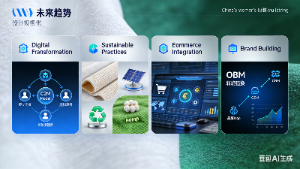
6.1 Intelligent & Digital Transformation
Future women’s clothing factories in China will increasingly rely on digital systems,
industrial internet platforms, and C2M (Customer-to-Manufacturer) models to support personalized customization.
6.2 Brand Building & Value Upgrade
Many manufacturers are transitioning from OEM to OBM, developing independent brands
and enhancing product value through design innovation.
6.3 Green & Sustainable Manufacturing
Sustainable development has become a key focus. Eco-friendly fabrics and energy-saving production processes
are now essential for global market compliance.
6.4 E-commerce & Cross-border Expansion
By integrating with e-commerce and cross-border platforms,
women’s clothing factories in China can directly connect with overseas consumers.
Explore our latest insights on the fashion manufacturing blog.
VII. Conclusion & Outlook
The Women’s Clothing Factory in China continues to play a vital role in the global fashion supply chain.
Despite challenges, its strong industrial foundation, flexible production capabilities,
and continuous innovation ensure long-term competitiveness.
Under the trend of digital transformation, branding, and sustainability,
China women clothing manufacturers are expected to maintain global leadership
and create greater value for international fashion brands.
If you are looking for a reliable manufacturing partner,
contact us today to discuss your project.
Comments