

Uniqlo’s OEM Factory in China: 30-Year Partnership, Large-Scale Production & Industry-Leading Innovation
When it comes to global fast fashion’s most reliable supply chain partners, Uniqlo’s OEM factory in China stands out as a benchmark of longevity, scale, and adaptability. For three decades, these manufacturing facilities have been the backbone of Uniqlo’s mission to deliver “LifeWear”—affordable, high-quality basics—to millions worldwide. Beyond mere production, the 30-year partnership between Uniqlo and its Chinese OEM factories has evolved into a synergy of innovation, sustainability, and operational excellence, redefining what it means to be a world-class apparel manufacturing hub.

1. The 30-Year Evolution: From Collaboration to Strategic Partnership
Uniqlo’s journey with Chinese OEM factories began in the early 1990s, a time when China was emerging as the “world’s factory.” What started as a modest collaboration—focused on producing core items like thermal underwear and basic tees—has grown into a deep, mutually beneficial alliance. Unlike short-term manufacturing contracts, Uniqlo’s OEM factory partnerships in China are built on shared goals: optimizing quality, reducing lead times, and co-creating products that resonate with global consumers.
Over the years, this partnership has transcended transactional relationships. Uniqlo works closely with its OEM factories to implement its “Total Quality Control” (TQC) system, training workers, upgrading equipment, and sharing data to streamline processes. For example, during the 2008 global financial crisis, Uniqlo doubled down on its Chinese OEM partners, investing in automation to enhance efficiency— a move that solidified the factories’ role as critical to Uniqlo’s global expansion. Today, the 30-year legacy of Uniqlo’s OEM factory in China is a testament to trust: these facilities produce over 60% of Uniqlo’s global apparel output, spanning everything from AIRism tees to Ultra Warm down jackets.

2. Large-Scale Production Capacity: Powering Uniqlo’s Global Supply Chain
One of the defining strengths of Uniqlo’s OEM factory in China is its unmatched large-scale production capacity. Spread across key manufacturing hubs like the Yangtze River Delta (Suzhou, Hangzhou) and Pearl River Delta (Dongguan, Shenzhen), these factories boast:
- Annual output of 500+ million apparel units: Enough to supply every person in North America with 1.5 Uniqlo items per year.
- 100+ production lines per factory: Specialized in knitting, weaving, dyeing, and finishing to handle diverse product categories.
- Flexible manufacturing capabilities: Able to scale production up by 30% during peak seasons (e.g., winter outerwear, summer basics) while maintaining lead times of 4–6 weeks.
This scale is made possible by China’s robust industrial ecosystem—access to raw materials (cotton, polyester), skilled labor, and efficient logistics networks. Uniqlo’s OEM factories in China also leverage economies of scale to keep production costs low, allowing Uniqlo to offer high-quality products at affordable prices globally.
3. Technological Innovation: Redefining Efficiency at Uniqlo’s OEM Factory
To stay ahead in the competitive apparel industry, Uniqlo’s OEM factory in China has embraced cutting-edge technology, moving beyond traditional manufacturing to “smart production”:
- Automated cutting systems: Computerized fabric cutters reduce waste by 15% and improve precision, ensuring consistent sizing across millions of garments.
- IoT-enabled production lines: Sensors track workflow in real time, identifying bottlenecks and reducing downtime by 20%.
- Digital pattern-making: 3D design software allows factories to test prototypes virtually, cutting development time by 30% and minimizing material waste.
- Smart warehousing: Automated guided vehicles (AGVs) and AI-powered inventory management systems speed up order fulfillment, ensuring products reach Uniqlo’s 2,300+ stores worldwide on time.
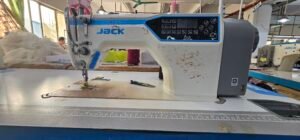
These innovations not only boost efficiency but also enhance the quality of Uniqlo’s products. For instance, automated sewing machines with precision stitching reduce defects to less than 0.5%—a rate far below the industry average of 3%.

4. Quality Control: The Non-Negotiable Standard for Uniqlo’s OEM Factory
Uniqlo’s reputation for durability and consistency hinges on the rigorous quality control (QC) processes at its Chinese OEM factories. Every step of production—from raw material inspection to final packaging—adheres to Uniqlo’s strict global standards:
- Raw material testing: Cotton and synthetic fabrics are checked for strength, color fastness, and safety (free from harmful chemicals) before production begins.
- In-line inspections: QC teams monitor production lines hourly, conducting random checks on stitching, seams, and sizing.
- Final audits: 100% of finished products undergo a final inspection, with samples sent to Uniqlo’s global QC labs for verification.
This uncompromising approach has made Uniqlo’s OEM factory in China a leader in quality assurance. In 2023, independent audits found that these factories maintained a 99.8% compliance rate with Uniqlo’s quality standards—higher than any other region in Uniqlo’s global supply chain.
5. Sustainability: Uniqlo’s OEM Factory Commits to Green Production
As consumers demand more eco-friendly fashion, Uniqlo’s Chinese OEM factories have emerged as pioneers of sustainable manufacturing. Key initiatives include:
- Renewable energy adoption: 70% of factories now use solar or wind power, reducing carbon emissions by 400,000 tons annually.
- Water conservation: Advanced dyeing technologies (e.g., air-dyeing) cut water usage by 60% compared to traditional methods.
- Waste reduction: Fabric scraps are recycled into insulation for jackets or repurposed into accessories, diverting 85% of waste from landfills.
- Eco-friendly materials: Factories prioritize organic cotton and recycled polyester, with 30% of Uniqlo’s core products now made from sustainable materials.
These efforts align with Uniqlo’s “ESG Vision 2030,” and have earned its Chinese OEM factories certifications like LEED (Leadership in Energy and Environmental Design) and OEKO-TEX Standard 100.
In an era of supply chain disruptions—from pandemics to trade tensions—Uniqlo’s OEM factory in China has demonstrated remarkable resilience. The 30-year partnership has fostered:
- Diversified production networks: Factories are strategically located to avoid regional disruptions, with backup facilities in inland provinces like Sichuan and Hubei.
- Agile response systems: During the COVID-19 lockdowns, factories quickly shifted to producing face masks and (protective clothing) for Uniqlo’s global markets, while resuming apparel production within weeks of reopening.
- Localized sourcing: 80% of raw materials are sourced from Chinese suppliers, reducing reliance on international shipping and cutting lead times.
This resilience has allowed Uniqlo to maintain stable inventory levels even during global crises, a key competitive advantage in the fast fashion industry.

Why Uniqlo’s OEM Factory in China Remains Irreplaceable
After 30 years, Uniqlo’s Chinese OEM factories are more than just manufacturing sites—they are strategic partners that drive innovation, quality, and sustainability. Their large-scale production capacity, technological prowess, and unwavering commitment to Uniqlo’s values have made them irreplaceable in the brand’s global supply chain.
As Uniqlo expands into new markets (e.g., Southeast Asia, Africa) and embraces new trends (e.g., circular fashion, customization), its OEM factories in China are poised to lead the way—adapting, innovating, and strengthening a partnership that has stood the test of time. For brands looking to build reliable, scalable manufacturing networks, Uniqlo’s OEM factory in China offers a masterclass in long-term collaboration and operational excellence.


Comments