
Uniqlo OEM Factories Exposed: 269 Chinese Plants Hold the Fort, Is Southeast Asia Replaceable?
In the latest exposure of global manufacturing layouts, Uniqlo , the renowned Japanese fast-fashion giant, has its network of 445 OEM factories laid bare. Among this sprawling supply chain, 269 factories are rooted in China, accounting for nearly 60% of the total. This striking data not only highlights China’s pivotal role in Uniqlo’s global production system but also sparks a heated discussion in the industry: as Uniqlo gradually expands its manufacturing footprint in Southeast Asia, can these emerging factories truly replace China’s irreplaceable position in the Uniqlo OEM chain?

China’s 269 Uniqlo OEM Factories: More Than Just Numbers, the Backbone of Supply Chain
When talking about Uniqlo OEM factories in China, the number 269 is far from a cold statistic—it represents a mature and resilient industrial ecosystem. These factories are not concentrated in a single region but spread across Guangdong, Jiangsu, Zhejiang, Fujian and other coastal provinces, as well as Sichuan, Hubei and other inland manufacturing hubs. This decentralized yet interconnected layout enables Uniqlo to respond quickly to market changes while avoiding supply chain disruptions caused by regional risks.
What truly makes Chinese Uniqlo OEM factories irreplaceable is their comprehensive capabilities. First, the complete industrial chain support is unparalleled. From high-quality cotton spinning, functional fabric production to precision cutting and automated sewing, every link of Uniqlo’s product manufacturing can find professional supporting enterprises within a radius of hundreds of kilometers in China. This “localized supporting” model greatly shortens the production cycle. For example, a batch of Uniqlo’s classic HEATTECH thermal underwear can complete the entire process from fabric customization to finished product shipment in as little as two weeks in China, while in many other regions, this cycle often takes more than a month.
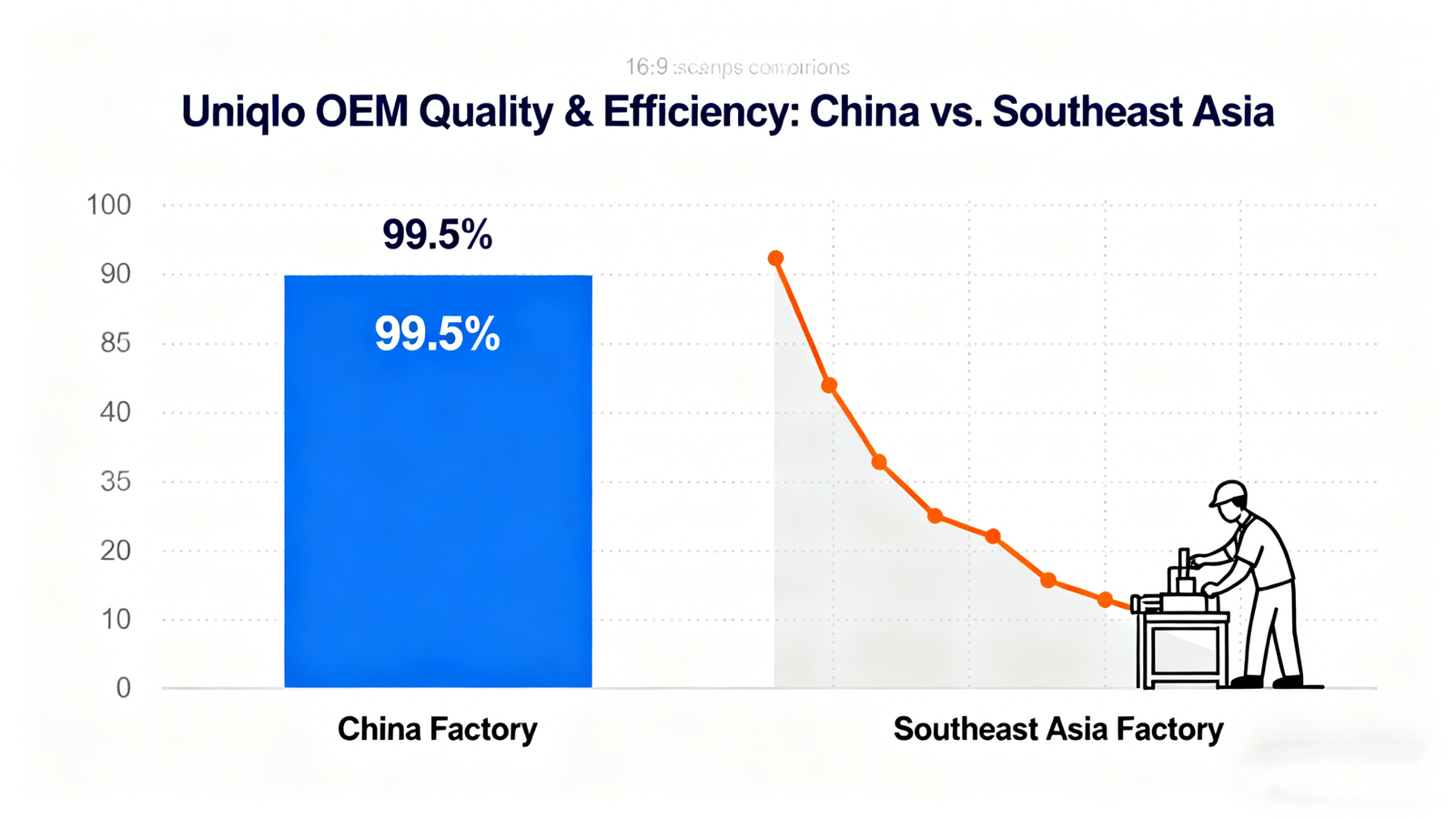
Second, the technical level and quality control system of Chinese factories are deeply recognized by Uniqlo. Uniqlo’s products are known for their high quality and durability, which puts strict requirements on the production process. Chinese Uniqlo OEM factories have accumulated rich experience in decades of cooperation. They not only master the core technologies of producing functional fabrics such as AIRism and Ultra Warm but also have established a set of quality inspection standards that are fully aligned with Uniqlo’s global requirements. According to Uniqlo’s internal quality report, the pass rate of products from Chinese factories has remained above 99.5% for a long time, far exceeding the average level of OEM factories in other regions.
Southeast Asia Uniqlo Factories: Cost Advantages vs. Development Bottlenecks
Against the backdrop of rising labor costs in China, Uniqlo has indeed increased its investment in Southeast Asian countries such as Vietnam, Cambodia, and Indonesia in recent years. At present, Southeast Asia has about 120 Uniqlo OEM factories, accounting for nearly 27% of the global total. The main driving force for this layout is the obvious labor cost advantage— the average monthly salary of workers in Southeast Asian factories is only 1/3 to 1/2 of that in coastal Chinese factories.
However, behind the cost advantage, Southeast Asian Uniqlo manufacturing plants are facing multiple development bottlenecks that are difficult to break through in the short term. The most prominent problem is the incompleteness of the industrial chain. Taking Vietnam, which has the largest number of Uniqlo OEM factories in Southeast Asia, as an example, more than 70% of the fabrics, threads, zippers and other accessories needed for production must be imported from China. This not only increases the transportation cost and production cycle but also makes the supply chain highly dependent on cross-border logistics, which is easily affected by factors such as customs clearance and transportation delays.
In addition, the shortage of skilled workers and unstable production capacity are also major pain points for Southeast Asian factories. Uniqlo’s production process involves many fine operations, especially the production of functional clothing, which requires workers to have certain technical literacy and operational experience. However, the labor market in Southeast Asia is relatively fragmented, and the mobility of workers is high. Factories often face the problem of insufficient skilled workers, resulting in unstable production efficiency and product quality. According to industry data, the production efficiency of Southeast Asian Uniqlo OEM factories is about 30% lower than that of Chinese factories.

Uniqlo’s OEM Strategy: Balancing Dependence and Diversification
The exposure of the 445 global OEM factories also reveals Uniqlo’s subtle balance in its supply chain strategy. On the one hand, China’s 269 factories are still the core of Uniqlo’s OEM system. Uniqlo’s annual report clearly states that China is its most important production base, and the company will continue to strengthen cooperation with Chinese factories to promote technological upgrading and product innovation. In recent years, Uniqlo has invested a lot of money to help Chinese OEM factories introduce automated production lines and digital management systems, further improving production efficiency and product quality.
On the other hand, Uniqlo’s layout in Southeast Asia is more of a risk diversification strategy rather than a complete replacement of China. By distributing part of the production capacity to Southeast Asia, Uniqlo can not only reduce the impact of rising labor costs in China but also avoid supply chain risks caused by regional trade frictions and policy changes. However, this diversification is based on the premise of not weakening the core position of Chinese factories. At present, most of the high-value-added products such as functional clothing and designer co-branded products of Uniqlo are still produced in Chinese factories, while Southeast Asian factories mainly undertake the production of low-value-added products such as basic T-shirts and casual pants.

The Future of Uniqlo OEM : China’s Core Position Remains Unshakable
Looking ahead, the pattern of Uniqlo’s global OEM supply chain will continue to be “China-centered and Southeast Asia supplemented”. With the continuous upgrading of China’s manufacturing industry, the advantages of Chinese Uniqlo OEM factories are no longer limited to cost and scale, but more reflected in technological innovation, industrial chain integration and rapid response capabilities. For example, some Chinese factories have begun to develop intelligent production systems, realizing real-time monitoring of the production process and traceability of product quality, which has further enhanced their competitiveness in cooperating with Uniqlo.
For Southeast Asian factories, it will take a long time to truly become a substitute for Chinese factories. They not only need to solve the problems of industrial chain supporting and skilled workers but also need to improve the level of quality control and logistics efficiency. In the short term, Southeast Asia will still be an important supplementary production base for Uniqlo, but it is difficult to shake China’s core position in the Uniqlo OEM system.
In conclusion, the exposure of Uniqlo’s 445 global OEM factories tells us that China’s manufacturing industry still has irreplaceable comprehensive advantages in the global supply chain. For Uniqlo, maintaining close cooperation with Chinese factories while moderately expanding the Southeast Asian market is the most rational supply chain strategy. And for the global fashion industry, this pattern also provides a valuable reference for the layout of their own OEM supply chains.



Comments