
Shenzhou International: Growth Logic and Industry Insights of the Global Apparel ODM Leader
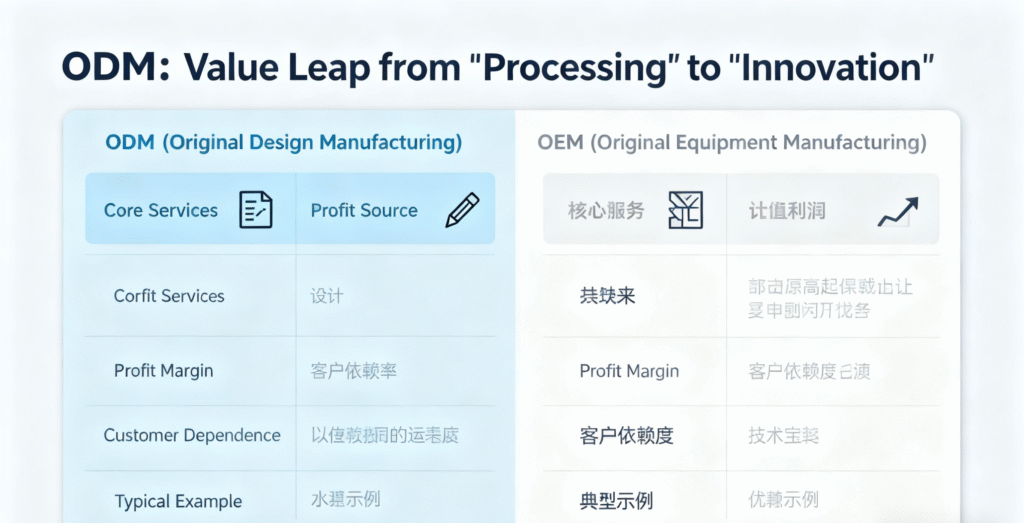
In the global trillion-yuan apparel market, the apparel ODM (Original Design Manufacturing) model, with its integrated capabilities of “design + production”, has become a core link connecting brand needs and manufacturing capacity. As the world’s largest apparel ODM factory, Shenzhou International not only leads the industry with 28.66 billion yuan in revenue and 6.24 billion yuan in net profit in 2024, but also has redefined the value boundaries of apparel ODM enterprises. This article will analyze Shenzhou International’s success factors and explore the survival logic of enterprises of different sizes in the apparel ODM ecosystem.
1. Analysis of the Apparel ODM Model: A Value Leap from OEM to Innovation
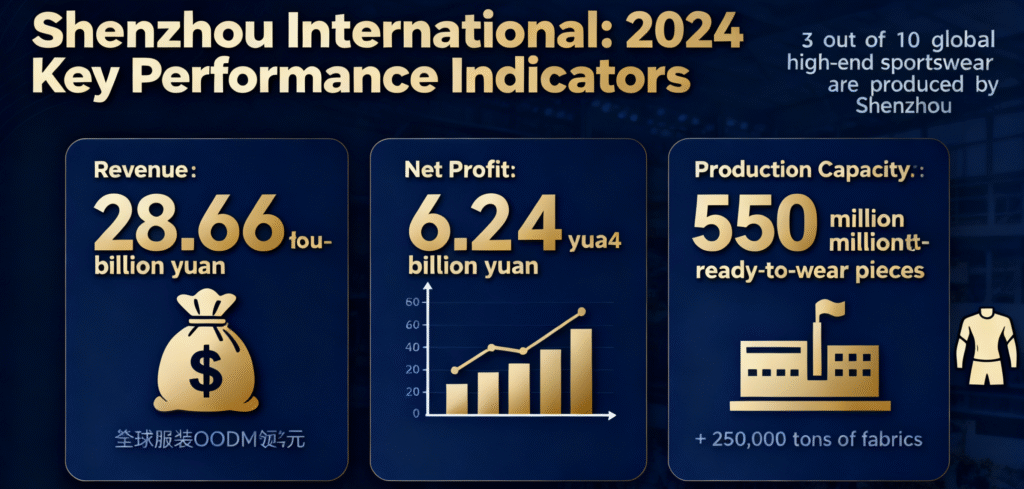
To understand Shenzhou International’s position, it is first necessary to clarify the core value of the apparel ODM model — it is fundamentally different from the traditional OEM (Original Equipment Manufacturing) model. In the OEM model, manufacturers only undertake the production link, with profits limited to meager processing fees (usually a profit margin of only 3%-8%), and are completely dependent on the brand’s design and orders. In contrast, the apparel ODM model centers on independent design, allowing manufacturers to deeply participate in product R&D and fabric innovation, and achieve higher returns through design premiums plus production profits, with profit margins reaching 15%-25% or even higher.
Shenzhou International’s development path is a microcosm of the upgrading of the apparel ODM model. Founded in 1988, the company started with OEM production and completed its strategic transformation to apparel ODM after 2012, achieving a value leap by integrating into the customer’s R&D system. Today, it not only provides production services for brands but also serves as an “external R&D department” for giants like Nike and Adidas, completely breaking free from the passive position of traditional OEM.
2. Shenzhou International: The Undisputed Benchmark in the Global Apparel ODM Industry
1. Dual Leadership in Scale and Profitability: The Pinnacle Performance of Apparel ODM
Shenzhou International’s industry status is supported by solid data: in 2024, it achieved an annual production capacity of 550 million ready-to-wear pieces and 250,000 tons of fabrics — 3 out of every 10 high-end sportswear items worldwide are produced in its factories. In terms of profitability, its net profit margin reached 21.77% in 2024, which not only far exceeds the average level of the apparel ODM industry but also surpasses the profit margins of core customers like Nike, making it an “profit miracle” in the industry.
In terms of market coverage, the company’s business spans major global apparel consumer markets. In 2024, 72% of its revenue came from overseas markets, with a 31.5% growth in the Japanese market and an 18.9% growth in the U.S. market. This diversified layout effectively resists the risks of regional fluctuations.
2. Customer Matrix: An Apparel ODM Ecosystem Tied to Global Top Brands
Shenzhou International’s customer list is like a “who’s who” of global apparel brands, including top 10 market leaders such as Nike, Uniqlo, Adidas, and Puma. In 2023, it accounted for approximately 30% of Nike’s ready-to-wear suppliers, and each of the top five customers contributed an average of 4.28 billion yuan in revenue. This deep binding stems from the irreplaceability of its apparel ODM services.
To strengthen cooperation stickiness, the company implements a “dedicated factory” model, creating a one-stop closed-loop service from R&D to delivery for core customers. For example, it jointly established a laboratory with Nike in Ningbo, realizing “shared R&D results and exclusive production process patents”. This symbiotic relationship makes it difficult for brands to replace suppliers easily.
3. Shenzhou International’s Core Competitiveness: Building a Moat for Apparel ODM
1. Vertical Integration: An Efficiency Revolution in Apparel ODM
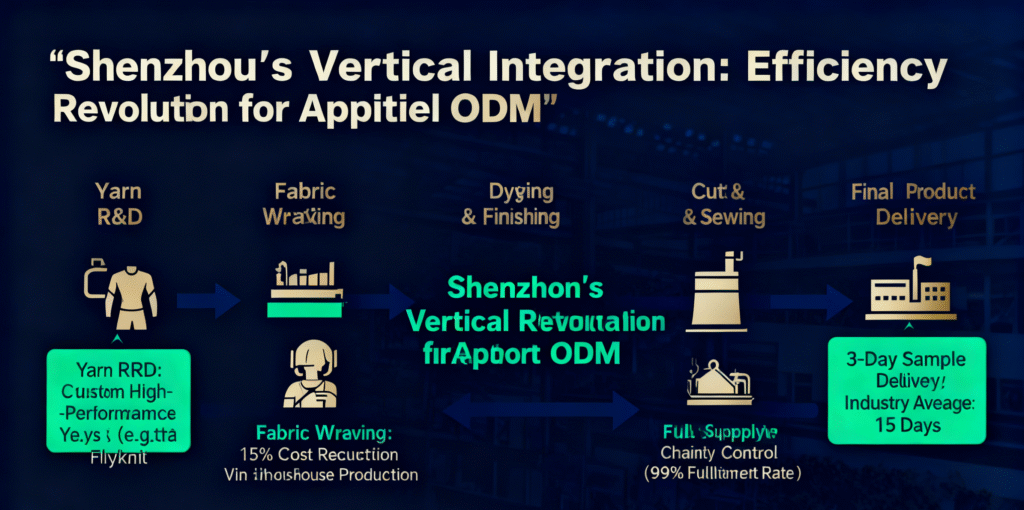
Shenzhou International has built a full-process production system covering yarn R&D, fabric weaving, dyeing and finishing, and cutting and sewing, concentrating all core processes in the same industrial zone. This vertical integration model brings three major advantages:
- Cost Optimization: Reduces transportation losses between processes and significantly lowers unit fixed costs;
- Quality Control: Full-chain quality management ensures a product fulfillment rate of over 99%;
- Speed Advantage: Through digital transformation, it achieves “order receipt within 3 hours, production scheduling within 30 minutes, and delivery of the first batch of samples within 3 days” — far exceeding the industry average of 15 days.
In 2024, its asset turnover ratio reached 0.85, higher than the industry average of 0.7, confirming the efficiency advantages of the integrated model.
2. R&D-Driven: The Core Value of Apparel ODM
R&D is the soul of Shenzhou’s apparel ODM model. The fabrics jointly developed by the company and its brands — such as Nike’s Flyknit, Uniqlo’s HEATTECH, and Uniqlo’s AIRism — have become industry classics. These high-performance fabrics, with functions like moisture-wicking, antibacterial, and thermal insulation, increase the gross profit margin of individual products by 15%-20%.
In terms of R&D mechanism, Shenzhou deeply binds customers through a “shared patents + exclusive processes” model: in the joint laboratory with Nike, R&D results are shared by both parties, but production process patents belong exclusively to Shenzhou, forming a unique technical barrier. In 2024, revenue from high-margin underwear products grew by 34.6%, with a gross profit margin exceeding 30% — a direct reflection of the value of R&D.
3. Global Layout: A Risk-Resistant Network for Apparel ODM
To balance costs and trade risks, Shenzhou has formed a three-region layout:
- China (47% of production capacity): Focuses on high-end fabric R&D and core technology reserves;
- Vietnam (27% of production capacity) and Cambodia (26% of production capacity): Leverage labor cost advantages (in 2021, the monthly income of Vietnamese employees was 2,173 yuan, only 24% of that in China) and tax incentives (10% income tax rate and a 4-year tax exemption period in Vietnamese industrial zones) to reduce costs.
This layout enabled it to maintain stable growth amid global tariff fluctuations in 2025, with overseas business contributing 72% of revenue while effectively avoiding single-market risks.
4. Insights from Shenzhou: Future Development Directions for the Apparel ODM Industry
Shenzhou International’s success points out three major upgrading paths for the apparel ODM industry:
1. From “Production OEM” to “Technological Collaboration”
The core competitiveness of apparel ODM has shifted from production scale to technological innovation. Shenzhou’s “joint R&D + exclusive process” model with customers proves that only by deeply integrating into the brand’s product system can enterprises break free from price competition and gain design premiums.
2. Dual Drive of Digitalization and Green Development
Digitalization is the key to efficiency improvement — Shenzhou optimized its multilingual websites through Google SEO tools and used Google Analytics to analyze market demand, achieving 28.8% export growth. Green development creates business value: its water-saving technology led Nike to be willing to pay a 15% price increase per unit, confirming the symbiotic relationship between environmental protection and profitability.
3. Building a “Customer Symbiosis” Ecosystem
Apparel ODM enterprises should transform from “suppliers” to “innovation partners”. Shenzhou’s “dedicated factories” and “order filtering mechanism” (rejecting non-core orders with a gross profit margin below 25%) realize long-term win-win cooperation with brands through accurate matching of high-value customers.
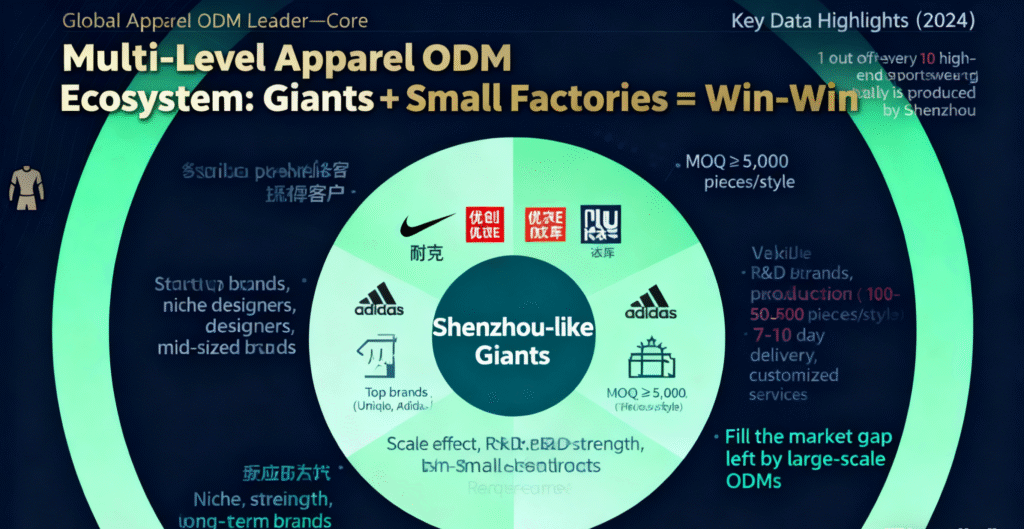
5. Complementary Force in the Apparel ODM Ecosystem: The Differentiated Survival Space of Small Factories
However, Shenzhou International’s scale advantages also come with certain cooperation thresholds — to ensure production capacity utilization, it usually requires cooperative brands to meet a high minimum order quantity (MOQ), such as no less than 5,000 pieces per style, and to sign annual fixed order agreements. While this model is suitable for the needs of top brands like Nike and Uniqlo, it deters mid-sized brands, startup brands, or niche designer brands.
It is this market gap that allows small apparel ODM factories focusing on small-batch services to find a differentiated position. Their core advantages focus on three aspects:
- Flexible Production: Supports small-batch orders of 100-500 pieces per style, meeting the production needs of startup brands for “product testing” and “niche designs” and avoiding inventory overstock risks;
- Rapid Response Capability: No need to align with large-scale production scheduling, enabling “delivery within 7-10 days for small-batch orders”, which adapts to the “rapid iteration and flexible adjustments” operation rhythm of small and medium-sized brands;
- Customized Services: Can deeply meet niche needs, such as custom eco-friendly fabrics and special process processing (e.g., hand embroidery, partial printing), with lower communication costs, making it more suitable for the “small but refined” product strategy of small and medium-sized brands.
Although these small factories do not have Shenzhou International’s scale and R&D capabilities, they have become an important supplement to the apparel ODM industry by “accurately serving segmented needs”. Together with leading enterprises, they form a multi-level industry ecosystem covering “large-scale production for top brands + flexible production for small and medium-sized brands”.
Conclusion: The Diverse Value of the Apparel ODM Industry Stems from Accurate Positioning
Shenzhou International’s rise proves the possibility for apparel ODM enterprises to build a moat through “technology + scale + ecosystem”. The survival logic of small factories, on the other hand, confirms the diverse value of the apparel ODM industry — whether it is a large-scale leader serving global giants or a flexible factory focusing on niche needs, as long as they accurately match the core needs of target customers, they can find a foothold in the industry.
For industry participants, clarifying their own positioning (whether to be “supporters of global leaders” or “experts in niche markets”) and focusing on core advantages (whether to strengthen R&D capabilities or optimize flexible production capacity) is the key to sustainable development in the apparel ODM track.


Comments