

Beyond H&M’s Storefronts: Unpacking H&M’s OEM – The Engine Powering Fast Fashion’s Speed & Style
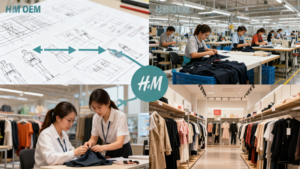
Walk into any H&M store, and you’ll spot on-trend pieces paired with perfectly distressed jeans – all priced to grab. But here’s a secret: none of these items are made in H&M-owned factories. That’s where H&M’s OEM comes in: the hidden backbone of the brand’s ability to drop new collections faster than you can scroll your Instagram feed. Let’s pull back the curtain on H&M’s OEM – how it works, who’s involved, and why it’s the secret sauce of fast fashion.
What Is H&M’s OEM, and Why Is It Non-Negotiable for Fast Fashion?
OEM (Original Equipment Manufacturing) refers to the process where H&M partners with third-party factories to design, produce, and assemble clothing under its brand name. For H&M – a brand built on “fast fashion” – H&M’s OEM isn’t just a choice; it’s the foundation of its business model.
Unlike luxury brands that own in-house production lines, H&M’s OEM network lets the brand pivot instantly when a viral TikTok trend hits: an OEM partner can adjust fabric orders, scale production, and ship new styles to stores in 2–3 weeks. This agility is why H&M’s OEM is the unsung hero behind those “I need that now” pieces in your cart.
The Global Web of H&M’s OEM Suppliers: Who Makes Your H&M Clothes?
H&M’s OEM network spans 20+ countries, with most production centered in Asian hubs like Bangladesh, China, and Vietnam. These factories aren’t just “sewing shops”: many H&M’s OEM partners specialize in niche skills – from knitting the soft knit sweaters (like the olive style in our lead image) to distressing denim for that lived-in look.
For example, a Guangdong-based H&M’s OEM factory might handle knitwear orders, while a Bangladesh facility focuses on denim – all coordinated by H&M’s global sourcing team to keep collections rolling. This decentralized setup lets H&M tap into regional expertise while keeping production costs competitive.

Speed vs. Responsibility: The Ongoing Challenges of H&M’s OEM
H&M’s OEM success comes with tradeoffs. Fast timelines can pressure H&M’s OEM suppliers to cut corners – whether on fair wages or eco-friendly materials. In recent years, H&M has faced scrutiny over its OEM partners’ labor conditions, prompting stricter audits for H&M’s OEM facilities.
On sustainability, H&M’s OEM is slowly shifting: some partners now use recycled fabrics, but scaling these changes across hundreds of H&M’s OEM factories remains slow and costly. For consumers, this means that affordable H&M sweater might carry hidden costs tied to its OEM production.
How H&M’s OEM Keeps Up With Your Ever-Changing Style
Today’s fashion fans want what’s trending this week – not next season. H&M’s OEM is built for this pace: when a micro-trend (like ruffled-collar sweaters, as seen in our featured looks) blows up on Instagram, H&M’s design team shares specs with H&M’s OEM partners within days. Top H&M’s OEM factories can prototype a style in 48 hours, then ramp up to 10,000 units in a week.
This speed is why H&M’s OEM doesn’t just make clothes – it turns viral moments into wearable (and affordable) pieces before the trend fades.

Next time you pick up a H&M sweater or pair of jeans, remember: it’s the product of a global H&M’s OEM network balancing speed, style, and cost. While H&M’s OEM has flaws, it’s also why fast fashion feels so accessible – and its future hinges on merging that speed with responsibility.

Comments