

The China-India Competition in the Global Women’s Apparel Manufacturing Landscape: Analyzing the Core Advantages of Chinese Manufacturers
In the global division of labor in the women’s apparel industry, China and India, leveraging their labor and resource advantages, have become two core production bases. India, with its natural raw material reserves and low-cost labor, has established a significant presence in specific niche markets. Meanwhile, Chinese women’s apparel manufacturers, leveraging decades of industry experience, have built a competitive advantage across the entire supply chain, playing an irreplaceable, core role in the global supply chain. The gap between the two lies not only in production scale but also stems from systemic differences in the integrity of their supply chains, technological innovation, and market responsiveness.
- Depth of the Supply Chain: Full Control from Raw Materials to End Products
The core advantage of China’s women’s apparel manufacturing industry stems from its unparalleled supply chain integrity. From the global fabric distribution center in Keqiao, Shaoxing, Zhejiang, to the “spinning-dying-sewing-sales” closed loop in Mule Town, Guangxi, to the “cotton-spinning-weaving-apparel” full-process layout in the Aral Economic Development Zone, Xinjiang, China has formed dozens of distinctive industrial clusters, achieving a seamless transition from basic raw materials to end products. In Keqiao, a “Baibu Robot” can match all the parameters of a desired fabric in just two minutes, clearly showing everything from knitting patterns to component ratios. In Mule Town, an industrial ecosystem comprised of over 500 companies collaborates across the entire process from design to shipment, with an annual output of over 300 million sets. - This clustering effect results in extreme cost control and efficiency improvements. Within core industrial zones, Chinese manufacturers can handle all aspects of the process, including fabric sourcing, auxiliary material supply, printing and dyeing, all in one place. This reduces procurement costs by 20%-30% compared to a decentralized layout, and shortens logistics cycles to 3-7 days. In contrast, despite India’s resource advantage as one of the world’s largest cotton producers, its industrial structure is fragmented, with insufficient investment and outdated equipment. Sixty percent of textile mills still use 20-year-old machinery, and the processing cost from raw cotton to finished garments is over 15% higher than in China. Production interruptions are often caused by auxiliary material shortages. Raw cotton exported from India’s Mumbai Port, after being processed in China, is increased eightfold through intelligent production systems. This disparity in the value chain directly reflects the difference in industrial chain integrity.
- 2. Technological Innovation: Digitalization Reshapes the Production Paradigm
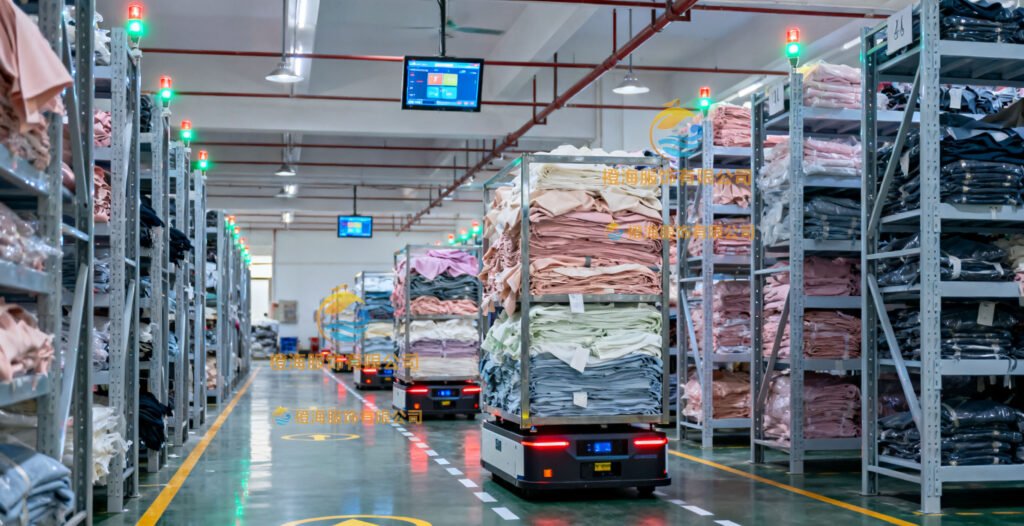
- Digitalization and intelligentization are reshaping the competitive landscape of women’s apparel manufacturing, and China’s leading edge in this sector is particularly significant. From AI-powered design to intelligent production, Chinese manufacturers have established a comprehensive digital ecosystem. Zhijing Technology’s Fashion Mind system generates clothing designs in just four seconds. Using AI, a single designer can create tens of thousands of designs per month, equivalent to the annual output of five traditional brands. Hanbo Group’s smart factory, through IoT-enabled sewing machines, enables real-time visualization of production data, reducing defect rates by over 20% and increasing production efficiency by 30%.
- On the production side, China’s intelligent transformation has been implemented on a large scale. In a textile workshop in Jiangsu, a single fully automatic winding machine can replace 20 workers, with an error rate as low as 0.1%. A knitting factory in Foshan, connected to a cloud-based system by sensors, has reduced downtime by 35% and reduced errors in incoming and outgoing goods to near zero. These technological investments have led to a qualitative leap in production efficiency. While China’s ring yarn production costs are slightly higher than those in India, its output per unit time is 2.3 times that of India, resulting in superior overall efficiency. India’s technological advancement lags significantly behind. Its textile industry remains dominated by traditional handicrafts and labor-intensive production, with a digital penetration rate of less than 10%. Unstable power supply (average annual power outages exceeding six hours per day) hinders continuous production. While India has unique strengths in areas such as traditional sari design, the technological gap in standardized and efficient production required for fast fashion makes it difficult to meet the delivery requirements of international brands.
- III. Efficiency and Quality: A Mature System Balancing Scale and Quality
- Chinese women’s clothing manufacturers have developed the dual capabilities of “large-scale production + flexible customization,” enabling them to handle million-level orders from brands like Zara and H&M while also meeting the “small-order, quick-response” needs of e-commerce platforms. This balancing act stems from a sophisticated production management system. Nearly 3,000 companies in the Humen Garment Industry Cluster have developed a differentiated division of labor, generating annual sales exceeding 84.5 billion yuan and serving both high-end brands and the mass market. Shaoxing Keqiao, through the development of “three high-tech zones,” has achieved a comprehensive upgrade of its supply chain, from fabric research and development to fashion shows. Its products have been showcased on international stages such as the Paris Olympics.
- The maturity of quality control systems has further widened the gap between China and India. Chinese garment companies of all sizes generally hold ISO international certification and have established comprehensive quality control standards, from raw material testing to finished product acceptance. The qualified rate for exported products remains consistently above 99%. However, due to inconsistent quality control standards, the return rate for women’s clothing in India remains high. The return rate for women’s clothing in India’s e-commerce market is as high as 30%-35%, 1.5 times higher than that of similar markets in China. Frequent returns result in annual losses of $20-30 billion for Indian sellers. This disparity in quality stability has led international brands to prefer placing core orders with Chinese manufacturers.
- IV. Policies and Infrastructure: The Underpinning Support for Industrial Development
- China’s comprehensive infrastructure and industrial policies provide a solid foundation for women’s clothing manufacturing. From the upgraded logistics network under the Belt and Road Initiative to the precise layout of textile and garment industrial parks, policy dividends continue to be unleashed. The Guiping Textile and Garment Industrial Park has invested 7.5 billion yuan to develop a comprehensive industrial chain ecosystem, and is expected to have a production capacity of tens of billions of yuan upon completion in 2025. The Aral Economic Development Zone, leveraging its “three major raw materials + comprehensive industrial chain” strategy, has maintained output value growth exceeding 40% for two consecutive years. In the logistics sector, customs clearance efficiency at hub ports like Qingdao Port is three times that of Mumbai Port in India, significantly shortening the delivery cycle for international orders.
- Although India has designated the textile industry as a pillar industry, its infrastructure shortcomings have become a bottleneck to its development. Inefficient ports and high road transport costs result in international delivery times for Indian women’s clothing being 15-20 days longer than in China. Insufficient power supply and fragmented policy implementation further undermine India’s cost advantage. World Bank data shows that logistics costs account for 14% of India’s manufacturing industry, compared to only 8% in China. This gap is particularly critical in the low-margin women’s clothing industry.
Conclusion: The Essence of Chinese Manufacturers’ Global Competitiveness
The gap between Chinese and Indian women’s clothing manufacturers is essentially a generational difference in their industrial development stages. India remains at the primary stage of competition based on “resources + labor,” while China has entered the advanced dimension of competition based on “industry chain + technology + ecosystem.” From Keqiao’s fabric innovation to Hanbo’s intelligent production, from Humen’s brand clusters to Mule’s flexible supply chain, China’s women’s clothing manufacturing industry is defining global industry standards with its comprehensive supply chain advantages.
In an era where fast fashion and sustainable consumption coexist, this advantage is further highlighted. Chinese manufacturers can not only achieve market responsiveness with “three-day shipping” through digitalization, but also meet green demands through innovations such as graphene fiber and recycled materials. For global brands, choosing Chinese women’s clothing manufacturers is not just about cost and efficiency, but also about supply chain stability, quality reliability, and continuous innovation. These are the irreplaceable core values of China’s women’s clothing manufacturing industry.
工厂关键词:#sourcing from China #apparel #cloth factory #customprocucts #odm #oem
clothing factory #apparel mamufacturer #Women‘s clothing wholesaler #apparel
Looking for Made-in-China 𝐎𝐄𝐌 𝐠𝐚𝐫𝐦𝐞𝐧𝐭?
Chenghai Apparel is a women’s clothing factory located in Humen, Guangdong.
We have been specializing in OEM production of women’s clothing for 17 years and are your reliable and stable partner!



Comments