
- In 2026, amidst profound restructuring in the global women’s clothing industry, Chinese women’s clothing factories are undergoing a critical transition period: maintaining scale and upgrading value.
- On the one hand, China maintains its core position in global women’s clothing manufacturing thanks to its well-established industrial clusters and resilient supply chains.
- On the other hand, the triple pressures of capacity diversion in Southeast Asia, tightening global compliance, and evolving consumer demand are forcing manufacturers to reshape their competitiveness from a “cost-driven” approach to a “technology + compliance” dual-engineered approach.
- 25% Core Position and Competitive Variables
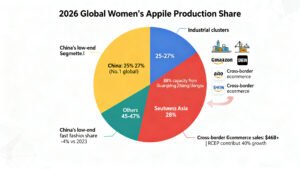
In 2026, China’s women’s clothing manufacturing industry will maintain its core position in the global market, projected to contribute 25%-27% of global women’s clothing production capacity, maintaining its position as the world’s leading manufacturing power. This share is supported by three core advantages:The deep accumulation of industrial clusters forms a fundamental barrier. Guangdong, Zhejiang, and Jiangsu provinces still account for 88% of China’s women’s clothing production capacity, with Guangdong leading the way with a 45% share. This has fostered a comprehensive industrial ecosystem, encompassing fabric R&D, design and sampling, and production and delivery. This clustering effect has resulted in a 12%-18% lower overall manufacturing cost per piece of women’s clothing than in Southeast Asia, and a shortened order response time of 7-15 days, far surpassing the 20-30 days seen in emerging manufacturing hubs like Southwest China.Cross-border e-commerce’s channel empowerment amplifies its market share advantage. China’s cross-border e-commerce sales of women’s clothing are projected to exceed 320 billion yuan in 2026, with the RCEP region contributing over 40% of this growth. The integration of livestreaming and social media commerce has boosted the penetration rate of the “factory-direct-to-overseas consumer” model to 35%. Deep collaborations with platforms like Amazon and SHEIN are driving Chinese women’s clothing factories to expand their overseas market reach from traditional OEM to a direct-to-consumer (DTC) model.
The increasing share of mid- to high-end manufacturing is providing incremental support. With domestic consumption upgrading and international brands shifting their supply chains to lower-tier markets, China’s share of mid- to high-end women’s clothing production capacity will rise to 48% in 2026, a 3 percentage point increase from 2025. Its manufacturing share in affordable luxury women’s wear and functional sportswear will surpass countries like Vietnam and Bangladesh, making it a key global OEM base for mid- to high-end women’s clothing.
It is noteworthy that global market share is experiencing structural divergence: Southeast Asia, leveraging its labor cost advantage, has taken on 28% of global orders for mid- and low-end women’s clothing, causing China’s share of fast fashion basics to decline by 4 percentage points compared to 2023. Furthermore, the implementation of the EU’s carbon tariff policy has imposed an additional 15%-20% cost pressure on Chinese women’s clothing factories that haven’t implemented carbon footprint traceability, leading to signs of a shift in some orders to Europe.
Manufacturing: Technology-Driven Structural Transformation
-
Manufacturing: Technology-Driven Structural Transformation
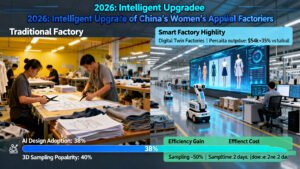
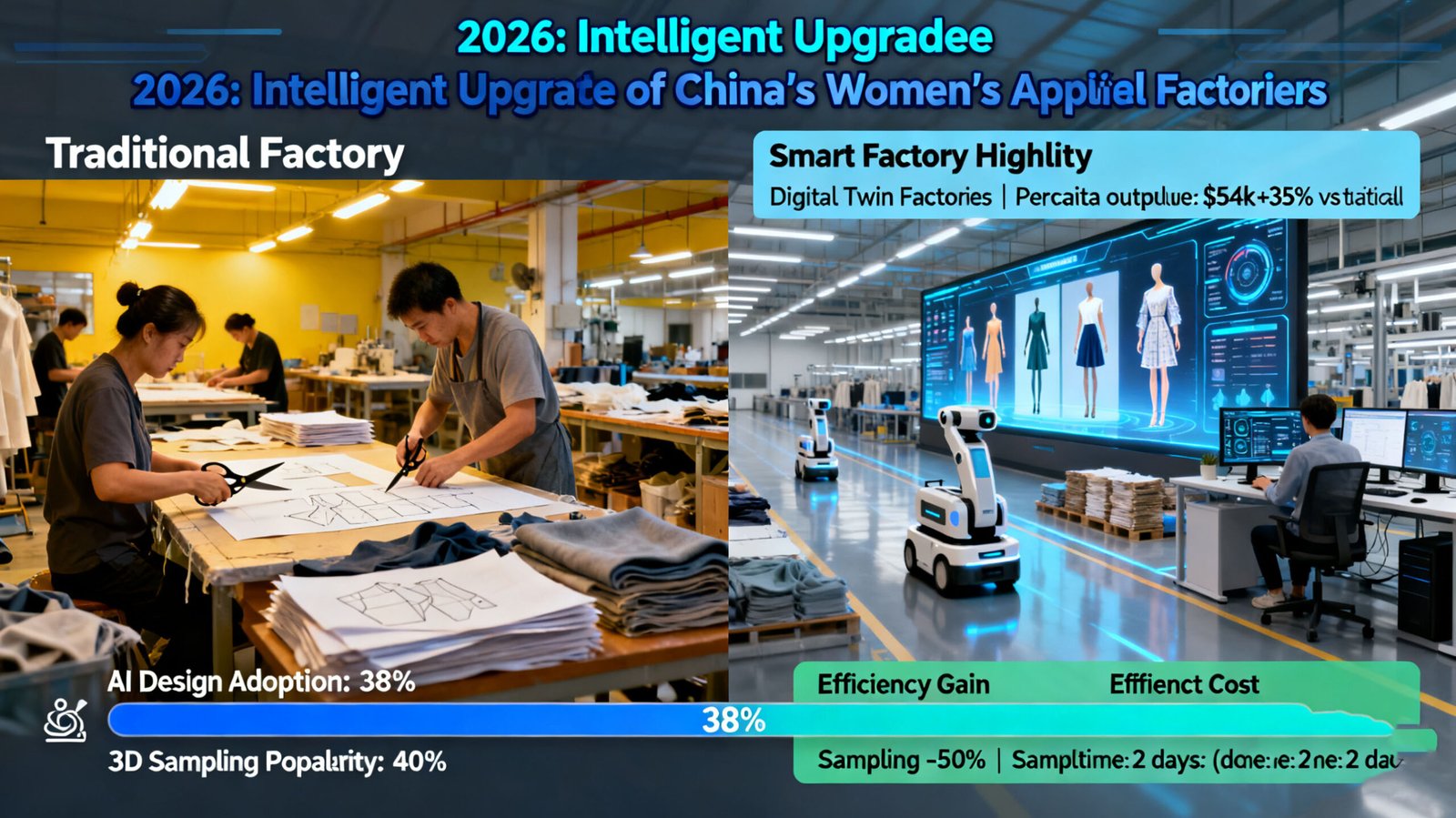
In 2026, the manufacturing sector of Chinese women’s clothing factories will undergo a profound restructuring towards digitalization, flexibility, and greening. Traditional scale-based manufacturing is accelerating its transition to value-based manufacturing, exhibiting three notable characteristics:Intelligent transformation has entered a phase of large-scale implementation. Industry data indicates that by 2026, AI design system penetration in women’s clothing factories will reach 38%, and the penetration rate of 3D virtual sample technology will exceed 40%. This will reduce sample production costs by 50% and shorten sample production cycles from 7 days to 2 days. Leading factories, such as the Peacebird Supply Chain Base, have already transformed into “digital twin factories.” Using equipment like automated guided vehicle (AGV) logistics and adaptive cutting robots, this has increased per capita output value to 380,000 yuan, a 35% increase compared to traditional factories. At the policy level, the Yangtze River Delta region’s 30% subsidy for smart factory transformation projects is further promoting equipment upgrades for small and medium-sized factories.
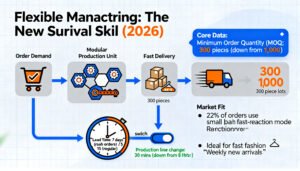
Flexible manufacturing has become a crucial survival capability. Driven by personalized consumer demand, the proportion of women’s clothing factories operating in a small, quick-response model will increase to 22% by 2026, with minimum order quantities dropping from the traditional 1,000 pieces to 300. Some leading factories have even achieved flexible production with a minimum order of 50 pieces. This transformation stems from the technological breakthrough of a “cloud-based MES system + modular production cells,” which reduces production line changeover time from 8 hours to 30 minutes, meeting the demand for “weekly new product releases” by fast fashion brands. Specialized flexible contract manufacturing factories have emerged in women’s clothing industry zones in Dongguan, Hangzhou, and other places, offering a 20%-25% higher price premium than traditional factories.
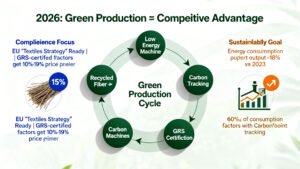
Green production has shifted from a compliance requirement to a competitive advantage. By 2026, the average recycled fiber usage rate in Chinese women’s clothing factories will reach 15%, a 3 percentage point increase from 2025. Some export-oriented factories have already achieved a 30% recycled material utilization rate to meet the environmental protection requirements of the EU’s “Textile Strategy.” The penetration rate of carbon footprint traceability systems among export factories has exceeded 60%, and GRS-certified factories can earn a 10%-15% product premium. Furthermore, the investment in green production equipment has reduced energy consumption per unit of output by 18% compared to 2023, becoming a key cost control measure against a backdrop of 20% fluctuations in chemical fiber prices.
Regional layout exhibits the characteristics of “core concentration + gradient transfer.” The Yangtze River Delta and the Guangdong-Hong Kong-Macao Greater Bay Area still concentrate 60% of women’s clothing factories above designated size. However, central and western provinces like Henan and Sichuan have increased their production capacity to 18% by embracing industrial relocation, creating a landscape characterized by “high-end design on the coast and basic production inland.”
Core Challenges and Solutions: Building New Competitiveness Amid Pressure
-
The challenges facing Chinese women’s clothing factories in 2026 will be characterized by a complex mix of internal and external factors, forcing the industry to accelerate transformation and upgrading. The path to a breakthrough is becoming increasingly clear in practice:
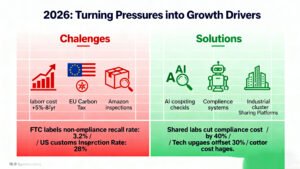
External pressures are concentrated on the dual squeeze of “cost and compliance.” Labor costs are increasing at an average annual rate of 5%-8%, squeezing profit margins for traditional contract manufacturing to 5%-8%. Tightening global regulations are exacerbating the pressure to survive. Amazon’s factory inspection standards now cover 12 areas, including quality management and employee rights. The FTC’s fabric labeling regulations have increased the recall rate of substandard products to 3.2%. US Customs will increase the random inspection rate of women’s clothing from 15% in 2024 to 28% in 2026, with the cost of a single inspection reaching as high as $5,000. Internal bottlenecks manifest themselves in the lagging transformation of small and medium-sized factories. 80% of these factories have yet to complete digital transformation, leaving them significantly behind leading enterprises in their ability to handle small orders.
The path to a breakthrough focuses on three key areas: First, technological cost reduction to achieve efficiency breakthroughs. By introducing AI-powered scheduling systems and 3D knitting technologies, production cycles can be shortened by over 30%, offsetting the pressure of rising labor costs. For example, the Jinjiang women’s sportswear industry belt, through 5G and industrial internet transformation, has reduced energy consumption per unit of product by 22%. Second, compliance capabilities can be transformed into competitive barriers. Leading factories have established a compliance system encompassing “raw material traceability, third-party testing, and full-process document management.” For example, a Zhejiang company, through proactive carbon footprint accounting, successfully entered the EU high-end women’s clothing supply chain, increasing its premium pricing by 25%. Third, industrial clusters collaborate to build ecosystem advantages. The Yangtze River Delta women’s clothing industry belt has established a public service platform combining “shared laboratories, centralized testing, and cross-border logistics,” reducing compliance costs for small and medium-sized factories by 40% and improving order acquisition efficiency by 30%.
•
Uncategorized
Analysis of China’s Women’s Clothing Factory Market in 2026
Cici
10/27/2025
Content
hide
1
Analysis of China’s Women’s Clothing Factory Market in 2026: A Dual Play of Market Share Defence and Manufacturing Innovation
Related Articles
Oct 30, 2025
How to Find the Right Women's Apparel Factory?
How to Find the Right Women's Apparel Factory? For women's apparel entrepreneurs, finding a suitable…
Read More
Nov 6, 2025
Which manufacturer makes the Uniqlo products?
Uniqlo's Behind-the-Scenes Garment Manufacturers: Brand Selection Logic & Small Order Solutions In the global fast…
Read More
Jan 30, 2026
Custom Women Clothing Manufacturer
Custom Women Clothing Manufacturer Custom women clothing manufacturer is the ideal partner for fashion brands…
Read More
Cici
Chenghai Fashion
Since starting my factory business in 2017, I've faced many hardships and challenges. Looking back now, I'm grateful for persevering—believing that hard work eventually pays off.
Comments