
In the women’s clothing industry, factory-based customization addresses individual needs while ensuring production efficiency and consistent quality. The complete women’s clothing factory customization process involves multiple, closely linked steps, each of which directly impacts the final product. The following explains each step:
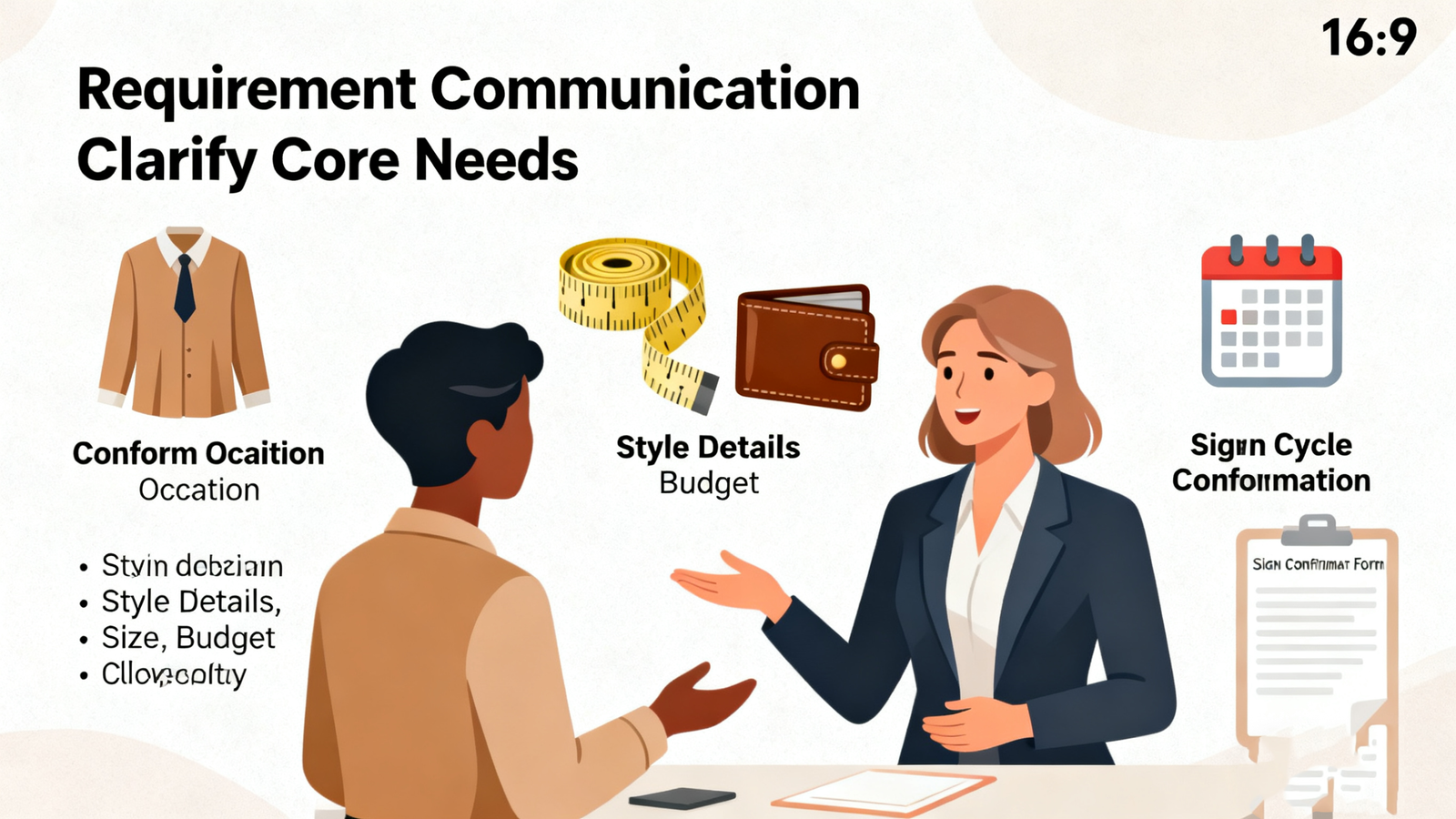
- Demand Communication: The client clearly identifies the core requirements for customization.
This is the starting point of the customization process and crucial for ensuring that subsequent steps remain on track. The factory will arrange for professional liaisons (such as merchandisers or designers) to conduct in-depth discussions with the client, focusing on four key areas:
Customization Scenario and Purpose: Determine whether the garment will be for daily wear, special occasions (such as weddings and banquets), wholesale production for a brand, or e-commerce development. Requirements for style, fabric, and craftsmanship vary significantly across different scenarios (for example, a formal dress requires drape and ornate details, while everyday wear prioritizes comfort and practicality). Style and Detail Preferences: Customers must specify their preferred style (e.g., French retro, minimalist commuter, sweet-cool-hot chic), and provide specific details, including neckline style (round, V-neck, or romper), cuff design (long, short, puff, or flared), skirt shape (A-line, straight, or pleated), and whether they require decorative elements such as pockets, embroidery, or beading.
Size and Fit Requirements: For custom orders, customers must provide their precise body measurements (shoulder width, chest, waist, hips, length, and sleeve length). The factory will adjust the basic fit accordingly. For mass orders, customers must specify the target customer size range (e.g., XS-XL or custom sizes) and fit preferences (e.g., loose, slim, or oversized).
Budget and Delivery Time: Customers must provide their budget, and the factory will recommend appropriate fabrics and craftsmanship based on this information. The factory will also confirm a delivery timeline, and the factory will assess feasibility based on production schedules to avoid compromising quality due to tight deadlines. After the communication is complete, the factory will compile a “Requirements Confirmation Form” for the customer’s signature to avoid subsequent disputes caused by ambiguity.
II. Design Proposal: Transforming Requirements into a Visual Plan
Once the requirements are clarified, the design phase begins. The factory’s designers will translate the customer’s requirements into a specific design plan, which primarily involves two steps:
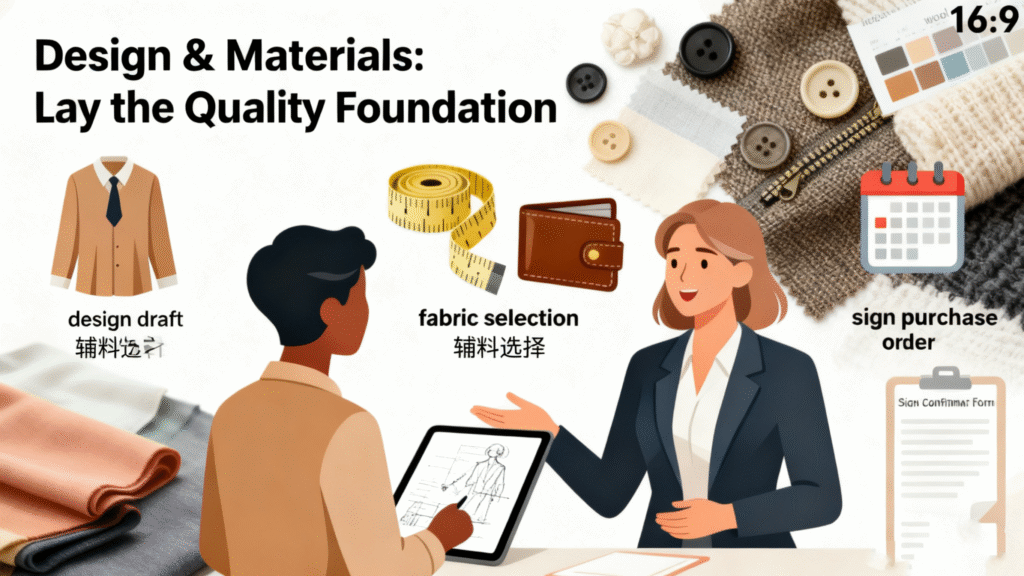
Preliminary Design: The designer will create a design sketch based on the “Requirements Confirmation Form” (including front, side, and back views), annotating key dimensions and details. This sketch will also include recommended fabric samples (such as cotton, silk, linen, wool, and synthetic fibers), explaining the fabric’s characteristics and compatibility. If the customer provides their own design, the factory will conduct a “feasibility review” to determine whether the processes (such as complex cuts and special prints) can be implemented using the factory’s equipment. If any difficulties arise, the factory will work with the customer to optimize them (for example, converting difficult-to-mass-produce hand embroidery to digital printing).
Proposal Confirmation and Revision: The preliminary design and fabric samples will be submitted to the customer for review. The customer may submit revisions (such as adjusting the neckline depth or changing the fabric color). The designer will iterate based on these suggestions until the customer signs the “Design Proposal Confirmation” and the proposal is finalized. 3. Fabric and Trim Selection: Laying the Foundation for Garment Quality
Fabrics and trims directly influence the texture, comfort, and durability of a garment. This phase requires joint decision-making between the client and the factory:
Fabric Screening and Confirmation: The factory will provide fabric samples that meet the client’s budget and design style. Clients can touch the fabric to feel its softness and smoothness, observe its texture and color (to ensure consistency with the design and avoid color discrepancies). The factory will also provide detailed fabric specifications (such as weight, yarn count, shrinkage, and washability). For example, for summer custom dresses, breathable cotton, linen, and Tencel fabrics are recommended; for winter coats, warm wool and cashmere fabrics are recommended. After selecting the fabric, the client must confirm the quantity (for bulk orders, the per-piece usage and loss must be calculated, and a 10%-15% reserve must be reserved) and sign a “Fabric Purchase Confirmation.” Trim Material Matching and Selection: Trim materials, while inconspicuous, are crucial to the integrity and aesthetics of a garment. These include:
Fasteners: Buttons (metal, resin, pearl, etc., must match the fabric style, e.g., metal buttons on a wool coat, pearl buttons on a dress); Zippers (invisible, metal, or nylon, selected based on placement, e.g., invisible zippers on the side seams of a skirt, metal zippers on the placket of a jacket);
Embroidery: Lace, trims, embroidery thread, beading, sequins, etc., must match the decorative requirements of the design;
Support: Lining (such as silk or synthetic interlining, to enhance the garment’s texture and comfort); Shoulder pads (used on suits and jackets to create shoulder shape).
After selecting trim materials, the factory will provide samples for customer review to ensure consistency with the fabric and design. IV. Sample Confirmation: Verifying the Feasibility and Suitability of the Plan
Sample production is a trial-and-error process in the customization process. By producing samples, problems in design, size, and workmanship can be identified in advance, preventing losses after mass production. The specific process is as follows:
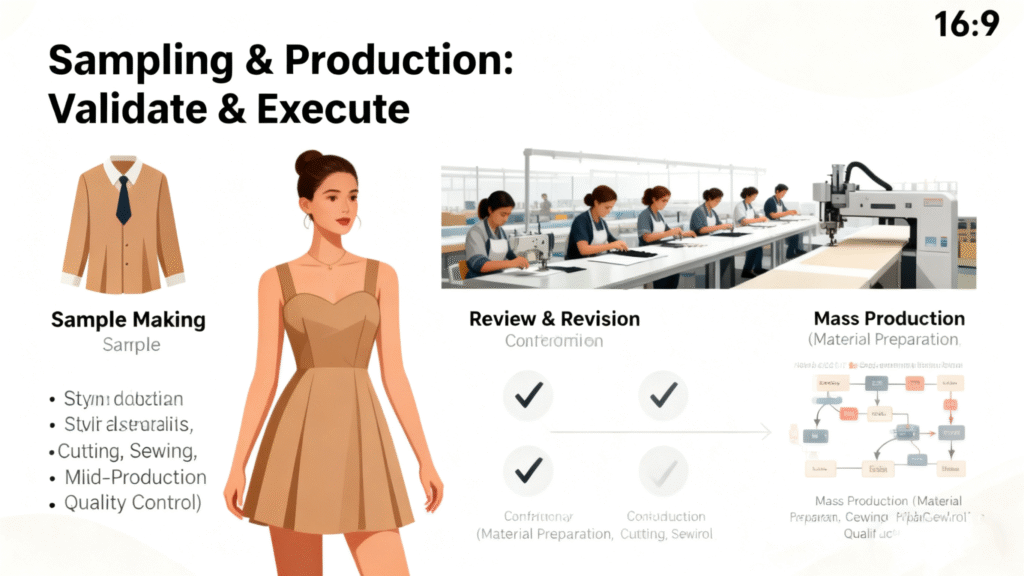
Sample Production: The factory arranges for the sample workshop to produce one or two samples based on the confirmed design, fabric, and accessories. The sample production process strictly adheres to the production process for the bulk product, including cutting (precisely cutting the fabric to the size and pattern, paying attention to the direction of the fabric grain. For example, stripes and plaids must align the grain to avoid misalignment), sewing (using the same stitching as the bulk product to ensure smooth and secure seams), embellishment (such as embroidery and beading to reproduce design details), and ironing (adjusting the temperature according to the fabric characteristics to shape the garment and remove wrinkles). Sample Review and Fitting: After sample production is complete, the factory will send the sample to the customer for review in three areas:
Appearance: Check that the style, color, and decorative details are consistent with the design, and check for issues such as loose threads and uneven stitching.
Sizing and Fit: For individual customizations, a fitting is required to confirm the fit (e.g., alignment of the shoulder line, proper waistline, and length). For mass customizations, the sample size must be compared against the size chart to verify that the dimensions meet the standards.
Comfort: Check the fabric’s wearing experience (e.g., breathability, skin-tightness), and the comfort of the accessories (e.g., smooth zipper operation, buttons).
Revisions and Finalization: If the customer requests revisions (e.g., if the size is too large or decorative details require adjustment), the factory will modify the sample accordingly until the customer is fully satisfied with the sample’s appearance, size, and fit. The customer then signs the “Sample Confirmation Form,” at which point the customization plan is officially finalized and can proceed to mass production. V. Production: Implementation of Customized Mass Production
After sample confirmation, the factory begins mass production. This phase requires strict control over production progress and quality, and is divided into three main steps:
Production Preparation:
Material Preparation: Procures sufficient fabric and accessories based on the batch size and pre-treats the fabric (e.g., washing to reduce shrinkage and prevent wear after the finished product); fabric inspection after pre-shrinkage to eliminate defects and color differences).
Production Scheduling: The factory develops a detailed production plan based on order volume, production equipment, and workforce, specifying timelines for cutting, sewing, ironing, and quality inspection.
Technical Briefing: The production manager explains the design plan, process requirements, and dimensional standards to the workers, ensuring that every worker understands key production points (e.g., stitching techniques for specific sewing areas and how to secure decorative elements).
Core Mass Production Steps:
Cutting: Using professional cutting equipment (e.g., automatic cutting machines), batches of fabric are cut according to the pattern drawing and required sizes. When cutting, pay attention to the thickness of the fabric layers (to avoid inaccurate cutting due to excessive thickness) and ensure proper marking (e.g., marking the size and location of the pieces to prevent confusion).
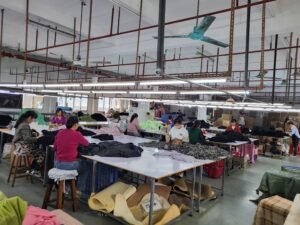
Sewing: Workers are divided into groups according to the production process (e.g., on the assembly line, one group sews the front and back of a jacket, another sews the sleeves, and another assembles the pieces). Quality inspectors conduct spot checks at each stage to ensure that the stitch density and sewing accuracy meet standards (e.g., stitch density of 8-10 cm is required). Needles are used to prevent thread unraveling.
Special Processing: Garments with special techniques such as embroidery, printing, or beading will be handled by specialized workshops (e.g., digital printing workshops use the designed pattern for printing, while embroidery workshops use computerized embroidery machines for embroidery). After processing, the results are inspected (e.g., whether the print is clear and the embroidery is secure).
Pressing and Finishing: After all garments are sewn, they enter the ironing process. Workers use specialized ironing equipment (e.g., steam irons, ironing tables), adjusting the temperature and pressure according to the fabric’s characteristics, to iron the garment throughout the entire garment (e.g., smoothing the body, shaping the neckline and cuffs), ensuring a smooth and crisp appearance.
Mid-Production Quality Control: During the production process, the factory’s quality control team conducts “patrol inspections,” randomly sampling semi-finished products for inspection. If any issues such as dimensional deviations or sewing defects are discovered, production is immediately halted to investigate the cause and rectify the problem to prevent a recurrence of these issues. VI. Quality Inspection and Packaging: Ensure Finished Product Quality Meets Standards
After production is complete, garments undergo rigorous quality inspection and standardized packaging before delivery to customers:
Full Finished Product Inspection: Quality inspectors individually check each garment according to the Sample Confirmation and quality standards:
Size Check: Measure key dimensions such as shoulder width, chest circumference, and length against the size chart. The tolerance must be within ±1cm (this tolerance may be relaxed for special styles).
Appearance Inspection: Check the fabric for color variations, stains, or holes; ensure the seams are smooth and free of loose threads; ensure the trimmings are secure (e.g., loose buttons, smooth zippers); and ensure the decorative details are complete (e.g., embroidery thread breakage, beading detachment).
Functional Inspection: Garments with special features (e.g., waterproof or sun-resistant) will undergo specialized testing (e.g., water-jet testing for waterproof fabrics).
Defective products will be marked with the defect type and sent to the repair workshop for correction. After correction, they will be re-inspected until they meet the quality standards. Products that cannot be corrected will be handled according to the contract (e.g., re-made or returned). Packaging: Qualified products enter the packaging stage, with packaging options tailored to customer needs.
Personalized customization: Typically packaged in individual gift boxes, complete with a dust bag (to protect the garment from dust) and a washing instruction sheet (indicating fabric washing instructions and contraindications, such as not machine washable or bleachable).
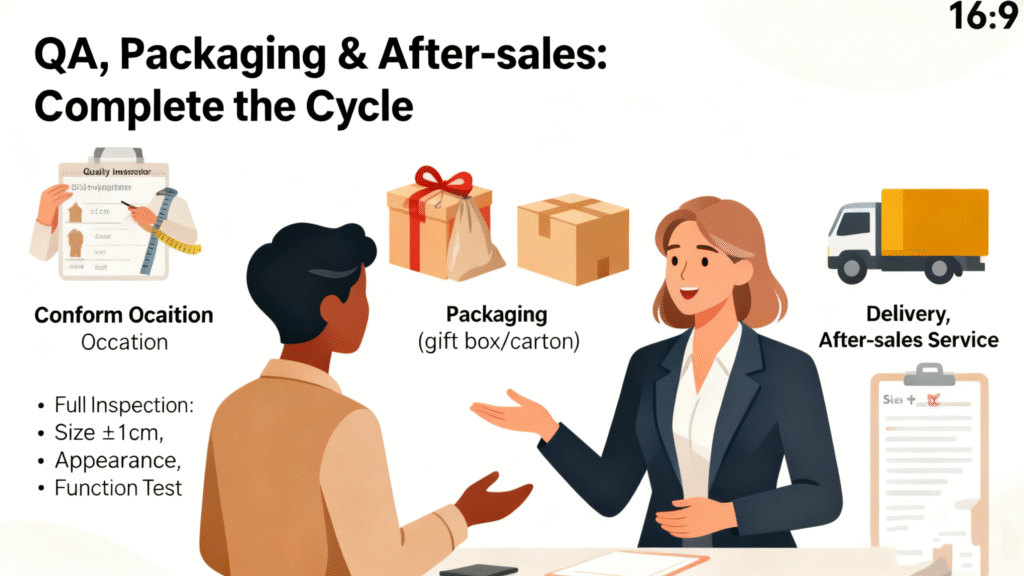
Bulk customization (e.g., OEM or e-commerce): Standard packaging is used. The outer box is labeled with the product name, style, size, and quantity, and the inner layers are separated by wrapping paper or bubble wrap to prevent wear and tear during transportation.
VII. Delivery and After-Sales Service: Completing the Customization Closed Loop
Delivery: The factory ships the product to the customer according to the agreed-upon delivery method (e.g., express delivery, logistics), and provides a logistics tracking number for easy tracking of the delivery progress. A “Finished Product Acceptance Certificate” is included upon delivery. After signing for the product, the customer must inspect the product within the specified timeframe (usually 7-15 days). Any issues must be promptly communicated to the factory. After-Sales Support: The factory will maintain after-sales records and provide after-sales support to customers.
Quality Issues: If a customer discovers a product with a quality issue (not caused by human error) during product acceptance, the factory will provide a free return, exchange, or repair.
User Consultation: If customers encounter any issues during wear or washing (such as how to address pilling or wrinkles), they can contact the factory at any time and we will provide professional solutions.
Subsequent Customization: If customers require subsequent customization, the factory can quickly connect with them based on historical customization data, improving customization efficiency.



Comments